


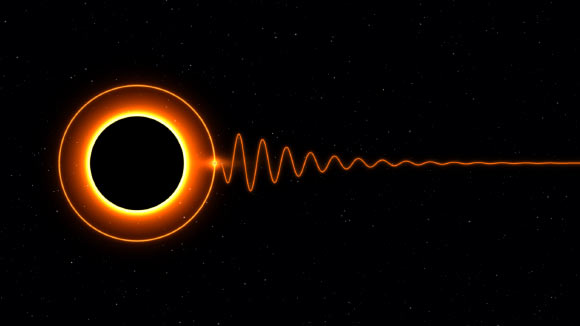
Black hole mergers produce gravitational waves that ring like a bell before fading in a distinctive pattern known as a ringdown. In general relativity, this signal should be determined only by the black hole’s mass and spin. However, additional structure—often called “black hole hair”—could leave detectable changes in the gravitational-wave signal. Researchers at Nagoya University and Kindai University have developed a general method for predicting how dark matter, exotic fields, or modified gravity could alter a black hole’s ringdown.
Researchers developed a method to search for black hole hair by analyzing changes in gravitational-wave ringdown signals. Image credit: Nagoya University
“Black hole hair may represent a deviation from the matter surrounding a black hole or from the simplest black hole solutions predicted by general relativity,” said Nagoya University researcher Ariadna Uxue Palomino Ira, lead author of the study.
“These features can slightly modify the ringdown signal. Detecting or filtering out those changes could provide new ways to test gravity under some of the Universe’s most extreme conditions.”
For their study, the researchers modeled black hole hair as a thin, anisotropic fluid surrounding both a non-rotating Schwarzschild black hole and a rotating Kerr black hole.
They then used the established connection between a black hole’s ringdown and the paths followed by light as it bends and orbits near the black hole. This allowed them to calculate how the additional matter changes the gravitational wave’s oscillation frequency and damping rate—the speed at which the signal fades.
The researchers found that the frequency and damping rate do not change by the same amount. The difference between these changes is determined by the local pressure of the hidden matter along the path of the orbiting photons.
This result suggests that black hole ringdown signals could reveal more than the presence of black hole hair. They may also provide clues about the physical properties and composition of the matter or field responsible for it.
“Ringdown waves may indicate that something unusual is influencing a black hole,” Palomino Ira said. “The way the signal changes could also offer insight into the nature of the hidden material surrounding it.”
The method was tested using three theoretically known black hole configurations and was later extended to rotating black holes. In the rotating case, light traveling in the same direction as the black hole’s spin behaves differently from light orbiting in the opposite direction.
“Rotation makes the calculations more complicated because light moving with the black hole behaves differently from light moving against it,” the researchers explained.
Depending on the direction of the black hole’s spin, hidden matter can alter the ringdown frequency and damping rate in different ways. The precise pattern depends on the type of matter or new physics involved.
Rather than analyzing every possible model of black hole hair separately, the new framework offers a common method for predicting how additional matter and alternative theories of gravity could affect black hole ringdown signals.
Although the results are still theoretical, the approach could help researchers identify what to look for in future gravitational-wave observations. Unexpected changes in the frequency or decay of a ringdown signal could provide evidence of surrounding dark matter, exotic fields, or deviations from general relativity.
In the future, this technique could help scientists estimate not only a black hole’s mass and spin but also the properties of any “hair” or hidden material surrounding it.
The team’s work appears in Journal of Cosmology and Astroparticle Physics.
_____
Ariadna Uxue Palomino Ira et al. 2026. Ring-down waves from a hairy black hole. JCAP 09:046; doi: 10.1088/1475-7516/2026/09/046
Source: www.sci.news