


Hello nature readers. Would you like to receive this science briefing free in your inbox every day? Sign up here.
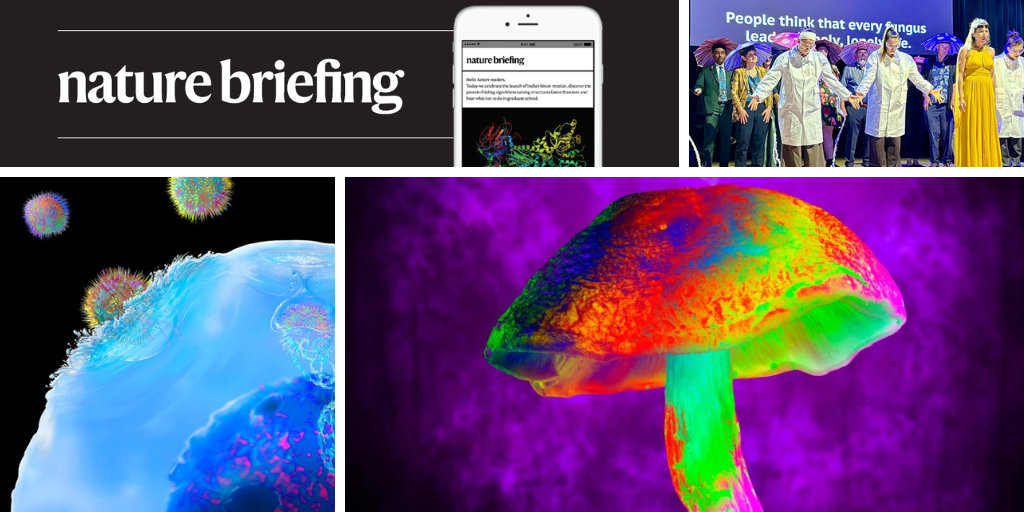
Studies in mice suggest that psilocybin, a psychoactive compound in magic mushrooms, could help prevent chemotherapy-induced neuropathy.
Credit: Victor de Schwanberg/SPL
Psilocybin may protect against chemotherapy-related nerve damage, according to a study in mice. The psychoactive compound appeared to prevent neuropathy, a debilitating side effect associated with some platinum-based chemotherapy drugs. Up to 60% of people receiving these treatments may develop neuropathy, which can cause persistent burning, pain or tingling in the hands and feet.
Moran Amit, an oncologist and study co-author, said that two doses of psilocybin given before chemotherapy completely prevented the adverse effects in mice. The findings could encourage further research into the use of psychedelic compounds beyond mental-health conditions such as depression. However, clinical studies in humans are needed to determine whether the treatment is safe and effective.
Nature | 5 minute read
Reference: Science paper
In vivo CAR-T cell therapy has eased autoimmune disease symptoms in 16 people, researchers report. The experimental treatment uses a modified virus to deliver genetic instructions directly to participants’ T cells. The engineered cells then produce chimeric antigen receptors, or CARs, that target antibodies made by immune cells attacking healthy tissues.
The results provide an early proof of concept for in vivo CAR-T therapy. Unlike conventional CAR-T treatments, which require cells to be removed from the body and modified in a laboratory, the new approach could be faster and less expensive to manufacture, said David Simon, a clinician and researcher. Larger studies will be needed to assess its long-term safety and effectiveness.
Nature | 5 minute read
Reference: New England Journal of Medicine paper
An experimental drug called daraxone lasib (Lasonc) could offer a new treatment option for lung cancer, according to results from a small clinical trial. The findings were announced one week after the U.S. Food and Drug Administration approved a drug for advanced pancreatic cancer.
A larger randomized study is now underway. It will compare daraxone lasib with standard chemotherapy in people with lung cancer. The results could help determine whether the FDA approves the drug for lung-cancer treatment.
Nature | 5 minute read
Reference: New England Journal of Medicine paper
Ig Nobel Prize

Nobel laureates in economics, physics and medicine dressed as mushrooms performed a fungi-themed opera with soprano Seraphina Giannoni at the satirical Ig Nobel Prize ceremony in Zurich. (Flora Graham/nature)
The Ig Nobel Prize ceremony celebrated unusual scientific research with humor, creativity and a message about the value of discovery. The annual event was held in Switzerland last night, marking the first time in its 36-year history that the ceremony took place outside the United States. Organizers said it was no longer safe for guests to visit the US.
This year’s awards included an economics prize for research suggesting that wealthy people eat more children’s snacks than people with lower incomes. Other honors recognized splash-proof urinal design and physics research. The Peace Prize went to a study suggesting that people value friends who are unkind to those they dislike.
Nature | 9 minute read
A breath of fresh air — and a flood of planes
This year’s Ig Nobel Prize ceremony delivered on its promise to “first make people laugh, then make them think.” Although previous events had been watched online, attending in person offered a closer look at the ceremony’s distinctive traditions, including the famous paper-airplane deluge.
Front-row seats came with the risk of planes flying overhead, but the spectacle was worth it. The winner of this year’s soil-science prize even collected one of the signed cotton pants thrown into the audience. The pants referenced research in which hundreds of similar garments were buried to study soil health.
Ig Nobel awards are presented by previous Nobel Prize winners, who also take part in the ceremony’s playful traditions. This year’s participants included Swiss astrophysicist Michel Mayor, who humorously wore the cotton pants on his head.
Playfulness can create space for unexpected scientific insights. More importantly, the ceremony celebrates curiosity and the joy of discovery. The energy of this unconventional celebration of science is likely to last until next year’s event in Antwerp.
Features and impressions
In the latest short story from the nature Futures series, two rebels become lost in a metropolis generated by artificial intelligence.
Nature | 6 minute read
In The Second Arrow of Time, mineralogist Robert Hazen and planetary scientist Michael Wong argue that the natural world’s transition from chaos to complex order may have been inevitable. The authors propose a new physical law that challenges the traditional interpretation of the second law of thermodynamics, which states that disorder generally increases.
“This book is fascinatingly written and very thought-provoking,” geologist Graham Shields wrote in a review. Although Shields argues that the authors’ case is “not solid,” he says the proposal is likely to generate debate among scientists and philosophers.
Nature | 6 minute read
DNA damage may contribute to several hallmarks of aging, including chronic inflammation, metabolic changes and problems with protein folding. At the same time, the human body has highly efficient DNA-repair systems that correct countless forms of damage every day, including damage caused by ultraviolet light.
Scientists are investigating whether improving DNA repair could slow biological aging and help people remain healthy for longer. Research into long-lived species such as bowhead whales (Balaena mysticetus) and naked mole-rats (Heterocephalus glaber), along with genetic studies of centenarians, is providing new insights into this potential approach.
Nature Podcast | Listen for 18 minutes
Subscribe to the Nature Podcast on Apple Podcasts, Spotify, YouTube Music or the RSS feed.
Source: www.nature.com