


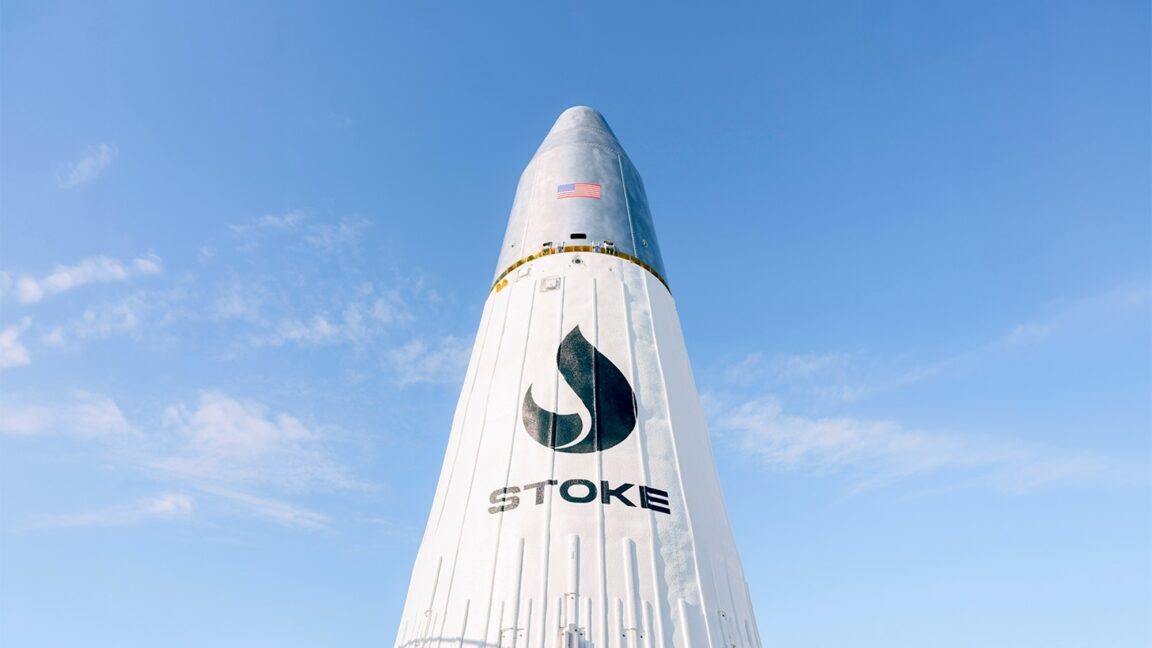
Stoke Space Targets Early 2027 Launch for Its Fully Reusable Nova Rocket
Stoke Space has announced its first target launch date for Nova, the company’s fully reusable rocket. Since its founding in 2020, Stoke has worked toward developing a vehicle capable of launching payloads to orbit and returning both stages for reuse. The company is now targeting an early 2027 launch for the Nova rocket.
Stoke CEO Andy Lapsa acknowledged that the schedule could change as the company completes stage testing, vehicle integration, and other final preparations. However, he said the current timeline is both realistic and achievable.
“I feel good about that launch date,” Lapsa said. “I think it is realistic. But, as you know, in our industry, things go wrong when it is ready.”
When Ars visited Stoke Space’s factory in Kent, Washington, last fall, the company appeared to be well advanced in assembling its flight hardware. Multiple vehicles were also moving through the company’s production and testing facilities.
Nova represents Stoke Space’s ambitious effort to develop a small, fully reusable orbital rocket. The vehicle’s progress will be closely watched by the launch industry, particularly after Stoke secured significant new funding to continue development and prepare for flight testing.
Stoke Space Develops a Larger Nova Block 2 Rocket
Stoke’s initial Nova Pathfinder vehicle is approximately 12.5 feet in diameter. That makes it slightly wider than SpaceX’s Falcon 9, although Nova is considerably shorter. The company’s planned Nova Block 2 rocket will be larger, measuring approximately 15 feet in diameter.
Like the Pathfinder, Nova Block 2 will use methane and liquid oxygen to power its Zenith engines. The upgraded rocket will feature a greater number of engines, increasing its performance and potential payload capacity. Its upper stage will continue to use liquid hydrogen and liquid oxygen as propellants.
“Probably the biggest change to the overall vehicle is the inclusion of a cylindrical second stage,” Lapsa said. “This is an area where we’ve been wrestling for years with how to remove the upper taper of the Pathfinder, and I think we have a pretty clever approach to doing it.”
The Pathfinder’s conical upper stage limits the amount of usable space inside its payload fairing. By adopting a cylindrical second stage, Stoke expects Block 2 to offer more internal volume for satellites and other payloads.
Stoke is targeting 2029 for the first launch of Nova Block 2. The larger vehicle is expected to play a key role in the company’s plans to compete for commercial, government, and satellite constellation launch contracts.
Growing Demand for Reusable Launch Vehicles
Satellite operators are facing increasing pressure to secure launch capacity as the space industry expands. Stoke’s Nova Pathfinder could address some of that demand, but the company will likely need the larger Block 2 rocket to compete at scale with reusable and partially reusable vehicles from SpaceX, Blue Origin, Relativity Space, and Rocket Lab.
Those competitors include SpaceX’s reusable Falcon 9, Blue Origin’s New Glenn, Relativity Space’s Terran R, and Rocket Lab’s Neutron. Lapsa said he believes the market can support multiple launch providers as satellite deployments continue to grow.
“The space economy will grow as fast as rockets can be launched,” he said. “There’s a lot of pent-up demand for rocket flights. The mismatch between launch supply and demand is huge.”
If Stoke Space can maintain its development schedule, the Nova rocket’s planned 2027 debut could mark an important milestone for the company and the broader push toward fully reusable orbital launch systems.
Source: arstechnica.com