


Hello Nature readers. Would you like to receive this daily science briefing in your inbox? Sign up here.
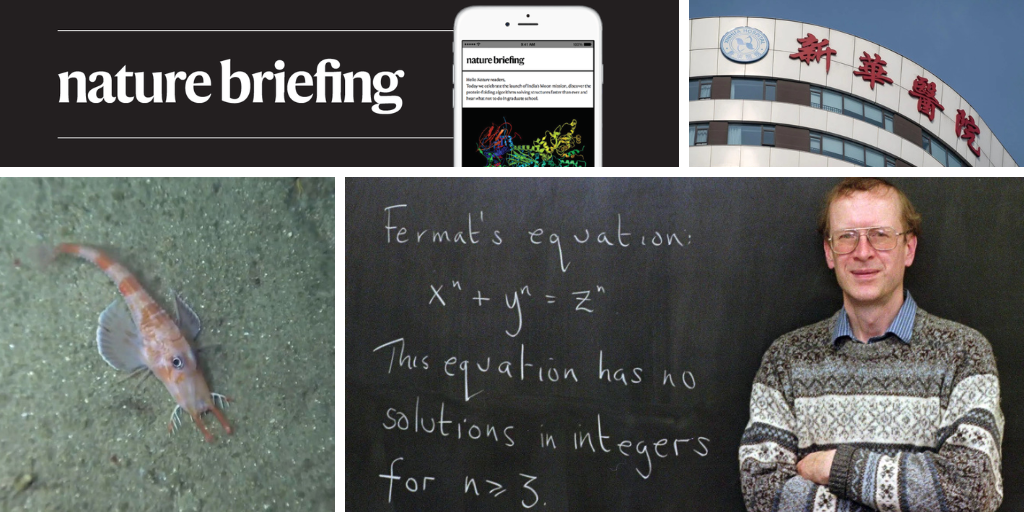
Mathematician Andrew Wiles completed the proof of Fermat’s Last Theorem in 1994, more than 350 years after Pierre Fermat first proposed it.
Credit: AP Photo/Charles Rex Arbogast/Alamy
AI chatbot creates computer-checked proof of Fermat’s Last Theorem
An advanced artificial intelligence chatbot prototype developed by Anthropic created a 13-million-line, computer-checked proof of Fermat’s Last Theorem in just 11 days. The achievement surprised number theorist Alex Kontorovich, who said he was “completely amazed” that an AI system could formalize such a landmark mathematical proof.
The project demonstrates how artificial intelligence could help mathematicians produce algorithmically verifiable versions of complex research. It also suggests that AI tools may soon be capable of analyzing and organizing large libraries of mathematical knowledge.
Nature | 5-minute read
Reference: Anthropic’s announcement on formalizing Fermat’s Last Theorem
More than 400 million pesticide poisonings reported each year
New estimates suggest that more than 400 million cases of acute, unintentional pesticide poisoning occur worldwide every year. Approximately 46% of farmers globally are estimated to experience pesticide poisoning.
The analysis attributes around 11,000 deaths each year to pesticide exposure, with nearly 60% occurring in India. The figures do not include longer-term health consequences that may develop gradually, including a possible association between pesticide exposure and Parkinson’s disease.
The Guardian | 6-minute read
Reference: Frontiers in Public Health research paper
This week’s image: a deep-sea fish that appears to walk backwards

Researchers have discovered a deep-sea fish in the northern South China Sea that can move sideways and even appear to walk backwards across the seafloor. The armored Serobin, Scaricus engiceros, has a distinctive body shape that marine researcher and study co-author Han Tian describes as resembling a shrimp-fish hybrid.
The unusual movement has not previously been observed in other fish species, making the discovery significant for scientists studying deep-sea animal behavior and evolution. (The Independent | 5-minute read)
Reference: Ocean, Land, and Atmosphere Research paper by Kedong Inn
Science features and insights
UK Biobank data breach raises questions about health-data security
In April, the UK Biobank—one of the world’s largest and most comprehensive health research databases—was affected by a major data breach. Information from hundreds of thousands of participants was reportedly sold online.
The open-access nature of the dataset has made it an important resource for medical researchers, but it has also created security challenges. As plans develop to reopen the resource, scientists are examining how stronger safeguards could protect participants while preserving the database’s value for research.
Nature | 10-minute read
How the Nancy Grace Roman Space Telescope could transform astronomy
The Nancy Grace Roman Space Telescope, launched on August 30, is named after NASA’s first chief astronomer. Its namesake helped establish space-based astronomy during the 1950s and 1960s, a period that historian Robert Smith describes as one of the most transformative eras in the history of astronomy.
Roman’s work helped pave the way for the Hubble Space Telescope, despite skepticism from some ground-based astronomers and NASA scientists who questioned the scientific value of the Apollo Moon missions.
Nature | 7-minute read
Why GDP may not be the best measure of prosperity
“Truly thriving societies are those that not only lift people out of poverty today, but also inherit the productive, human and natural capital that enables future generations to thrive,” writes economist Eoin McLaughlin.
He argues that debates about replacing or improving measures such as gross domestic product should focus on whether governments are leaving future generations with more or less wealth, environmental resources and human capital.
Nature | 14-minute read
Source: www.nature.com