



Fluid motion is described by the Navier–Stokes equations, one of mathematics’ most challenging unsolved problems.Credit: Kertlis/Getty
OpenAI says its artificial intelligence systems have produced a potential solution to one of the most important unsolved problems in mathematics: the Navier–Stokes equations. The company says the work may reveal a breakdown in fluid dynamics, addressing a problem that has challenged mathematicians for more than a century.
On September 8, the San Francisco-based AI company announced that it had generated a solution to the Navier–Stokes equations, the primary mathematical model used to describe the motion of fluids. The work focuses on whether fluid flows can develop singularities, such as infinite velocity, in a finite period of time. This question is one of the seven Millennium Prize Problems selected by the Clay Mathematics Institute as among the most difficult problems in mathematics. A complete, independently verified solution would qualify for a prize of US$1 million. OpenAI published a preprint outlining its findings.
“This is certainly an exciting day as we reflect on the announcement of major advances in human understanding of mathematics,” said mathematician Martin Bridson, director of the Clay Mathematics Institute.
“Our proof shows that there are fluids that are initially perfectly normal and, according to the Navier–Stokes equations, can reach infinite velocities in a finite amount of time,” OpenAI computer scientist Ven Chandrasekaran said at a press conference. Because such behavior is not observed in real fluids, including liquids and gases, Chandrasekaran said the result could indicate limits in how the equations represent physical reality under certain conditions.
“To me, this is a beautiful culmination of the arc we’ve seen over the past 12 months,” OpenAI mathematician Sebastian Bubeck told reporters, referring to the growing use of AI to tackle increasingly complex mathematical problems.
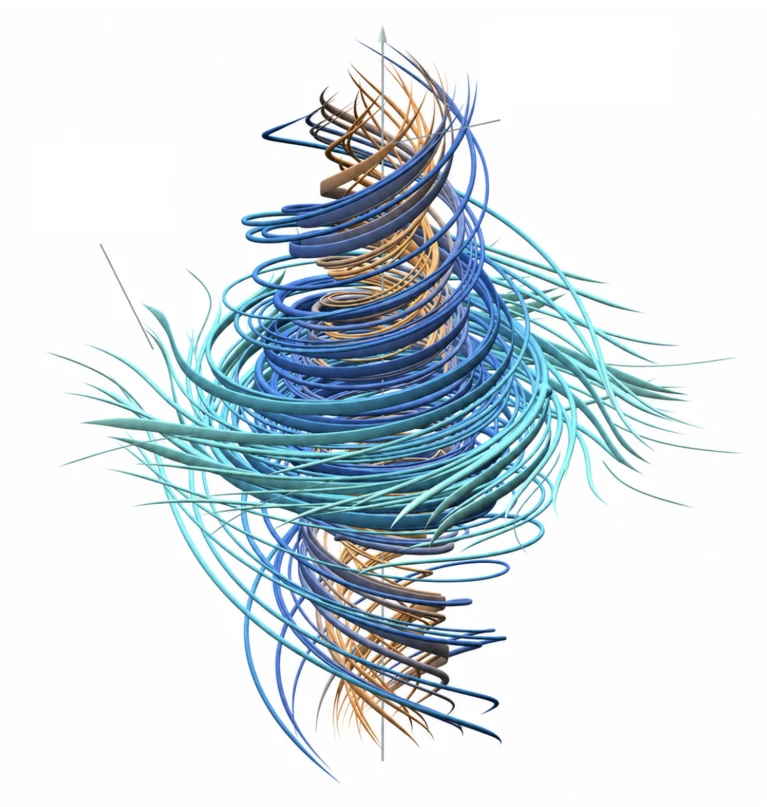
Swirling vortices are central to the Navier–Stokes existence and smoothness problem.Credit: OpenAI
“I think this is a really remarkable result,” says Luis Martínez Zoroa, a mathematician at CUNEF University in Madrid, Spain, who has conducted influential research on the Navier–Stokes problem.
AI-driven progress on the Navier–Stokes problem
OpenAI researchers said they are evaluating the capabilities of their latest AI systems on all six remaining Millennium Prize Problems. On September 1, mathematicians Levent Arposis of Harvard University in Cambridge, Massachusetts, and Tristan Buckmaster of New York University reportedly shifted their attention to the Navier–Stokes problem after hearing that a version of the fluid-dynamics puzzle had been solved with Anthropic’s AI models.
On September 7, Alpöge and Buckmaster published a paper describing a solution to the fluid equation that produces infinite velocity in the simplified case of a fluid with no viscosity. They used Anthropic’s Claude alongside OpenAI’s Codex and Astra models. The researchers said they also had results for more general cases and planned to publish them later.
On the same day, computer scientist Anima Anandkumar of the California Institute of Technology in Pasadena and her colleagues announced a solution to the zero-viscosity problem using a “physically informed neural network” rather than a general-purpose large language model. Bubeck told reporters that OpenAI devoted an unprecedented amount of computing power to the challenge. Its system first used 1,000 AI agents to solve a simplified version of the problem in less than 50 hours. “Then we decided to go full Navier–Stokes and increased the amount of compute,” Bubeck said, describing an experiment involving 10,000 agents.
Mathematicians debate the announcement
Terrence Tao, a mathematician at the University of California, Los Angeles, described Alpöge and Buckmaster’s work as a “remarkable achievement” on the social media platform Mastodon.
Source: www.nature.com