


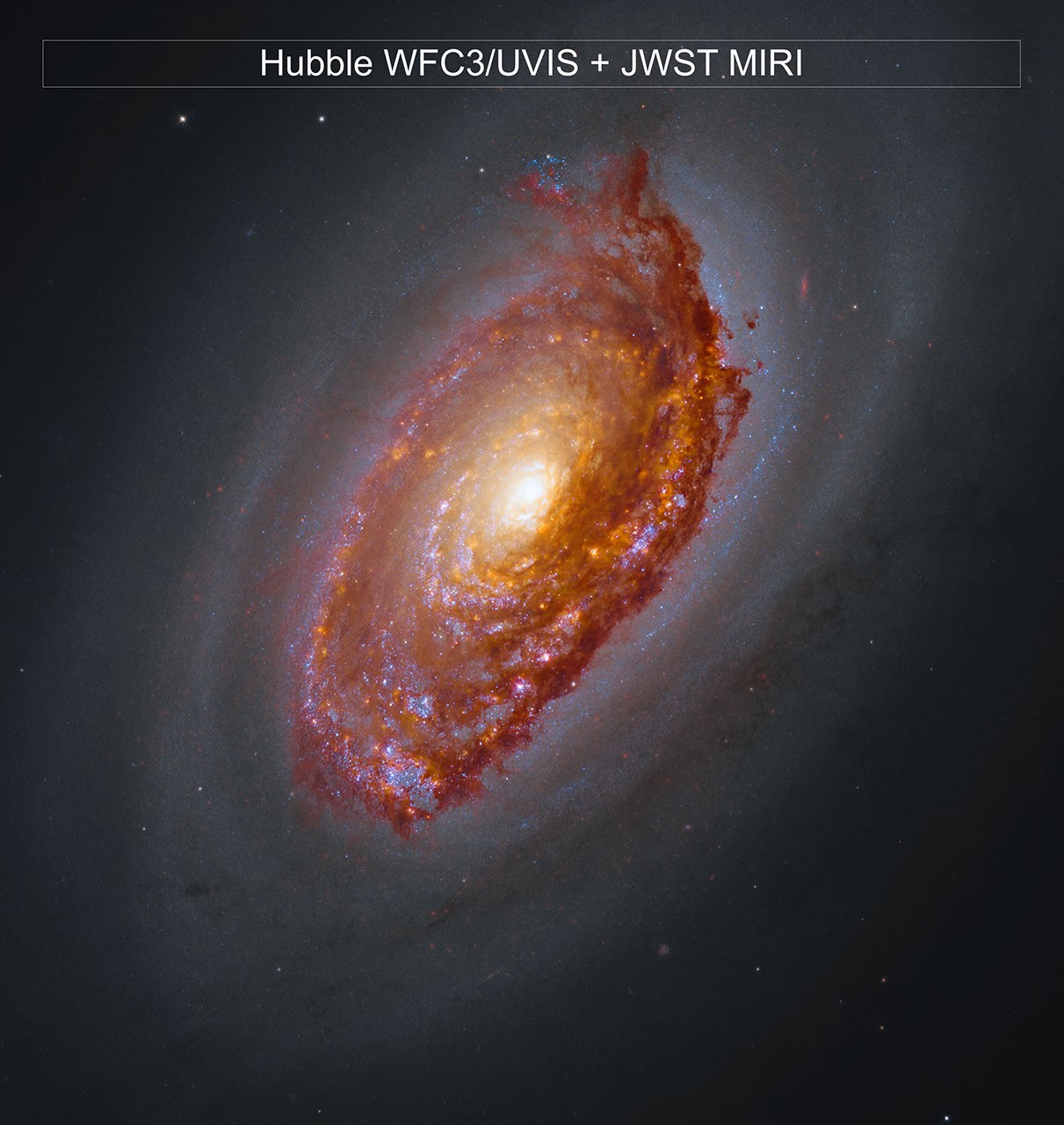
James Webb and Hubble Reveal the Dusty “Black Eye” of Galaxy M64
Explanation: If Hubble reveals the darkness in a galaxy, the James Webb Space Telescope may reveal the light hidden within it. Today’s composite image features Messier 64 (M64), a nearby spiral galaxy also known as the Black Eye Galaxy.
M64 earned its nickname because a dark band of dust partially blocks its bright central region. Webb’s Mid-Infrared Instrument (MIRI) will observe how this dust, shown in red, absorbs and re-emits light from surrounding newborn stars.
Why M64’s Dust and Gas Matter
In the Hubble image, young stars appear embedded in pink star-forming regions. The inner and outer gas regions of M64 rotate in opposite directions. Where these two gas streams meet, they become compressed and create a region of increased star formation.
The opposing motion of the outer gas may have resulted from a merger between M64 and a smaller galaxy. Spiral galaxies were once thought to have peaceful histories, but M64 provided important evidence that their evolution can be more complex. Similar mergers may also have shaped the Milky Way.
Webb’s view of M64 will help astronomers study the structure, motion, and composition of the galaxy’s dust while providing additional context about the history and evolution of galaxy mergers.
NASA’s main site for APOD is: apod.nasa.gov. Go to science.nasa.gov/apod.
Tomorrow’s photos: treasure
Source: science.nasa.gov