


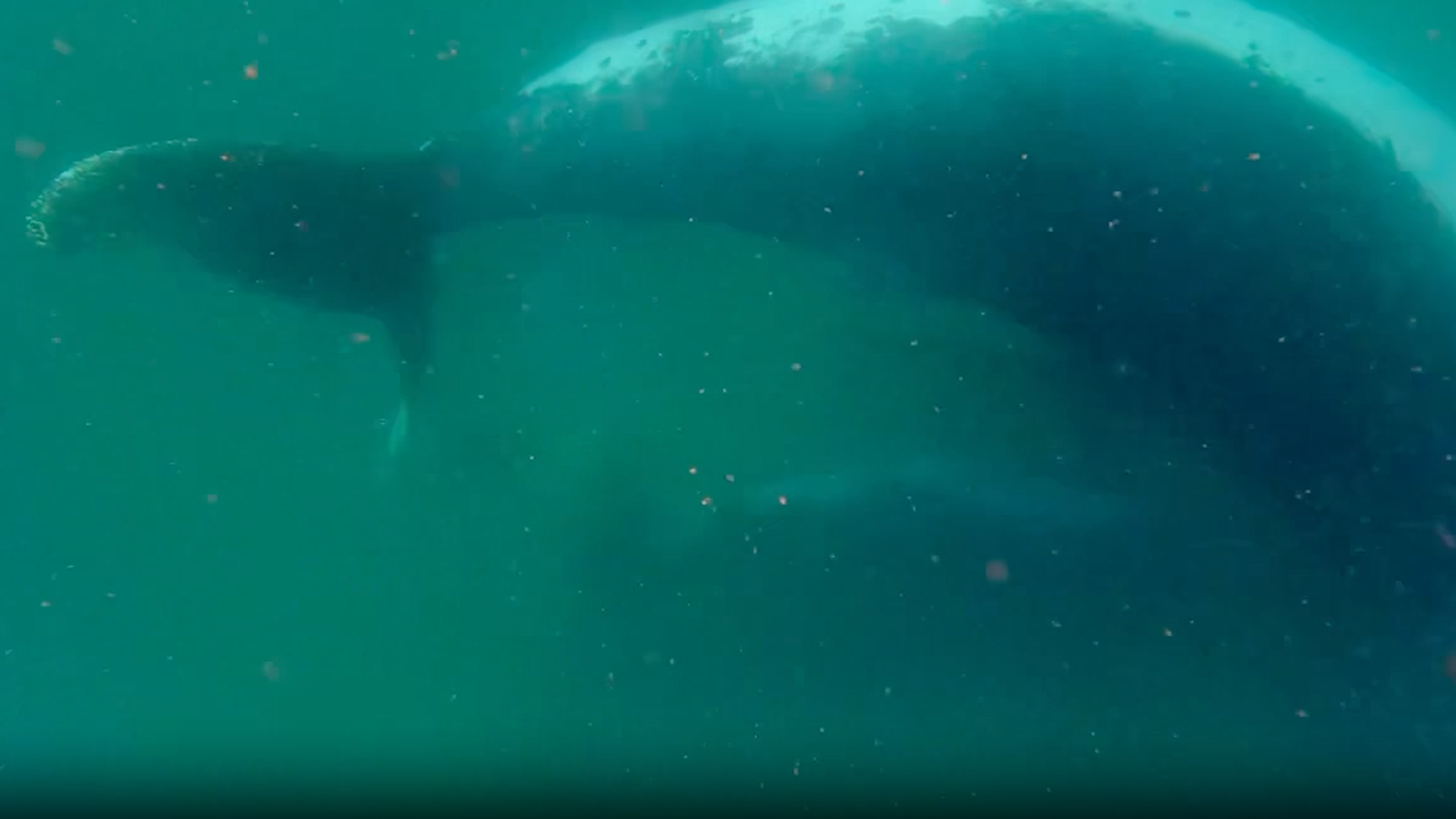
Rare Video Shows Mother Humpback Whale Grieving Her Stillborn Calf
Researchers have recorded what they believe is the first video of a mother humpback whale displaying grief-like behavior toward her stillborn calf.
The footage was recorded off southeastern Australia in July 2025 and described in research published in the journal Nature on September 16. In the video, the female humpback whale (Megaptera novaeangliae) hovers over the calf’s motionless body on the ocean floor and repeatedly appears to try to make eye contact with it.
A rare glimpse of humpback whale behavior
“It’s extremely rare to witness,” study lead author Olaf Meinecke, a marine ecologist at Australia’s Griffith University, told Live Science in an email.
Only about 20 humpback whale births have ever been observed and described in scientific literature, Meinecke said. None of those observations involved a stillborn calf.
Newborn humpback whales do not have enough body fat to float without help from an adult whale. Unlike the babies of toothed whales and porpoises, they can sink soon after birth. This may help explain why scientists have rarely observed a stillbirth: A dead calf would quickly disappear beneath the surface and be almost impossible to locate from a distance.
How researchers discovered the stillborn calf
The video was captured by study co-author Andrew Mulville, who was aboard a private boat when he noticed two adult humpback whales in the water. One whale moved into a vertical position with its tail pointing upward. Moments later, Mulville saw remnants of an amniotic membrane—the lining of the placental sac surrounding a fetus—floating on the surface.
The whale had apparently just given birth, but there was no sign of a calf. Mulville and the others on the boat followed the female underwater with a GoPro camera. They found the calf dead on the ocean floor while the mother remained nearby.
The mother stayed with the calf for at least 90 minutes
Researchers described the whale’s actions as “cautious postmortem behavior.” She repeatedly dove toward the calf, swam beside it and rested on the ocean floor for about a minute at a time. She also moved her pectoral fins over the calf before diving away again.
The researchers observed this behavior for about two hours. The mother continued returning to the area for at least 90 minutes and possibly for several days. She did not attempt to carry the calf to the surface, which may indicate that she understood it had died during birth.
This behavior differs from observations of toothed whales, which have sometimes been seen pushing stillborn calves toward the surface after death.
What the behavior may reveal about whale emotions
Researchers cannot definitively prove sadness without physiological or neurological measurements. However, the mother’s repeated attempts to approach the calf, along with her presence in the area during the following two days, suggest a strong maternal attachment and an emotional response to its death, according to the study.
Meinecke said the observation offers a valuable opportunity to study how humpback whales respond to dead members of their species. Whales have been observed approaching dead companions, helping distressed individuals and even protecting other species from predators. In this case, the behavior was directed toward the female’s own calf.
The role of the second whale
The other adult whale seen near the mother was likely an escort assisting her before and during the birth. Its size and appearance suggested it may have been a female roughly the same age as the mother, although researchers have not confirmed its sex or relationship to her.
Both male and female escorts are common among humpback whales. They often travel with females and their calves during migration and may assist pregnant females.
Source: www.livescience.com