



Hidden Rooms Beneath Tutankhamun’s Tomb? New Evidence Reignites the Nefertiti Debate
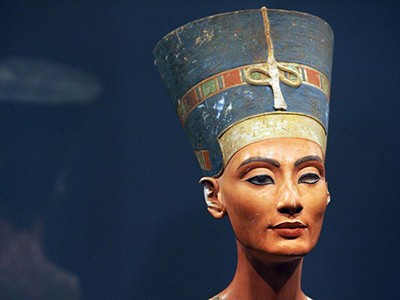
Nefertiti, the ancient Egyptian queen who is thought to have ruled as a pharaoh, may be buried near Tutankhamun.
Credit: Filo/Getty
Tutankhamun’s tomb in Egypt’s Valley of the Kings has long puzzled archaeologists. Now, a new analysis of radar, microgravity and other geophysical data is renewing the controversial possibility that hidden rooms behind the tomb’s walls could contain the burial place of Nefertiti.
The chamber, if it exists, is thought to lie a few metres from the existing tomb, known as KV62. Any decision to investigate it rests with Egypt’s Supreme Council of Antiquities. Study co-author George Ballard said that, if permission is granted, a careful excavation using small tractors equipped with cameras could begin in November.
The researchers used several geophysical techniques, including ground-penetrating radar (GPR) inside the tomb and, for the first time at the site, gravity-based methods to examine the density of the ground around it. When combined with studies of the tomb’s structure, surrounding ground and wall paintings, the findings suggest a possible “hidden complex” of corridors and rooms that predates Tutankhamun’s burial, said lead researcher Mahmoud El-Damati, an archaeologist at Cairo’s Ain Shams University and a former Egyptian minister of antiquities.
Is this Nefertiti’s tomb? Radar clues reignite debate about hidden rooms
If confirmed, El-Damati said, the discovery could be “one of the most innovative archaeological discoveries of our time”. The team’s conclusions are described in the study published online as Extraordinary documents regarding the Amarna Royal Tombs project1.
Why Tutankhamun’s tomb may contain hidden rooms
The latest study is one of several attempts to determine what lies behind the walls of KV62. In 2015, co-author Nicholas Reeves, an independent British Egyptologist who has worked extensively in the Valley of the Kings, proposed that the tomb could conceal the burial place of Tutankhamun’s predecessor, Nefertiti. Many Egyptologists believe that Nefertiti briefly ruled as a pharaoh.
The tomb was built in the 14th century B.C. and discovered in 1922. It is unusually small for a royal burial, which has contributed to the mystery surrounding it. Reeves argued that lines and cracks in the north wall of the burial chamber, along with ancient changes to the room’s paintings, could indicate a false wall. Ancient Egyptian tomb builders sometimes used such walls to conceal further chambers.2
According to Reeves’s theory, KV62 was originally a much larger royal tomb. When the young Tutankhamun died unexpectedly, the entrance may have been expanded and modified for his burial, while the deeper part of the tomb was sealed off.
Geophysical analyses designed to test the theory have produced mixed results. Some researchers have concluded that a hidden chamber exists, whereas others have found no convincing evidence of one.
What the new radar and microgravity surveys found
El-Damati and colleagues at Egypt’s National Institute of Astronomy and Geophysics used ground-penetrating radar to examine the inner walls of the tomb once again. Ballard, president of the international geophysical consultancy GBG Group and a structural engineer, analyzed the new results alongside data from earlier surveys.
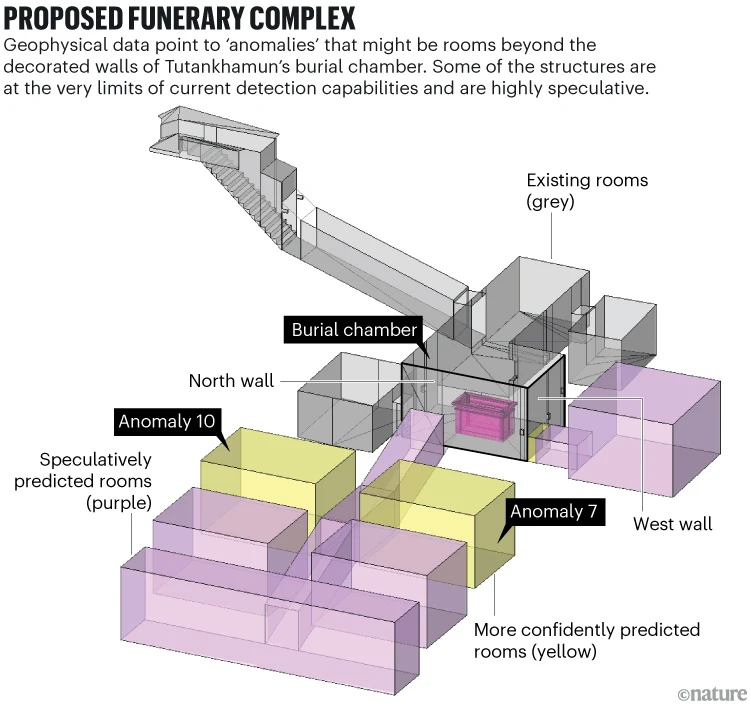
Ballard believes the combined evidence indicates a corridor approximately two metres wide and filled with debris extending from the burial chamber. He said previous research teams may have missed it because they were searching for a large open space immediately behind the wall.
Ground-penetrating radar has limited reach when used from inside a tomb, so the researchers also carried out microgravity surveys. This non-invasive technique detects changes in underground density by measuring small variations in Earth’s gravitational field.
Ballard said the researchers collected more than 1,200 measurements across an area of 35 square metres. The data point to what could be a man-made room, with “right-angled, low-density structures whose axes are interestingly parallel to the north wall”.
Electrical resistivity tomography, a method used to map underground structures, had also detected anomalies in similar locations in data collected in 2017.3 At the time, however, the anomalies were dismissed as unrelated to KV62.
Ballard considers one feature, known as “Anomaly 7”, particularly significant. It is mainly a low-density zone containing approximately square areas of higher density. He suggests that it could represent a room filled with objects, while acknowledging that researchers are examining “the very edge of detection”.
The possible room does not appear to connect to another entrance. If it exists, it may not have been entered since ancient times. Another possible chamber lies just west of the burial chamber, but the signal there is complicated by the gravitational effects of a nearby grave.
Experts urge caution over possible Nefertiti tomb discovery
Other geophysicists are intrigued but cautious. Christopher Gaffney, an archaeologist and ground-penetrating radar expert at Britain’s University of Bradford, described the report as “interesting” but said it did not provide enough information to support definitive conclusions. “I’m feeling pretty ambivalent,” he said.
Peter Stiles, a geophysicist at Keele University in the United Kingdom, said the microgravity data make the existence of a chamber “plausible”. He also wants to see more details. Ballard said he has not yet received permission from Egyptian authorities to release all the data.
Source: www.nature.com