


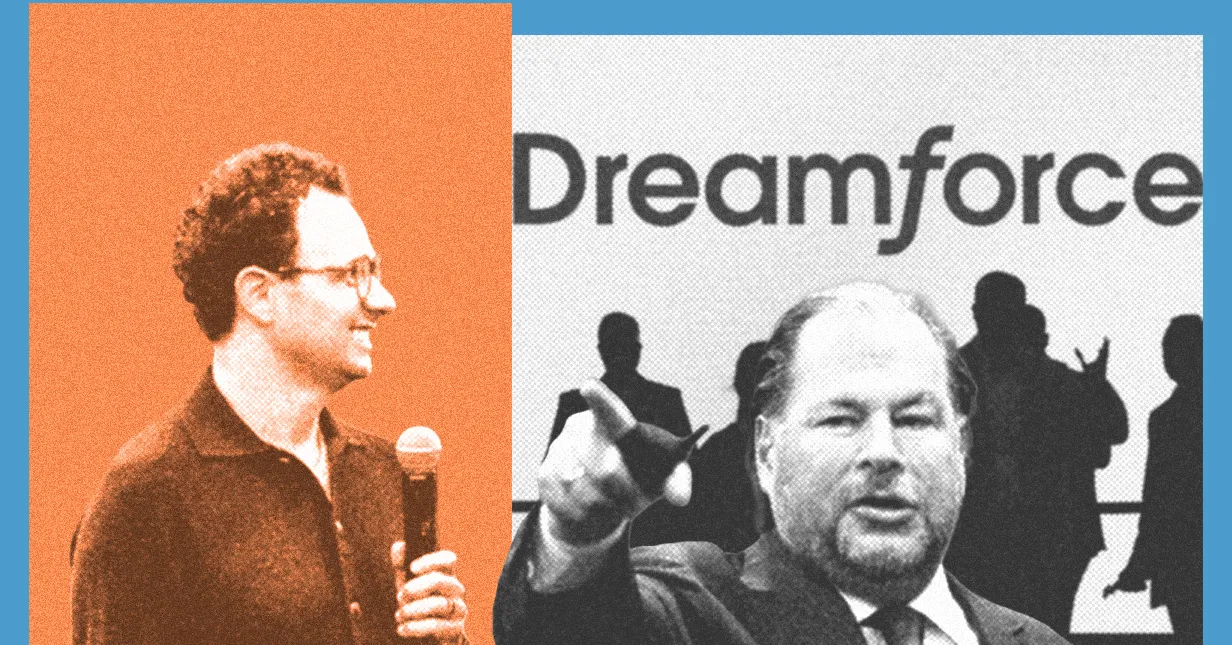
Dreamforce 2026: Salesforce Puts AI Safety at the Center of Its Enterprise Tech Showcase
Dreamforce opened with a performance from Gwen Stefani, who belted out her 2002 single “Underneath It All” to a packed San Francisco conference center Tuesday morning. Dressed in purple and plaid, Stefani was only warming up. At the end of her performance, she shouted into a checkered microphone, “Dreamforce! Let’s go!” before Salesforce CEO Marc Benioff stepped into the spotlight.
Dreamforce is touted as the world’s largest enterprise software conference, but this year’s event felt more like a megachurch—with Salesforce’s AI vision at the center of the sermon.
Marc Benioff Brings AI Evangelism to Dreamforce
Benioff walked through the audience preaching about the Dreamforce vision, while a remote-controlled camera on wheels projected his face onto a screen suspended from the ceiling of the cavernous room. Within minutes, he ordered a graph showing Salesforce’s annual revenue. The company is expected to pay its highest price ever. $46 billion in 2027, the audience applauded, thanks in part to demand for AI-powered products.
But dark questions hung over the entire affair: Is artificial intelligence really worth risking our lives for?
AI Leaders Debate Safety and Regulation
Between flashy software demonstrations featuring agents building dashboards, conference attendees watched Silicon Valley leaders debate whether the AI industry should continue moving forward at its current pace—or whether governments should slow AI development to prevent catastrophic risks posed by the technology.
Last week, AI researcher Jacob Coxon resigned from Anthropic and publicly warned that companies racing to make AI systems self-improve are “risking their lives.” By the end of the week, other Anthropic employees had echoed his concerns, while CEO Dario Amodei urged world leaders to help “keep the pace at the frontier” of AI development. Other AI CEOs have since supported the idea, including Sam Altman of Anthropic’s biggest rival, OpenAI.
However, not everyone agrees. David Sachs, the White House AI adviser, dismissed Amodei’s proposal, describing fears of AI doom as “simply an attempt at regulatory co-optation.” President Trump went further this week, calling concerns about the existential risks of AI a “hoax.” Despite the difficult political environment, Congress is using the moment to move forward with legislation to regulate the AI industry.
Anthropic and Salesforce Explore Enterprise AI
On stage, the 6-foot-5 Benioff towered over Anthropic CEO Dario Amodei and shook his hand before asking for his latest assessment of AI’s progress. Although Dreamforce is clearly Benioff’s show, Anthropic has become a key partner as Salesforce moves deeper into the AI era.
“Let’s say you run a car company and another car company that isn’t yours has some sort of safety incident,” Amodei said, referring to OpenAI’s not-so-subtle Hugging Face incident. “Obviously, it’s very tempting to attack our competitors,” he explained, but the more responsible course would be to “organize the rest of the industry and advocate for how we can set standards for everyone.”
Amodei noted that operating at the frontier does not mean “freezing technology in place,” and he also took time to highlight Claude’s integration with Salesforce.
Jensen Huang Pushes Back on Calls for New AI Laws
Shortly after Amodei left the stage, Nvidia CEO Jensen Huang appeared and began downplaying the concerns raised by Anthropic’s CEO. Huang argued that AI safety is effectively an “engineering issue” and that companies developing AI only need to monitor themselves.
“We don’t need new laws or regulations,” Huang told Dreamforce attendees. “We’ll run as fast as we can, but if we feel like the company is going to get out of control or the product is going to be unsafe, at that point, we’ll pause.”
Why AI Safety Belongs at Dreamforce
The discussion may feel heavy for Dreamforce, but perhaps this is the best place for it. As technology executives promoted enterprise AI tools, I slipped out of the room, past stuffed-animal mascots and vaguely Hawaiian ornaments, to answer a phone call from Sayash Kapur, Berkeley’s incoming computer science professor.
Source: www.wired.com