


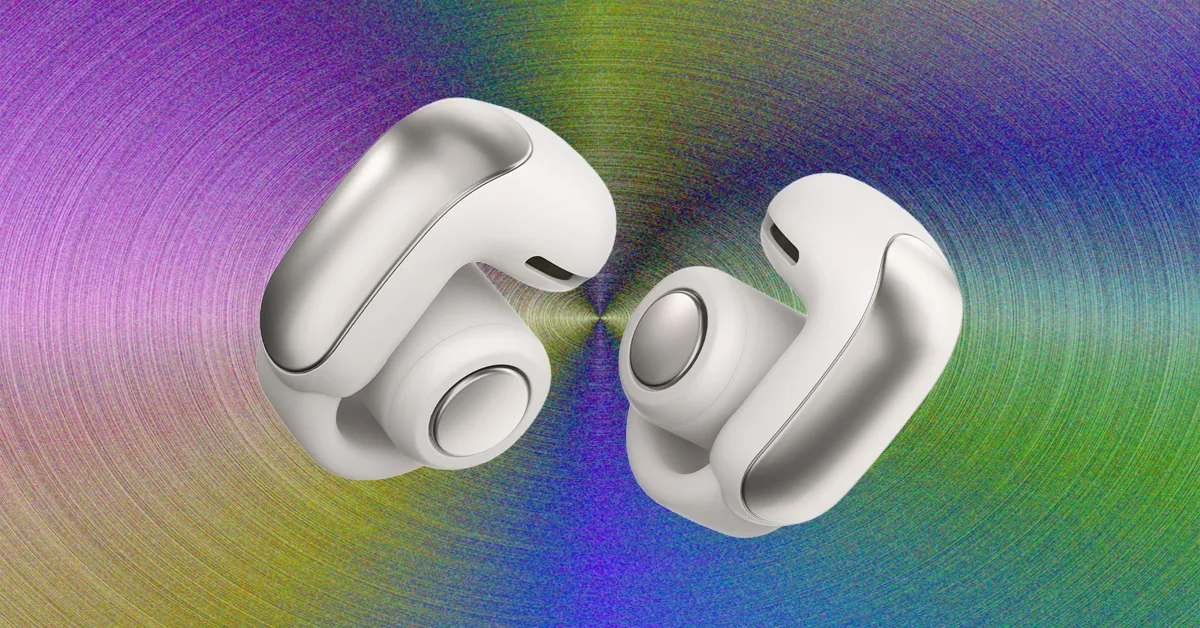
Best Open-Ear Headphones: Tested Picks for Running, Cycling and Everyday Listening
Open-ear headphones let you listen to music and podcasts while keeping your ears open to your surroundings. They can be especially useful for running, cycling, outdoor workouts and household chores, although they generally cannot match traditional earbuds for sound clarity, bass or noise cancellation.
Affordable Shokz OpenRun Air 2
I wish these headphones were a little cheaper. We are currently testing the recently released, more affordable Shokz OpenRun Air 2 and hope they become a budget-friendly alternative.
Honorable mentions
Nothing Ear (Open) — $99
Former WIRED editor Adrian So likes these earphones and uses them for almost every outdoor activity. They are very slim—19 mm wide—and lightweight. The earbuds fit slightly over your ears and, like many Nothing headphones, have a distinctive transparent design.
The case does not close tightly, so you need to be careful with it. At this price, however, that compromise is acceptable.
JLab Epic Open Sport — $100
JLab’s Epic Open Sport stands out for its controls. The JLab emblem is touch-sensitive, while each earbud also has physical buttons on top for easy control.
The main weakness is audio quality. The sound is not especially detailed and can be boring to listen to.
Other open-ear headphones I’ve tested
EarFun Clip — $70
At around $70, the EarFun Clip is a solid option for shoppers on a budget. Waniata found that the overall package offered a lot for the price, including a crisp, compact case, a comfortable fit, push-button controls and reliable multipoint Bluetooth connections.
The challenge is competition from the budget pick, the Soundpeats PearlClip Pro, which is often available for considerably less and offers a similar overall experience. Even when the EarFun Clip is heavily discounted, it is worth considering.
Shokz OpenFit Pro — $250
The Shokz OpenFit Pro is designed to combine an open-ear listening experience with noise cancellation. You can hear your surroundings as you would without headphones, then turn on noise cancellation when you want a more conventional earbud experience.
Some noise is canceled, but not much. The bigger issue is the price. For $250, you can buy open earbuds and excellent noise-canceling headphones that do a better job at each task.
Suunto Wing 2 — $179
These open-ear headphones are designed for endurance athletes. They offer up to 12 hours of battery life and include a wireless power bank for use on the go. Docking the headphones with the power bank provides up to 36 hours of total battery life.
There is nothing inherently wrong with the Suunto Wing 2, but I would not recommend it over the Shokz OpenRun Pro 2, which sells for the same price and offers greater comfort, a sleeker design, better sound and a more robust app.
Suunto Spark — $179
The Suunto Spark has a similar story to the Suunto Wing 2. Designed with athletes in mind, it can sync with Suunto fitness watches, but the similarly priced Shokz OpenFit 2 performs better in important areas, including comfort, sound quality and battery life.
What are open-ear headphones, and how do they sound?
At first glance, open-ear headphones can look a lot like standard wireless earbuds. The key difference is that they sit outside the ear canal, leaving your ears open so you can hear sounds around you.
This design is useful for outdoor exercise such as running and cycling. You can listen to music while remaining aware of other runners, cyclists and cars.
Because the speakers sit outside your ears and do not create a seal, the sound is generally less clear, intimate and bass-heavy than what you get from traditional earbuds. Open-ear headphones also usually lack effective noise cancellation, making them less suitable for offices, airplanes and noisy commutes.
When and where should you use open-ear headphones?
Open-ear headphones are useful for outdoor activities and situations where you want to talk to other people without removing your headphones. For running and cycling, they allow you to hear your surroundings and stay aware of potential hazards.
They can also be convenient around the house while cooking, doing laundry or completing other everyday tasks.
What are semi-open earbuds?
Semi-open earbuds, such as Apple’s AirPods, sit inside your ear but do not use ear tips to create a tight seal. Since the speaker and microphone are close to your ear and mouth, they can provide better sound quality than other open-back earphones.
Semi-open earbuds are comfortable, but they are often loose and can fall out easily, making them less suitable for fitness activities.
How I test open-ear headphones
I test open-ear headphones in the real world and during everyday use. I wear each pair for at least a few weeks to evaluate comfort, battery life, ease of use and onboard controls. I listen to podcasts, watch TV shows, play playlists and make phone calls.
With open-ear headphones, I also wear them while jogging, biking and running errands to evaluate how securely they stay in place. I do not expect effective noise cancellation from this category, so I do not test these headphones on airplanes or during noisy commutes. They are not designed for those situations.
My primary source is Spotify Lossless, although I also test other formats and codecs when possible.
Source: www.wired.com