


New Liquid-Helium Electron Microscope Images Materials at Near-Absolute-Zero Temperatures
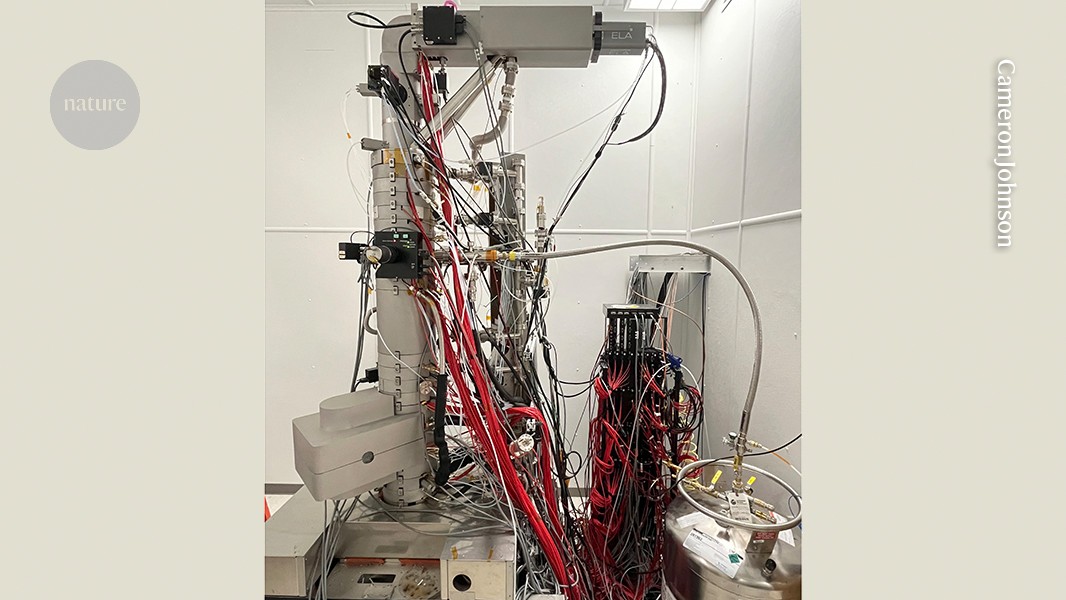
Bruker’s GAIA scanning transmission electron microscope can image materials at atomic resolution for more than 30 hours at temperatures as low as 7 kelvin.
GAIA is a scanning transmission electron microscope with a built-in system that cools samples to extremely low temperatures using liquid helium.
Credit: Cameron Johnson
When it comes to imaging materials, colder samples can reveal more detail. At room temperature, atoms vibrate with thermal energy and can appear blurry in images. At temperatures near absolute zero—0 kelvin—atoms become nearly stationary and can display unusual quantum behavior.
For decades, scientists have worked to adapt powerful transmission electron microscopes (TEMs) to operate at the lowest possible temperatures. Now, ultra-cold atomic-resolution imaging is becoming a reality.
GAIA brings atomic-resolution imaging close to absolute zero
Last year, American researchers reported that a TEM attachment using liquid helium could cool a sample to −253 °C (20 kelvin) and maintain stable atomic-resolution imaging for more than 10 hours.1
By early next year, Bruker, an equipment manufacturer based in Billerica, Massachusetts, will ship the first scanning transmission electron microscope (STEM) that uses liquid helium to operate stably near absolute zero. The instrument, called GAIA, can image materials for more than 30 hours at temperatures as low as approximately −266 °C (7 kelvin).
GAIA stands for “Generational Advance in Instrumentation for Analysis.” The microscope’s name also refers to Gaia, the goddess of the Earth in ancient Greek mythology.
“It’s a little humbling to put God’s name on a microscope, but we’re pretty confident in its capabilities,” said Tracy Lovejoy, divisional vice president and general manager at Bruker.
Researchers say GAIA could make it possible to explore material properties that have never been observed under stable, ultra-cold conditions.
“It’s incredibly exciting,” said Sherry Conroy, an electron microscopy technician at Imperial College London. Conroy secured a time slot to use GAIA after it is delivered to the Ernst Ruska Center for Electron Microscopy and Spectroscopy in Jülich, Germany.
The other two microscopes will be sent to Oak Ridge National Laboratory in Tennessee and the Canadian Center for Electron Microscopy in Hamilton.
Last year, electron microscopist Noah Schnitzer observed a demonstration of GAIA at the Annual Microscopy and Microanalysis Conference in Salt Lake City, Utah. He had previously used a microscope attachment to image cryogenic materials, but said the process required “a huge amount of optimization” and involved “fighting the system along the way.”
Schnitzer, who works with Conroy at Imperial College London, said GAIA’s stability was impressive. With microscopy, “that’s kind of the whole game,” he said.
Why liquid helium is difficult to use in electron microscopy
Combining TEM and STEM instruments with cryogenic systems is not a new idea. Scientists have long used temperature as a “tuning knob” to nearly freeze atoms in place and cause materials to develop specific properties, said Seok-Hyun Sung, an electron microscopist at the University of Michigan in Ann Arbor who helped develop the TEM attachment reported last year.
Most electron microscopes are cooled with liquid nitrogen, which lowers the sample temperature to approximately −196 °C (77 kelvin). Reaching even lower temperatures requires liquid helium, which condenses at about −269 °C (4 kelvin).
The challenge is that liquid helium evaporates quickly. In a TEM, the sample is held on a rod connected to a thermos-flask-like container called a dewar, which contains the liquid helium. Evaporation can make the sample vibrate, blurring the image and making reliable data collection nearly impossible for more than short periods.

Ismail El Baggari, co-founder of h-Bar Instruments, aligns one of the microscope company’s attachments before inserting it into the TEM.
Credit: Sherry Conroy
One Zurich-based company, condenZero, has developed a liquid-helium cooling attachment that cools materials to about −269 °C (4 kelvin) for 24 hours. However, atomic resolution was not the goal of that system.
Engineering a stable microscope for ultra-cold samples
In 2020, University of Michigan electron microscopist Robert Hovden and his colleagues began developing an electron microscope that could achieve atomic-resolution imaging at these temperatures. They used heat exchangers and other engineering adjustments to reduce vibrations caused by liquid helium and produce clearer images.
In 2022, Hovden co-founded h-Bar Instruments in Ann Arbor to commercialize the attachment.
GAIA also uses liquid helium, but its cooling system is integrated directly into the microscope. Development began in 2017 at Nion, an electron microscopy company that Bruker acquired in 2024.
In addition to enabling atomic-resolution imaging at ultra-low temperatures, GAIA includes several features that researchers say could expand its capabilities. Like other advanced electron microscopes, it is aberration-corrected: lenses and software compensate for the natural blurring and distortion that occur during imaging, producing a clearer view of the sample.
GAIA also has a monochromator that controls the energy of the electrons hitting the sample. This allows researchers to study how materials respond to low-energy excitations.
Source: www.nature.com