


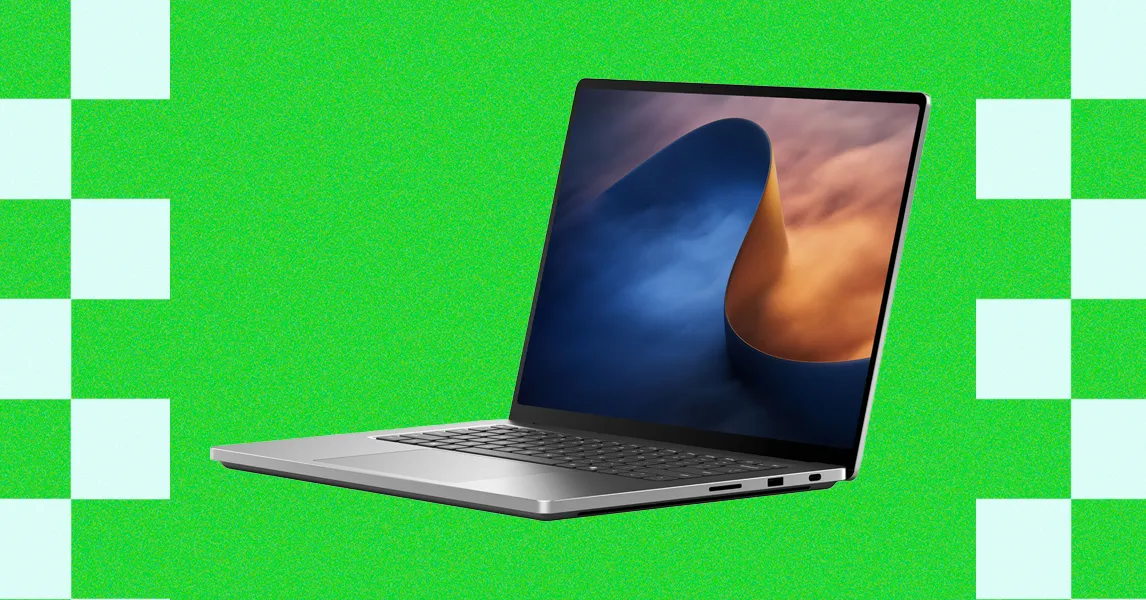
Surface Laptop Ultra Display Review: 1,945-Nit HDR Brightness and Nvidia N1X
Brightest Laptop Display Ever Made
With 1,344 dimming zones, this is the brightest laptop screen ever made. Using a colorimeter, I measured 987 nits in SDR and 1,945 nits in HDR with a 9% window.
The result is impressive HDR performance. Although the display cannot match OLED’s perfect black levels, games and movies still look excellent. Combined with a 120Hz refresh rate, it makes for a beautiful gaming display—especially for single-player games, where the enhanced visuals feel more immersive.
High Brightness Can’t Eliminate Screen Reflections
The display’s main drawback is its high reflectivity. This is also an issue with the standard Surface Laptop, but the screen is noticeably more reflective than the MacBook. Even at maximum brightness, I found myself looking at my own reflection when viewing websites with dark backgrounds.
That is particularly noticeable given that this is arguably the brightest laptop screen ever made. Still, this is my only major complaint. In every other respect, it is one of my favorite laptop displays I’ve tested.
1080p Webcam Falls Behind the MacBook Pro
The 1080p webcam is less impressive. It struggles in low-light conditions, producing images with significant noise. By comparison, the MacBook Pro webcam offers excellent image processing and brightens faces without overexposure.
Introducing Nvidia N1X
Nvidia N1X is the first Nvidia chip to appear in a Windows laptop. Qualcomm opened the door for Windows laptops with its Snapdragon X chip in 2024, and the Surface Laptop was an early adopter. These chips primarily served as an answer to the MacBook Air and, later, the MacBook Neo.
However, Qualcomm’s chips never scaled to the performance required to compete with Apple’s M5 Pro and M5 Max MacBook Pro chips. That is where Nvidia N1X comes in.
Nvidia N1X Configurations and AI Performance
Both Snapdragon X and N1X use a System on a Chip (SoC) design that combines the CPU, GPU, and memory. Apple Silicon chips use the same approach. Importantly, this design allows the CPU and GPU to access local memory.
That shared access is important for faster local AI processing, which requires the GPU to access as much memory as possible. Nvidia N1X is available in two configurations: an 18-core system with 5,120 GPU cores and a 20-core system with 6,144 GPU cores.
These configurations are comparable to Apple’s M5 Pro and M5 Max. The main differences are GPU performance and available configuration options. If you need 128GB of memory for better AI performance, you should choose the 20-core N1X.
So far, 18-core models are limited to 24GB or 32GB of RAM. The only N1X laptop we’ve seen with 24GB of memory is the Surface Laptop Ultra.
Source: www.wired.com