


Close Menu
HitechubHitechub
    What's Hot
    Science

    Ancient Plague Outbreaks Killed Entire Families Thousands of Years Before the Black Death

    Science

    Hubble Reveals the Mystery Behind the Milky Way’s Early Merger

    Science

    Synergistic Viral-Bacterial Co-Infection Accelerates Algal Bloom Collapse

    Important Pages:
    • About Us
    • Privacy Policy
    • Terms & Conditions
    Facebook X (Twitter) Instagram Pinterest
    Facebook X (Twitter) Instagram
    HitechubHitechub
    Saturday, November 28
    • Shop
      • Fashion
        • Mens
        • Womens
        • Accessories
          • Handbags
          • Keychain
          • Masks
          • Money clicps
          • Neck Pillow
          • Rings
          • Towels
          • Wallets
        • Jewelry
        • Watches
        • T-shirts
        • Hawaiian shirts
        • Vests
        • Swim trunks
        • Swimsuits
      • Fun
        • Magic cubes
        • Magnifiers
        • Misc
        • Photo books
        • Puzzles
        • Toys
      • Home
        • Cleaning/Care
        • Mailbox covers
        • Mugs
        • Pot Holders
        • Spoon
      • Office and Electronics
        • Chairs
        • Office Supplies
        • IPad cases
        • Laptop stickers
        • Mouse pads
        • Notebooks
        • Pencil bags
        • Pens
        • Phone cases
      • Personalized
      • Pets
      • Sports
        • Cycling
          • Balaclava Mask
          • Bike Bell
          • Bike Computer
          • Bike Fender
          • Bike Grips
          • Bike Kickstand
          • Bike Light
          • Bike Locks
          • Bike Mitts
          • Bike Pumps
          • Bike Repair Stand
          • Bike Seat
          • Bike Trainer
          • Bike Wheels
          • BIKES
            • Folding Bikes
            • Road Bikes
          • Carbon Fiber Bike Products
          • Cycling Mask
          • Kid’ Bike Helmets
          • Inner Tube
          • Motorcycle Bag
          • Nylon Pedals
          • Adult Helmets
          • Photochromic Sunglasses
          • Soft Coolers
          • Suction Cup Bike Rack
          • Tool accessories
          • Winter Cloth
          • Heart Rate Monitor
        • Outdoors/Camping
          • Outdoor Bags
        • Sweatband
    • Technology
      1. AI
      2. Gadgets
      3. View All

      This is the most popular CEO in the world

      Sectors in which “Chat-GPT” is most often used

      Artificial intelligence has begun to “swallow” professions

      The unusual robot conductor of a concert in Seoul

      Here’s how you can tell if your phone is being tapped

      PlayStation 5 becomes a completely silent console and gets more space

      This is the first phone that can be used to park a car

      Best Gaming Laptops 2023: Powerful Portables for PC Games

      Why Firewalls Aren’t Enough: Hidden Security Risks of Unmanaged Virtual Machines (VMs)

      Boston Scientific Data Breach Exposes Patients’ Personal Medical Information

      pCloud Confirms Password Manager Hack Following Suspicious Login Alert

      How Advanced Prosthetics Help Us Explore the Human Mind

    • Science
      1. Space
      2. Wheels
      3. View All

      Space Perspective: A Journey to the Edge of Space

      5 Fascinating Facts About Space

      Space Exploration: Unveiling the Wonders of the Universe

      Toyota wants to make a new generation battery with a range of up to 1,200 km

      Meet Toyota’s lunar “baby” that could make exploring the Moon easier

      What does a night drive look like with one of the most beautiful cars in the world: the Rolls-Royce Ghost

      Ancient Protein Links Chinese Fossil Remains to Denisovans

      DARPA Evaluates Microsoft’s Majorana 2 Quantum Computing Technology: What If It’s Proven Legitimate?

      Scientists Identify Two Ages When Children Are Most Vulnerable to Screen Time Effects

      WATCH: Why Are We the Last Humans Left on Earth?

    HitechubHitechub
    Home » Geothermal Amoeba Thrives at 63°C, Challenging the Limits of Eukaryotic Life
    Science

    Geothermal Amoeba Thrives at 63°C, Challenging the Limits of Eukaryotic Life

    Share Facebook Twitter Pinterest WhatsApp
    Share
    Facebook Twitter LinkedIn Pinterest WhatsApp

    New Heat-Loving Amoeba Sets a New Temperature Record for Eukaryotic Life

    Scientists have discovered a new species of heat-loving amoeba that completes cell division at 63 degrees Celsius (145 degrees Fahrenheit) and remains motile at temperatures as high as 64 degrees Celsius (147 degrees Fahrenheit).


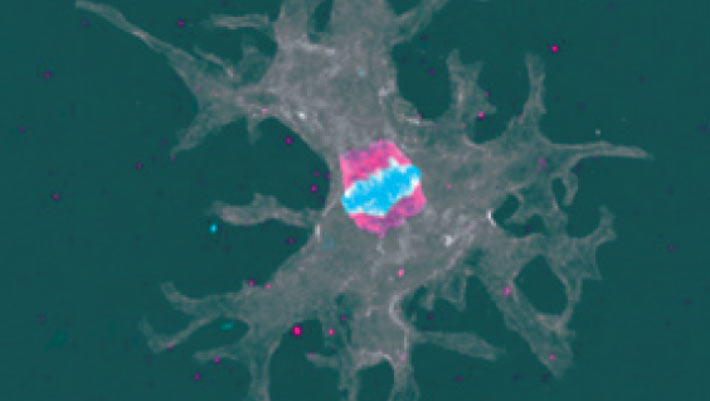
    Incendiamoebae cascadensis completes cell replication at temperatures of up to 63 degrees Celsius. Image credit: Rappaport et al., doi: 10.1016/j.cell.2026.08.043.

    Incendiamoebae cascadensis thrives in extreme heat

    The newly identified amoeba, Incendiamoebae cascadensis, has been described as a “fire amoeba.” It completes its full cell-division cycle, including visible mitosis, at 63 degrees Celsius—well above previously recognized temperature limits for eukaryotes.

    Eukaryotes are organisms whose cells contain nuclei and include animals, plants, fungi, algae and amoebas.

    For decades, the upper temperature limit for eukaryotic growth was considered to be about 60 degrees Celsius (140 degrees Fahrenheit), based on a small number of thermotolerant fungi and red algae. Some amoebas have been recorded at slightly lower temperatures, with one species reaching approximately 57 degrees Celsius (135 degrees Fahrenheit).

    “Thermophiles are organisms that have a high thermal limit and grow optimally above 45 degrees Celsius (113 degrees Fahrenheit),” said Syracuse University doctoral student Beryl Rappaport and colleagues.

    “Thermal limits are defined by three thresholds: life-cycle completion, such as cell replication; metabolic activity, such as motility and feeding; and survival.”

    How hot can life grow?

    The highest known growth temperature is 122 degrees Celsius (252 degrees Fahrenheit), reached only by certain archaea, including Methanopyrus kandleri. Some bacteria, such as Geothermobacter ferrireducens, can grow at temperatures of up to 100 degrees Celsius (212 degrees Fahrenheit).

    These temperature limits are notable because heat can denature proteins and other biomolecules while also altering the fluidity of cell membranes.

    Despite the importance of thermophilic organisms, efforts to characterize heat-loving eukaryotes and establish their upper temperature limits remain limited. Much of the eukaryotic diversity found in high-temperature environments is still unexplored.

    Collected from a geothermal environment in California

    Rappaport and colleagues collected Incendiamoebae cascadensis from a tributary of Hot Springs Creek in Lassen Volcanic National Park, California. They sampled the site over a three-year period.

    Genetic analysis places the species within Amoebozoa, making it a close but genetically distinct relative of Vermamoeba vermiformis, a heat-tolerant amoeba with a maximum temperature range of approximately 40–45 degrees Celsius (104–113 degrees Fahrenheit).

    The researchers also identified matching genetic signatures in metagenomic databases from geothermal areas in New Zealand and Yellowstone National Park. The finding suggests that related heat-tolerant amoebas may be more widespread than previously recognized.

    Cellular adaptations help the amoeba withstand heat

    By comparing gene activity at 48 degrees Celsius (118 degrees Fahrenheit) and 61 degrees Celsius (142 degrees Fahrenheit), the scientists found that Incendiamoebae cascadensis strengthens its cellular repair systems under extreme heat.

    At the protein level, the amoeba displayed distinctive chemical properties, including fewer sticky, aggregation-prone surface patches and a high abundance of positively charged surface residues.

    “We were able to discover many strategies in Incendiamoebae cascadensis that could be helpful in understanding thermophiles across all organisms,” Rappaport said.

    “For example, some proteins in Incendiamoebae cascadensis have a high positive surface charge, which may help maintain their stability. The charges on these proteins are similar to those found in thermophilic bacteria and archaea.”

    Could heat-loving amoebas survive beyond Earth?

    “Finding eukaryotes that survive in high-temperature environments not only expands our understanding of where life can be found, but also deepens our understanding of how complex life can be,” said Dr. Alison Olcott, an Astrobiology Program scientist at NASA Headquarters who was not involved in the study.

    The discovery may also inform the search for life in extreme environments beyond Earth. However, temperature is only one factor that determines whether an organism can survive. Acidity, oxygen levels, pressure, water and food availability are also essential.

    “Complex life such as Incendiamoebae cascadensis might be able to survive on another planet, but Earth is currently the only planet where we know it can thrive,” Olcott said. “Incendiamoebae cascadensis could not survive alone. Other forms of life and supporting environmental conditions would also be necessary.”

    The discovery is reported in a paper published in the journal Cell.

    _____

    H. Beryl Rappaport et al. Geothermal amoebas set a new temperature limit for eukaryotes. Cell, published online September 22, 2026. doi: 10.1016/j.cell.2026.08.043.

    Source: www.sci.news

    Share. Facebook Twitter Pinterest LinkedIn WhatsApp
    Previous ArticleDownload Report: India’s Smart Glasses Threat and AI’s $1 Trillion Gamble
    Next Article How a Single Kubernetes YAML File Can Take Over Your GCP Organization

    Related Posts

    Science

    Ancient Protein Links Chinese Fossil Remains to Denisovans

    Science

    DARPA Evaluates Microsoft’s Majorana 2 Quantum Computing Technology: What If It’s Proven Legitimate?

    Science

    Scientists Identify Two Ages When Children Are Most Vulnerable to Screen Time Effects

    Science

    WATCH: Why Are We the Last Humans Left on Earth?

    Science

    Cassiopeia’s Dust Fingerprint Reveals Former Star’s Reorganization Before Explosion

    Science

    Scientists Convert Hard-to-Recycle Plastic into High-Performance Lubricant

    Science

    Narwhal Tusk: The Surprising Engineering Secrets Behind Its Legendary Unicorn Horn

    Science

    The Unforgettable Beauty of Wetlands: Book Summary and Key Insights

    Add A Comment
    Leave A Reply Cancel Reply

    Stay In Touch
    • Facebook
    • Twitter
    • Instagram
    • Pinterest
    Top Picks
    Technology

    Estée Lauder Reports Data Breach Caused by Oracle E-Business System Vulnerability

    Cosmetics leader Estée Lauder has informed its customers about a data breach stemming from an…

    How Enhancing Access to Replication Studies Can Improve Scientific Self-Correction

    Unlock Faster Cryptocurrency Mining with Energy-Efficient Quantum Computers

    Scientists Discover How Diamonds Can Generate Electricity

    How Stephen Miller Planned His Rise to Political Power

    Most Popular
    Technology

    OpenSSL Server Vulnerability: HollowByte DDoS Flaw Leads to Memory Bloat with 11-Byte Payload

    Technology

    Do Face Masks Protect Against Wildfire Smoke? Yes, But Additional Measures Are Essential

    Categories
    • AI (9)
    • Gadgets (6)
    • Science (3,623)
    • Space (3)
    • Technology (3,054)
    • Wheels (3)
    Our Picks
    Science

    Tips to Stand Out in a Challenging Industry Interview: How to Improve Your Performance

    Science

    Unveiling Hidden Black Holes: Solving Galactic Mysteries at the Centers of Galaxies

    © 2026 Hitechub.
    • Home
    • About Us
    • Privacy Policy
    • Terms & Conditions

    Type above and press Enter to search. Press Esc to cancel.

    GDPR Cookie Banner

    We are using cookies to give you the best experience on our website.

    You can find out more about which cookies we are using or switch them off in .

    Ad Blocker Enabled!
    Ad Blocker Enabled!
    Our website is made possible by displaying online advertisements to our visitors. Please support us by disabling your Ad Blocker.