


World’s Most Accurate Clock Would Lose Just One Second in 260 Billion Years
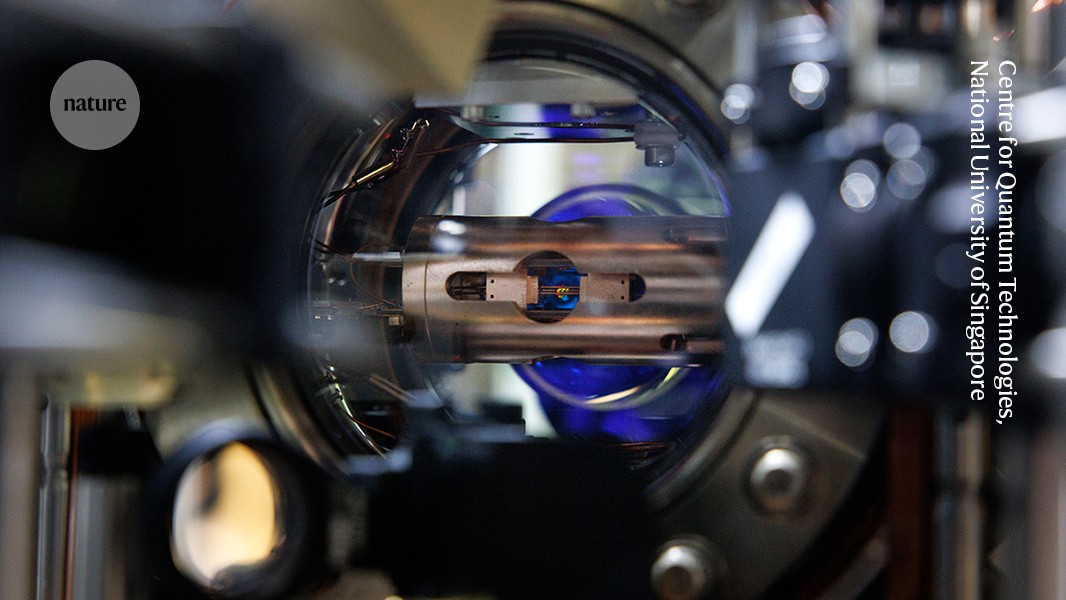
A close-up of the inside of the world’s most accurate timekeeping lutetium clock.
Credit: Center for Quantum Technology, National University of Singapore
Physicists have unveiled the world’s most accurate clock, a lutetium-based optical atomic clock so reliable that it would take more than 260 billion years to lose one second.
High-precision clocks support technologies and research ranging from satellite navigation to the search for dark matter. More accurate clocks could also enable scientists to map changes in Earth’s gravitational pull with exquisite precision and help establish a future definition of the second.
The laboratory clock, created by researchers at the National University of Singapore (NUS) using the rare-earth metal lutetium, is four times more accurate than the previous leading clocks, which were based on calcium ions.12
How the lutetium optical atomic clock works
The device is an optical atomic clock. It uses visible-light frequencies at which elements absorb and emit radiation to measure time. The researchers continuously observed individual lutetium ions and locked a laser to the precise frequency that caused the ions’ electrons to transition into a higher-energy, or “excited,” state. The laser’s oscillations then served as the clock’s ticks.
The clock’s accuracy is “impressive,” says David Leibrandt, a physicist at the University of California, Los Angeles, who works on ultra-precise clocks. He adds that the team’s comparison of the clock outputs is especially important because it independently verifies the measurement.
Two clocks confirm record-breaking precision
The researchers calculated the clock’s accuracy and verified it by comparing two lutetium clocks with each other. This comparison is essential for establishing confidence in the results. “If you only have one clock, how do you know it’s accurate?” says NUS physicist Murray Barrett, who led the team.
The ticks from the two clocks coincided to the 19th digit, which the team says is the most accurate comparison of clocks ever made.

A clock developed by researchers at the National University of Singapore is four times more accurate than the next closest candidate.
Credit: Center for Quantum Technology, National University of Singapore
Why lutetium could improve future timekeeping
The NUS team believes it is the only group in the world manufacturing clocks from lutetium. NUS physicist Kyle Arnold says the element’s properties are “well suited” to the task.
Compared with atoms commonly used in atomic clocks, including ytterbium and strontium, lutetium is less sensitive to changes in temperature and magnetic fields. These environmental factors can shift the frequency of atomic transitions and reduce clock accuracy.
Lutetium clocks require only commercially available laser technology and operate at room temperature. The developers say the device is sufficiently robust that they hope eventually to make it small enough to take outside the laboratory.
Barrett says the September 23 study was the culmination of more than a decade of research. “We’re pleased with what we’ve accomplished and want to know what the future holds,” he says.
“I think lutetium will play a leading role in accurate timekeeping in the future, and I hope this will lead to wider recognition of its benefits in optical clocks,” says Arnold.
Source: www.nature.com