


Beyond CRISPR-Cas9: New Gene-Editing Tools Can Insert Large DNA Sequences
Researchers are developing a growing toolkit for large-scale gene editing, including technologies that can add thousands of DNA bases to the genome.
Ten years ago, Ying Chan found herself in the midst of a medical revolution.
Chan was one of the first scientists hired by CRISPR Therapeutics in Zug, Switzerland. The biotech company was founded in 2013 to treat diseases using CRISPR-Cas9 gene editing. The technology had only recently been made public, and Chan and her colleagues began developing ways to take advantage of this innovative tool.
However, she quickly became frustrated. Many of her plans involved replacing an entire defective gene with a healthy copy, which she realized would be difficult with CRISPR-Cas9. “When we first got there, we were full of excitement,” says Chan. “Once we actually did all the work, it turned out to be more complicated than we thought.”
It is easier today. At China’s Wuhan University, Chan and other researchers are developing a growing toolkit for rewriting genomes, whether for therapeutic purposes or basic research. Some of these methods build on CRISPR-Cas9, whereas others are completely independent of it. “It’s an explosion of new technology,” says Shannon Miller, a bioengineer at Scripps Research in La Jolla, California.
These technologies are still in their infancy, and each has advantages and disadvantages. No method has yet demonstrated the simplicity and versatility that CRISPR-Cas9 offers for more modest DNA-editing tasks. The best approach depends on the size of the DNA that needs to be inserted, where it must be added in the genome and which cell type researchers want to modify.
“There are so many different flavours,” says Amy Puller, director of neurotherapy at Regeneron in Tarrytown, New York. “It’s not going to be a one-size-fits-all approach.”
Choosing the right gene-editing tool
CRISPR-Cas9 is convenient and versatile when researchers need to make small changes to DNA sequences or disable genes. A related and more precise technique called base editing uses the CRISPR mechanism to change individual DNA “letters”.
Both techniques have been used to treat human diseases, but they also have limitations. CRISPR-Cas9 gene-editing tools must break DNA before they can modify it. The Cas9 enzyme cuts both DNA strands at a target site, after which researchers rely on the cell’s natural, error-prone repair mechanisms to close the gap. The resulting edits can be unpredictable and often disable the gene.
Base editing must also be tailored to an individual’s DNA, which makes it impractical for some diseases. Stargardt disease, an inherited form of vision loss, can be caused by more than 1,200 variants in the ABCA4 gene. Approximately 750 of these variants could be corrected using base editing, but treating them all would require hundreds of different therapies.
“It’s not realistic to develop a drug for just one patient,” says Chan. “If we can incorporate the whole healthy gene, we can cover at least one genetic disease with one treatment.”
Researchers also want to use large-scale gene insertions to give cells new functions. For example, this technology could enable chimeric antigen receptor (CAR) T-cell therapies to produce immune-stimulating proteins or gene switches that activate cells only when they are near a tumour.
In basic research, scientists can manipulate large DNA segments to create improved models of human diseases, recreate metabolic pathways, investigate the relationship between genome structure and function and construct synthetic chromosomes.
CRISPR-Cas9 is not always the best tool for these goals. Although it can insert DNA, its efficiency declines as the DNA segments become larger, so researchers typically use it with segments shorter than 2,000 base pairs. The technique can also be difficult to use in cells that are not actively dividing, including neurons.
Another CRISPR-based technique, prime editing, can insert sequences without cutting both DNA strands, but it can accommodate only a few hundred bases. “This is a real bottleneck for the field,” says Bing Liu, who is developing gene-editing technology at The Ohio State University in Columbus.
PASTE: inserting tens of thousands of DNA bases
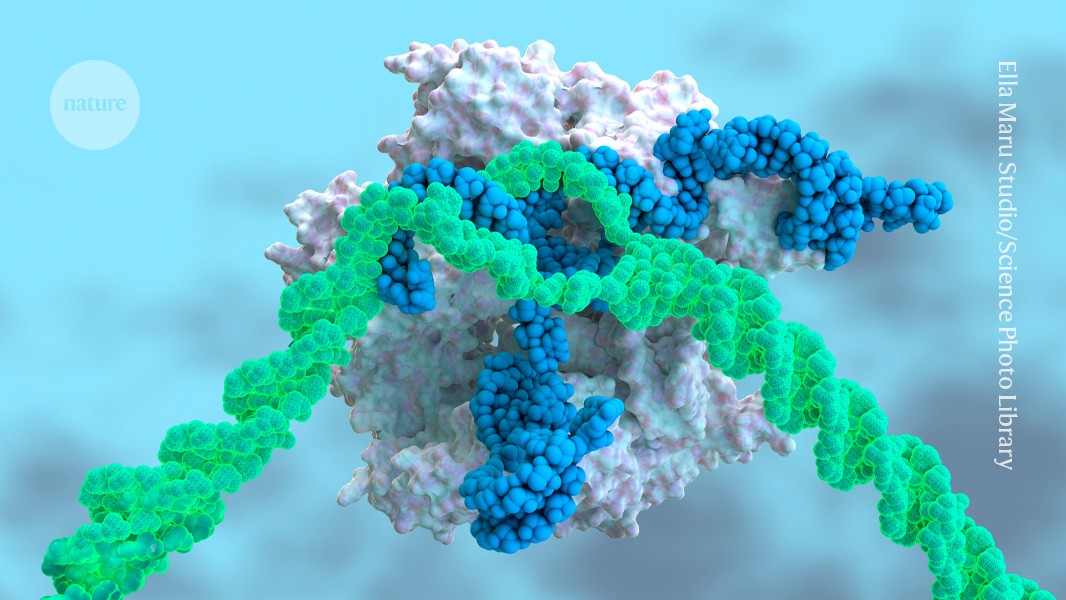
To address this bottleneck, researchers have combined components of CRISPR gene-editing systems with other enzymes that can join large DNA segments to genomes. Genome engineers Omar Abudayeh and Jonathan Gootenberg at Harvard Medical School in Boston, Massachusetts, developed a method that uses enzymes capable of stringing together tens of thousands of DNA bases in a genome.1
The enzyme, called a large serine integrase, inserts DNA at a specific site without cutting both DNA strands. Abudayeh and Gootenberg use an integrase called Bxb1. Their method, known as PASTE, uses prime editing to introduce sites called landing pads, and then inserts DNA using the Cas9 protein bound to Bxb1.

Jonathan Gootenberg (left) and Omar Abudayeh are researching genome-editing methods.
Credit: Caitlin Cunningham Photography
Researchers at TOM Biosciences, a now-closed company in Watertown, Massachusetts, co-founded by Abudayeh and Gootenberg, used a variation of PASTE in cynomolgus monkeys (Macaca fascicularis) to replace a gene involved in the human blood disorder haemophilia B.2 After one treatment, about half of the animals’ liver cells contained the corrected version of the gene.
However, PASTE requires several components: a modified Cas9 enzyme that cuts or nicks one DNA strand at a target site, a landing-pad sequence, reverse transcriptase to copy the landing pad into the genome, an integrase, guide RNA and donor DNA.
To deliver these components in the monkey experiments, the researchers used two delivery methods. A lipid nanoparticle carried messenger RNA encoding an enzyme and a guide RNA. An adeno-associated virus, or AAV, carried the donor DNA and landing-pad sequence.
“These complexities add up,” says Abudayeh. “We got 50% in the liver, but it will be very difficult to target other organs.”
CRISPR-associated transposases target specific genomic sites
Other large-scale gene-editing methods are even more complex. Mobile DNA elements called transposons can insert themselves into DNA with the help of enzymes known as transposases. In many cases, this insertion appears to occur randomly.
CRISPR-associated transposases, or CASTs, can target specific sites in the genome when supplied with a guide RNA and donor DNA containing transposon sequences at each end.
Sam Sternberg, a biochemist at Columbia University in New York City, and chemical biologist David Liu at the Broad Institute of Massachusetts Institute of Technology and Harvard University in Cambridge, Massachusetts, have optimized one CAST system for use in human cells.
The system, called evoCAST, can insert up to 15,000 DNA bases into human cells, including several therapeutically relevant sites within the genome.3
Some evoCAST designs contain six or seven proteins, however, which is extremely difficult to achieve with current delivery methods. “One of the big focuses is to streamline the number of components into as few molecules as possible and work on different ways to deliver them,” says Sternberg.
Alternative approaches to large DNA insertion
By contrast, Miller is using a technology based on genetic modification that can rewrite bacterial genomes. Her system requires about 1,500 base pairs, not including donor DNA, and can be packaged into a single AAV genome depending on the size of the donor DNA.4 Miller and her colleagues are working to improve the system’s efficiency in human cells.
Another class of mobile genetic element, called an R2 retrotransposon, can be delivered entirely as RNA molecules packaged inside lipid nanoparticles. These elements can carry much larger cargo than AAV.
However, targeting retrotransposons to different genomic regions requires researchers to redesign the retrotransposon’s DNA-binding domain. This is considerably more difficult than changing a guide RNA. As a result, researchers typically insert donor DNA into predetermined “safe-zone” regions of the genome, where it is less likely to cause harm.
For now, no single large-scale gene-editing technology is suitable for every application. Researchers are continuing to balance DNA cargo size, targeting precision, delivery, efficiency and the type of cell being modified.
Source: www.nature.com