


NASA’s Curiosity Rover Investigates Strange Disk-Shaped Rocks Before Mars Drilling Campaign
Written by Lucy Lim, planetary scientist at NASA Goddard Space Flight Center
Earth Plan Date: Friday, September 18, 2026
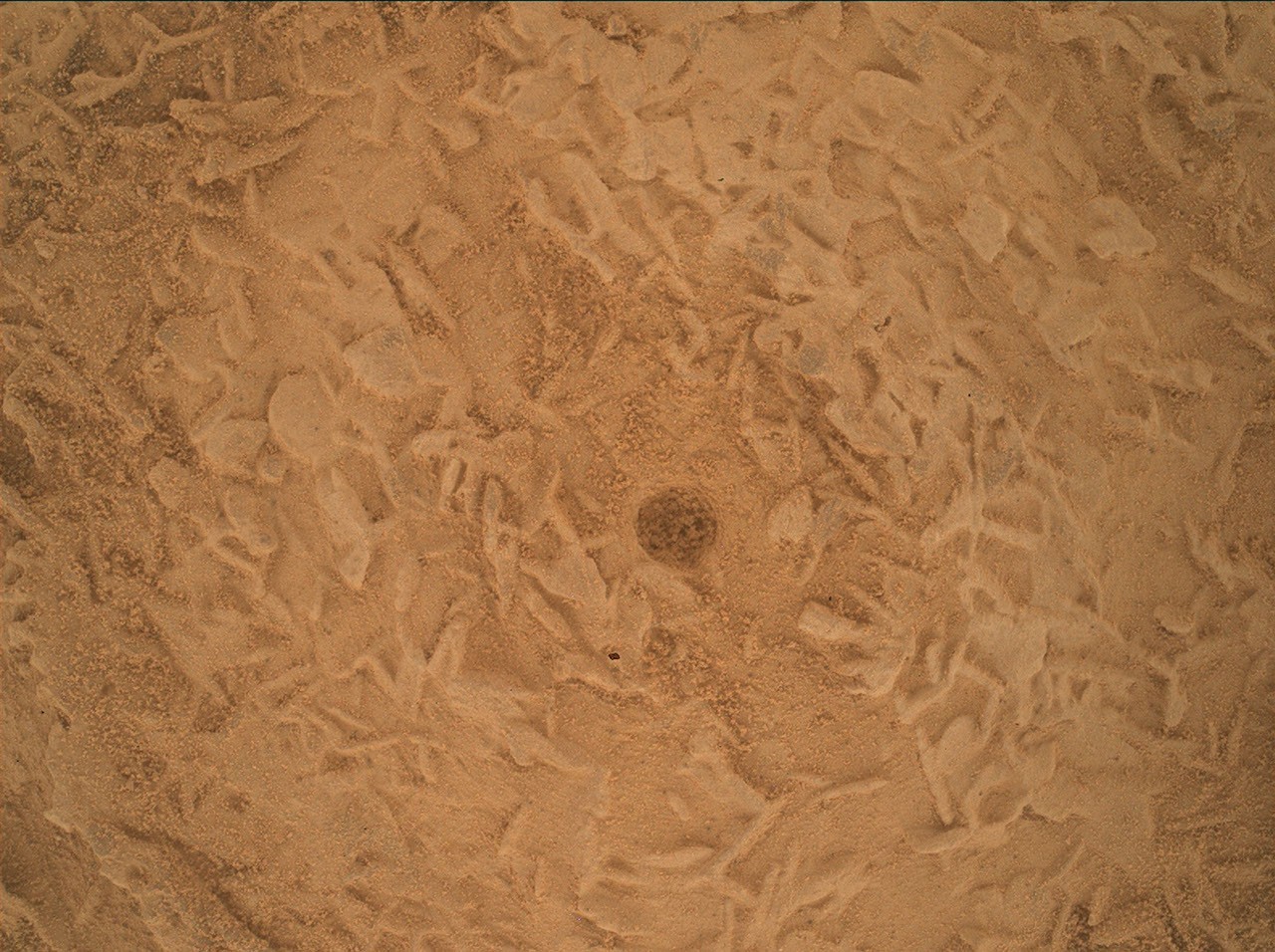
Curiosity discovers unusual disk-shaped rock features
At the beginning of the week, NASA’s Curiosity rover encountered a striking change in the texture of the Martian rocks. Instead of the finely layered rock blocks observed during recent sulfate unit workshops, the rover found blocks covered—or perhaps filled—with a jumble of small, disk-shaped masses.
Similar features have appeared earlier in the mission and are also found in terrestrial rocks, including near Pahrump Hills in the Murray Mudstone. They are especially common in environments where minerals are precipitated from evaporating liquids.
The disk-like shapes may have formed through the growth habits of crystalline minerals known to develop similar structures. Another possibility is that they are fragments of harder rock formations that broke apart and accumulated in the area.
To investigate the features, the team planned Mastcam and MAHLI imaging to capture details of the jumbled disk-covered blocks at “Yungei” and “Chiu Chiu.” ChemCam LIBS observations were planned at “Puya Raimondi,” “Liolemus tacnae” and “Pisque Valkatana,” while the Alpha Particle X-ray Spectrometer (APXS) was assigned to “Bacas Salt Lake” to study composition.
Long-range imaging maps the geology of Valle Grande
Curiosity’s ongoing long-range imaging project used the ChemCam Long Range Remote Imager (RMI) and Mastcam to create a mosaic of the buttes on either side of Valle Grande.
Cross-section images of geological formations above the rover will help scientists map the sedimentary structure of future units and better understand how these rocks formed and eroded. Observations of more recent erosional deposits may also reveal how Valle Grande itself developed.
Curiosity prepares for its next Mars drill site
To identify minerals, Curiosity needs data from its CheMin X-ray diffractometer, which requires a drilling campaign. Although the rover traveled more than a kilometer from its previous drilling site at Campo Marte, this will be the first time it has drilled on an eroded surface.
Wednesday’s drive brought Curiosity next to a promising drill field, a short distance beyond the area where the disk-like feature was observed and imaged by Mastcam as “Torres del Paine.”
Friday’s plan included site characterization using instruments on Curiosity’s robotic arm at “Alberta Wild Rose” and “Moonraker Mountain,” ChemCam LIBS observations at “Osoyoos,” and Mastcam imaging at “Trincomali Channel” and “Yellow women’s shoes.”
The team also selected a specific drill target and planned a very short drive to place it within reach of the rover’s arm. The sequence will begin with contact science, followed—if everything goes well—by preload testing and drilling.
Looking ahead to Drill Sol 1
On Monday, I will return to the drawing board as Geology and Mineral Science Theme Leader for Drill Sol 1, focused on triage contact science. We will see where the investigation leads from there.
Source: science.nasa.gov