


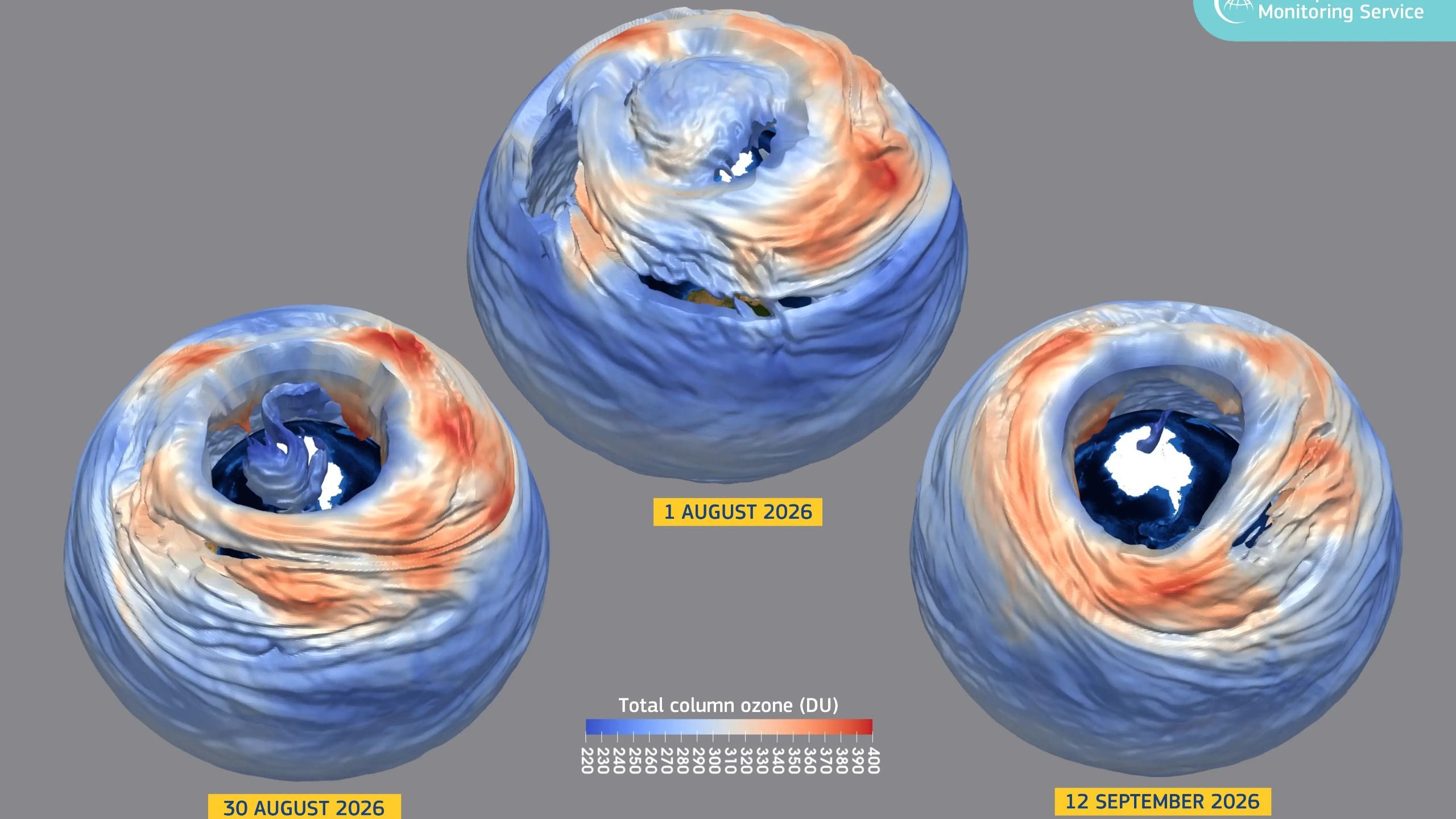
Antarctic Ozone Hole Reaches Its Second-Largest Size on Record for This Period
The Antarctic ozone hole reached 10.6 million square miles (27.4 million square kilometers) on September 20, 2026, making it the second largest observed during this period.
The last time the ozone hole reached a similar size was in October 2015, when it covered 10.8 million square miles (27.9 million square kilometers), according to Copernicus Atmospheric Monitoring Service records.
So why has the ozone hole—the region of depleted ozone that helps shield life on Earth from harmful ultraviolet solar radiation—grown so large this year, even as other indicators suggest the ozone layer is continuing its long-term recovery from damage caused by man-made chemicals?
Why the Antarctic ozone hole grew so large in 2026
There is no immediate reason to worry about the ozone hole this year, Hannah Kessenich, a postdoctoral researcher at New Zealand’s University of Otago, told Live Science by email. Kessenich used satellite data and computer models to assess the ozone hole’s size in 2026.
“But there are still many unanswered questions,” Kessenich said. “That’s something we need to keep a close eye on.”
The ozone hole has since shrunk to about 9.3 million square miles (24 million square kilometers), according to the latest figures from the Copernicus Atmospheric Monitoring Service. It is unlikely to break the 2015 record, but scientists expect it to remain large and fluctuate during the coming weeks.
The 2026 Antarctic ozone hole peaked on September 20 and has been shrinking since then.
Image credit: Copernicus Atmospheric Monitoring Service
When does the Antarctic ozone hole form?
The Antarctic ozone hole expands every year from winter into spring in the Southern Hemisphere. It typically reaches its maximum size between mid-September and early October, when temperatures in the stratosphere remain below freezing and sunlight returns to the continent after months of darkness.
The ozone hole then shrinks until late January, as ozone-rich air from surrounding regions mixes into the depleted area.
How CFCs damaged the ozone layer
The Antarctic ozone hole was caused by emissions of ozone-depleting chlorofluorocarbons, or CFCs, from the 1930s through the late 1980s. These chemicals increased chlorine concentrations in the stratosphere, triggering chemical reactions that destroy ozone.
Countries signed the Montreal Protocol to phase out CFCs beginning in 1989. However, scientists estimate that the ozone layer could take about 60 years to recover because many major CFCs remain in the atmosphere for 50 to 100 years.
The ozone layer is particularly vulnerable above Antarctica because of the extremely cold conditions in the polar stratosphere. Temperatures below minus 108 degrees Fahrenheit (minus 78 degrees Celsius) can produce high-altitude clouds. In the presence of sunlight, the icy surfaces of these clouds convert relatively inactive chlorine into forms that rapidly destroy ozone.
These conditions are less common in the Arctic. Warm air from the mid-latitudes mixes more easily with cold Arctic air than with air over Antarctica, limiting the formation of the high-altitude clouds that accelerate ozone loss.
A strong polar vortex drove rapid ozone loss
The unusually large ozone hole in 2026 was primarily linked to an extremely strong polar vortex surrounding Antarctica and the Southern Ocean during winter. The vortex trapped cold air above the continent, producing colder-than-usual conditions in the Antarctic stratosphere and accelerating ozone depletion.
Researchers did not detect an increase in reactive chlorine. Instead, the unusually cold polar vortex appears to have caused more ozone depletion than usual.
Susan Solomon, a professor of chemistry and environmental studies at MIT who pioneered research into the Antarctic ozone hole in the 1980s, said that a single year does not show whether the ozone layer is recovering or deteriorating.
“The hole size is expected to rise and fall from year to year. A hole large or small over a year or several years tells us nothing about ozone loss or recovery; it’s just fluctuations. We need to look at long-term trends, and these indicators continue to tell us that the ozone hole is slowly recovering as expected.”
Susan Solomon, MIT professor of chemistry and environmental studies
A large ozone hole does not necessarily mean a thinner ozone layer
One reassuring sign is that, although the 2026 ozone hole is large in area, it is not as “thin” as it has been in recent years.
Scientists calculate the ozone hole’s extent by measuring the area over Antarctica where ozone concentrations fall below 220 Dobson units. A Dobson unit measures the amount of ozone in a vertical column of Earth’s atmosphere.
Ozone concentrations have not fallen as sharply this year as they did last year. Kessenich and her colleagues said this suggests that less ozone has been lost from the hole than during some previous years when a large ozone hole occurred. They described their findings in The Conversation.
Could large ozone holes become more persistent?
Although natural fluctuations in atmospheric dynamics most likely explain the ozone hole’s size this year, researchers are investigating whether a longer-term shift could make large ozone holes persist later into spring.
Changes in global atmospheric circulation unrelated to CFCs may be increasing the likelihood of long-lived ozone holes. Kessenich and her colleagues have suggested that climate change could eventually strengthen the Antarctic polar vortex, lower stratospheric temperatures and increase ozone loss during spring.
If the polar vortex remains strong, the ozone hole could stay large into November. However, it is too early to determine the cause of the recent atmospheric changes, and further research is needed.
Help us improve Live Science Pro: We are always striving to improve our content. Leave your feedback about Pro here.
Source: www.livescience.com