


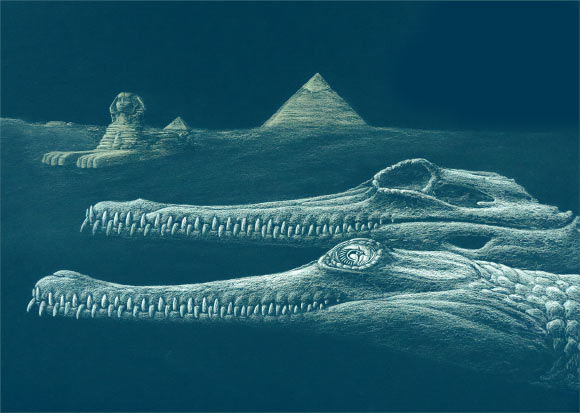
Egyptian Fossil Once Classified as a Giant Gharial Reveals a New Gavial Lineage
Micro-CT scans have shown that a fossil crocodile discovered near Cairo was not a close relative of the giant gharial, as paleontologists had long believed. Instead, the Middle Eocene fossil represents an early-diverging member of the gavial lineage.
Gavialoid crocodiles include the living Indian gharial and the false gharial. The modern giant gharial, Tomistoma schlegelii, is restricted to freshwater habitats in Southeast Asia and is classified as endangered on the IUCN Red List, according to Professor Philip Mannion of University College London and his colleagues.
Many Cenozoic fossil crocodiles have historically been assigned to Tomistoma. Their fossil record indicates that gavialoids were once more diverse and had a much wider geographic distribution, extending across Africa and Europe.
The Egyptian species Tomistoma kairense, from the Middle Eocene, was considered one of the oldest taxa assigned to the genus. It was first described in 1927 and is known from several specimens, including a relatively complete holotype skull housed at the State Museum of Natural History in Stuttgart, Germany, under the designation SMNS 10575.
Micro-CT scans reveal the fossil’s internal anatomy
The researchers used micro-CT scanning to examine the inside of the SMNS 10575 skull and reconstruct its internal anatomy without damaging the fossil. They then compared the specimen with other gavialoids, including the false gharial and Indian gharial.
The team also conducted an evolutionary analysis involving 152 species and 331 anatomical traits. The results placed the Egyptian fossil among the gavialoids, but not close to modern false gharials.
Now named Helgaavialis chirensis, the animal was an early-diverging member of the gavial lineage. It falls outside the group containing living Indian gharials and their closest relatives.
The crocodile had an elongated snout that made up approximately 64% of the skull’s total length. Its eye sockets also had raised edges, among the anatomical features that helped distinguish it from other gavialoids.
Ancient gavialoids once lived around the Mediterranean
The researchers also examined the broader history of gavialoids in the Mediterranean region. At least six species lived there during the Paleogene, and at least six were present during the Miocene. However, no gavialoids are currently known from the intervening Oligocene.
Like other crocodiles in the region, Mediterranean gavialoids appear to have declined during the Late Miocene and disappeared before the Pliocene. Their extinction was likely linked to the Messinian salinity crisis, when the Mediterranean largely dried out approximately 6 million years ago.
“For most of the past 50 million years, the Mediterranean region has been home to a wide variety of crocodile species, including gharials,” said Dr. Paul Burke of University College London.
“However, this diversity fluctuated over time, appearing to respond to changes in global temperature and sea level, until all crocodiles in this region were lost as a result of the drying of the Mediterranean about 6 million years ago.”
The team’s study was published in Royal Society Open Science.
_____
Paul M. J. Burke et al. 2026. Cranial anatomy of a mid-Eocene Egyptian crocodile, Helgaavialis chirensis: New insights into gavialoid diversity in the Mediterranean region. Royal Society Open Science 13 (10): 261173. doi: 10.1098/rsos.261173.
Source: www.sci.news