


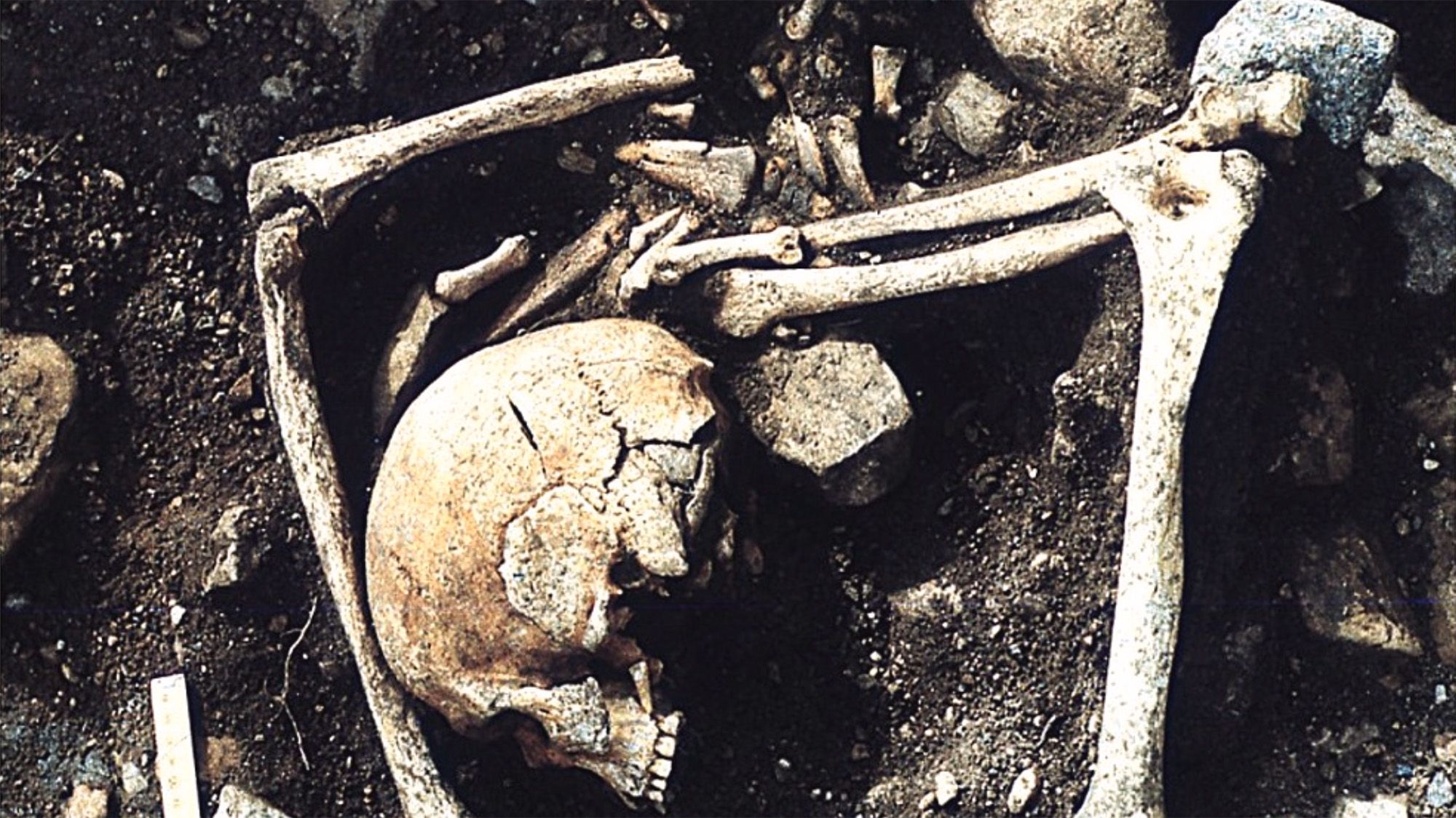
Six People Buried Together in Latvia May Have Been Victims of a Viking Age Raid
DNA evidence, violent injuries and a carefully arranged burial suggest that six people died in the same event more than 1,000 years ago.
Six people buried in a single grave in Latvia more than 1,000 years ago may have been killed during a violent Viking Age raid, according to a new archaeological study.
Genetic analysis revealed relationships among some of the individuals. One boy was the son of one of the men, while another man was a third-degree relative, possibly a cousin or great-uncle. The remains also included a girl and two other men.
Violent injuries point to a deadly conflict
The father, his relative and another man died from injuries caused by a “sharp impact,” probably from an ax or sword, researchers reported in the Journal of Archaeological Science: Reports.
Bone marks indicate that one man suffered defensive cuts to his forearm and hand. Another died from a blow that shattered his jaw, while a third was nearly decapitated. Researchers said the fourth man and the two children may have died from soft-tissue injuries that left no visible marks on their bones.
The findings do not prove that the victims were killed by Vikings. They may instead have died during fighting with neighboring communities or in violence within their own community. However, the timing and the nature of the injuries make a Viking attack one possible explanation.
“We will never know whether they were killed in the attack, but the date of the graves and the fatal injuries sustained by the three make it a possibility,” study co-author Elina Peterson-Gordina, an archaeologist at the University of Latvia, said.
A rare multiple burial from Iron Age Latvia
Radiocarbon dating indicates that the grave dates to the late ninth century, an early period of the Viking Age. It is located in the Čunkani-Dreņģeri cemetery near the Gulf of Riga, a protected bay on the Baltic Sea.
The cemetery was discovered in 1924 and contains hundreds of burials. People were buried on riverside terraces there during Latvia’s Iron Age, which lasted from approximately the seventh to the 11th century.
Most graves in the cemetery contain the remains of a single person. The discovery of six people in one grave is therefore unusual, especially because at least three appear to have died violently.
Careful burial suggests the victims were respected
Despite their apparent violent deaths, the individuals were buried carefully and accompanied by traditional grave goods. The only woman was placed with her head facing northwest, while the men were arranged beside her with their heads facing southeast. This orientation was also observed in other local burials from the same period.
Researchers emphasized that the grave should not be described as a mass grave. The bodies were not hastily discarded. Instead, the arrangement represents a “multiple burial,” in which each person was deliberately placed in the grave according to local customs.
The orderly burial suggests that the dead may have belonged to a respected group. Their placement in one grave also indicates that they probably died during the same event, the researchers said.
DNA links some of the dead to one family
Genetic analysis found that all of the individuals had Indigenous ancestry from the Baltic states. The burial customs and other archaeological evidence also matched remains found elsewhere in the Čunkani-Dreņģeri cemetery.
The group appears to have been local rather than Scandinavian. In the ninth century, Latvia was not part of the Scandinavian Viking world. The region was inhabited by Indigenous Baltic peoples, including the Semigallians and Curonians.
The six individuals analyzed in the study were Semigallians, an Iron Age population that lived across the region’s fertile plains. DNA showed that the boy was the son of one of the men, and that another man was related to him at roughly the level of a cousin or great-uncle. The other two men were not genetically related to them.
This pattern suggests that the unrelated men may have belonged to the same community or extended household. They may have been killed in the same violent incident as the family members, even though they were not close relatives.
Were Vikings responsible?
Vikings or their predecessors were active in the eastern Baltic region around this time. Two Scandinavian ship burials discovered on Saaremaa Island in Estonia and dated to around A.D. 750 contained the remains of men who had suffered battle injuries. The Salme ship burials provide evidence of Scandinavian military activity in the region before the more familiar Viking raids of the late eighth and ninth centuries.
Given the date of the Latvian burial and the severe injuries found on several individuals, a Viking attack remains possible. But the evidence cannot distinguish a Scandinavian raid from a battle involving neighboring Baltic communities.
“These people may have died from violence within their own communities or from neighboring communities, but they also may have died from Viking attacks,” said Rimantas Jankauskas, an anthropologist and archaeologist at Vilnius University in Lithuania who was not involved in the study.
Jankauskas added that the research offers new insights into Semigallian society. The care and resources devoted to the burials may reflect an emerging social hierarchy or aristocratic structure.
The study, titled Multiple Viking Age burials in Semigalia, Latvia, was published in the Journal of Archaeological Science: Reports.
Source: www.livescience.com