


Consider a professional athlete; their success hinges on what occurs between competitions. This proactive approach fosters continuous improvement, adapting to challenges from new opponents, and refining skills based on insights gained from previous matches.
Similarly, Agent AI operates on dynamic principles. Instead of merely providing answers, the model is given specific goals and must adapt as conditions evolve, edge cases emerge, and tools change. Unlike standard generative models that simply respond to prompts, agent models must evaluate, plan, and utilize various tools, overcoming obstacles in real-time.
Consequently, the post-training phase—refining the model after its initial training—is no longer just a final step. This process has become a continuous cycle, as the environment in which agent models function evolves rapidly. Tools may vary weekly, and unforeseen edge cases may arise in production environments, necessitating adaptations each time new code, policies, or environments are deployed.
Each time an issue is faced, post-training runs are initiated from production environments, escalating the computational demands. The need for ongoing execution creates a continuous cycle; agentic AI introduces innovative post-training compute patterns, establishing it as a crucial workload driver in the era of AI.
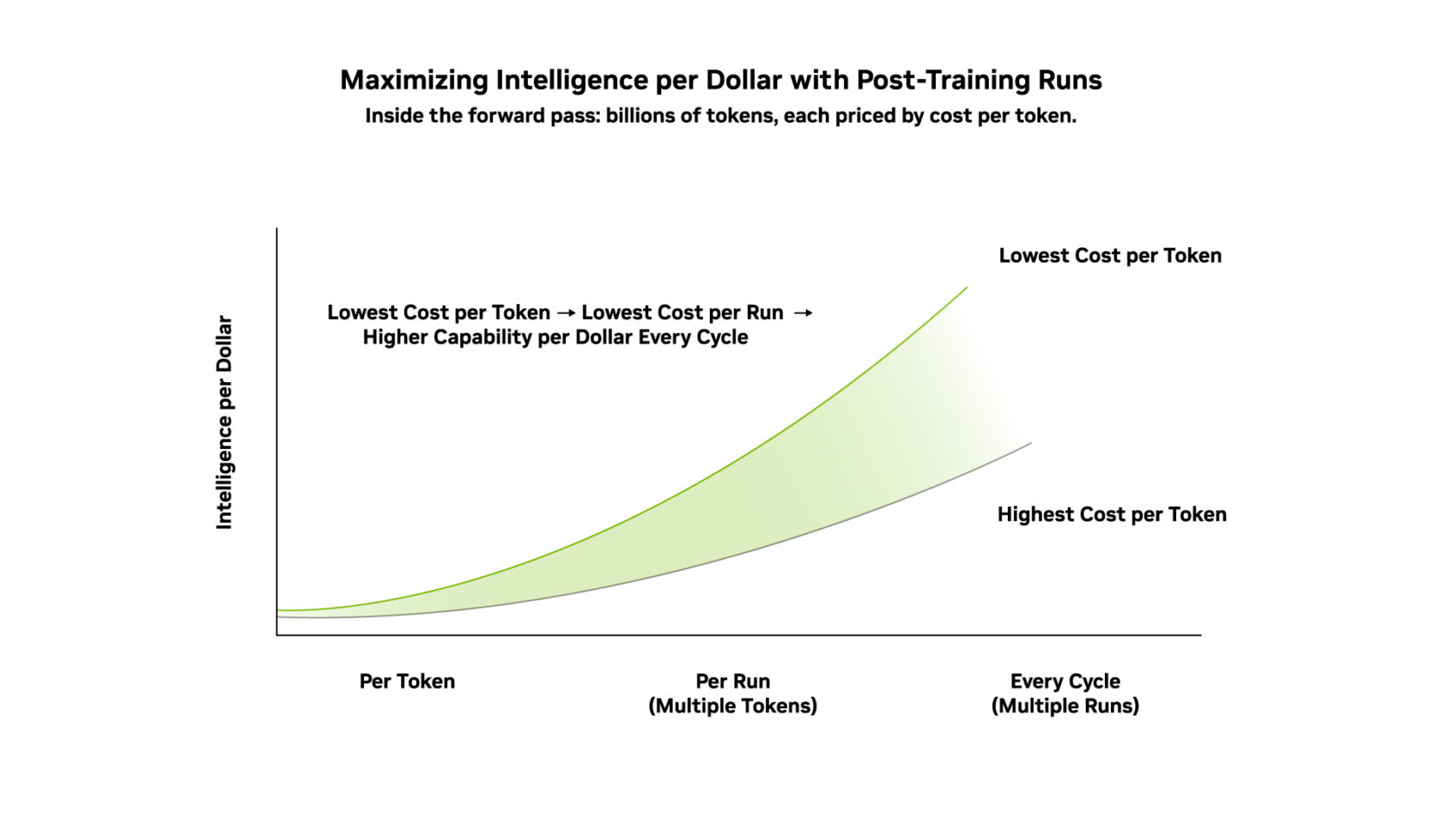
The objective of post-training is to maximize intelligence per dollar by optimizing the yield of all forward and backward passes in the continuous learning cycle. The forward pass—also known as inference—is measured in cost per token, meaning improvements in this area directly enhance intelligence per dollar.
Unraveling the Mystery After Agent Training
Intelligence builds after training. During the pre-training phase, the model learns to predict the next token, achieving fluency but lacking true intelligence. Post-training focuses on developing skills like coding, planning multi-step tasks, using search tools, and recovering from errors. In this phase, inference occurs on jobs, with costs calculated per token.
Without answers to memorize—only rewards—the model engages in the reinforcement learning (RL) technique. Given a task, it performs a forward pass similar to job execution, with feedback from trials refining model weights (backward pass). Through millions of trials, intelligence flourishes.
Each step involves intensive computations; scaling this continuous loop presents an orchestration challenge. Thousands of environments run simultaneous rollouts, validating rewards and updating weights to feed into acceleration-maximized training. Tools like NVIDIA NeMo Gym and Nemo RL transform post-training from tailored research efforts into a scalable infrastructure.
Understanding How Intelligence Per Dollar Enhances Cost Per Token
If inference serves as the revenue source, then post-training acts as a multiplier. A more capable model means every token delivered becomes more valuable.

The cost per token is a vital metric for inference factories, quantifying the total cost of delivering a million tokens. In contrast, intelligence per dollar delves deeper, assessing the cost of building a valuable model and maintaining that value in an evolving environment.
These metrics are inherently linked; AI infrastructure that decreases the cost per token simultaneously reduces the costs associated with each point of intelligence within the model. Elevated intelligence enhances the value of every token produced by inference factories.
In essence, while cost per token reflects operational yield, intelligence per dollar gauges the return on investment in model intelligence.
Maximizing Intelligence per Dollar: NVIDIA Nemotron 3 Ultra After Training
NVIDIA Nemotron 3 Ultra — This open-weight, 550 billion parameter Mixture of Experts (MoE) model delivers verifiable benchmarks and fully defined post-training protocols compatible with NeMo RL. It achieved a score of 71.7% on standard coding benchmarks validated by SWE Bench. Notably, we developed valid fixes for 7 out of 10 real-world software bugs within open-source projects, with each fix validated against the project’s tests.
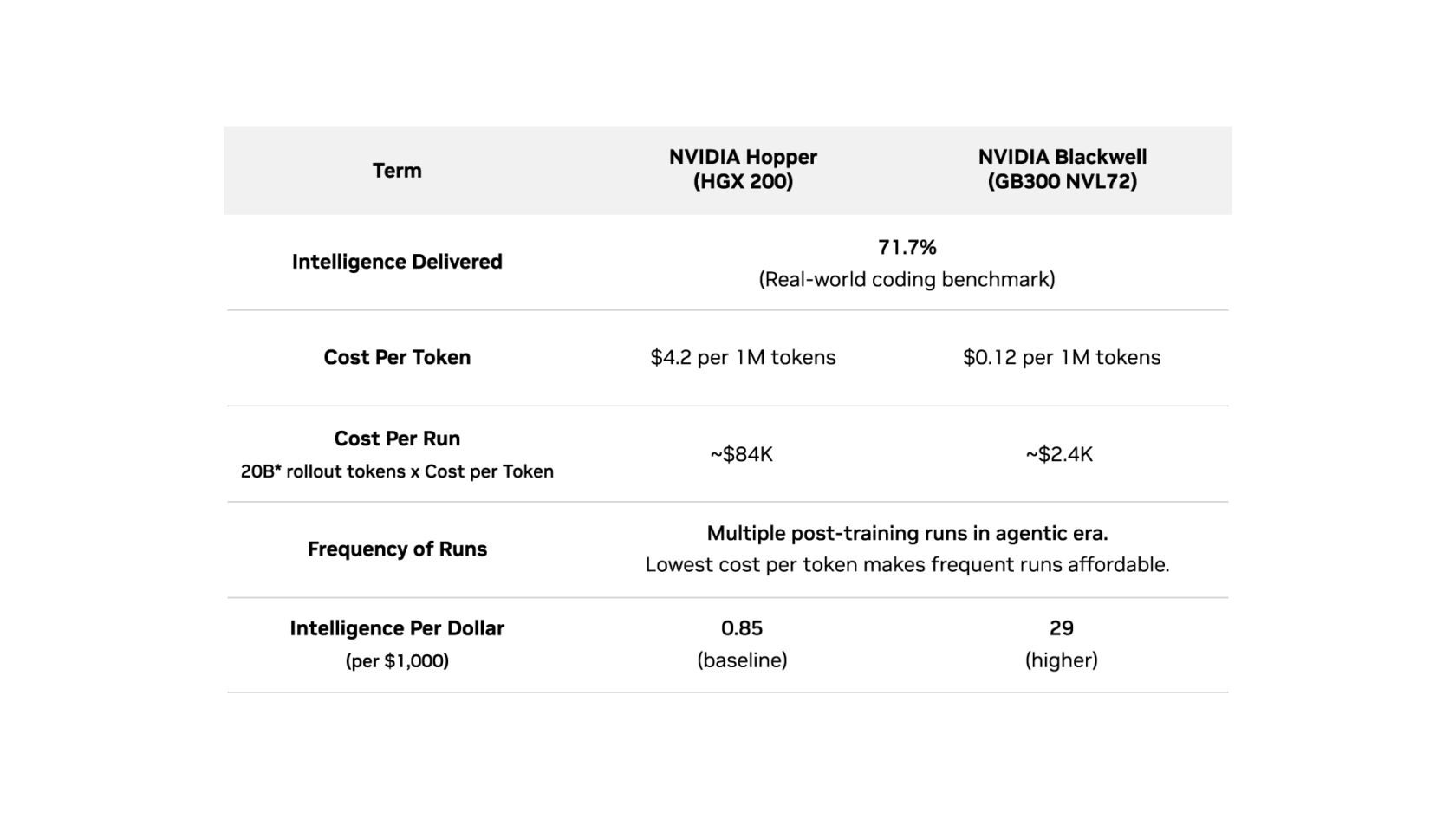
The NVIDIA Blackwell platform effectively reduces execution costs, rendering frequent post-training economically viable within the agent era, maximizing intelligence across all token transactions.
Moreover, the NVIDIA Vera Rubin platform further enhances this trajectory, enabling the training of the largest models on a fraction of the Blackwell generation GPUs. This platform is engineered to maximize intelligence per dollar for agent post-training loads, facilitating increased rollouts and environments during active iterations within a continuous post-training cycle.
The Actual Post-Training Workflow
Prime Intellect’s Laboratory actively post-trains frontier open models using NVIDIA Blackwell, leveraging NVIDIA Dynamo for orchestration of inference. With Vera Rubin, Prime Intellect plans to expand its reinforcement learning environment, enhancing the number of rollouts per run and expediting iterative loops between training and inference for superior intelligence per dollar delivery to enterprises.
Prime Intellect enhances its sandbox infrastructure to utilize the NVIDIA Vera CPU, known for low latency and energy efficiency, integrating open-source tools and models like NVIDIA Nemotron and NVIDIA NeMo Gym into the software stack. A comparison of realistic RL sandbox workloads against alternative x86 architectures reveals that Vera achieves an average throughput increase of 30% per CPU.
Perplexity employs an RDMA-based weight transfer engine within the RL post-training stack, facilitating asynchronous operations across hundreds of NVIDIA GPUs and enabling synchronization of trillion-parameter models between training and inference compute nodes within two seconds. The trained Qwen3 235B model is executed on an NVIDIA GB200 NVL72 system.
Together, AI delivers a post-training service that includes supervised fine-tuning, reinforcement learning, and direct optimization. This comprehensive service is accessible via a feature-rich API and SDK that supports various post-training tasks on the AI Native Cloud platform, all powered by NVIDIA’s infrastructure and optimized kernel libraries, with prospects for leveraging the Vera Rubin platform in future initiatives.
Click here for more details: NVIDIA Vera Rubin, a platform designed for AI factories that maximizes intelligence per dollar across diverse workloads. Explore NVIDIA’s complete stack platform for frontier model training.
Source: blogs.nvidia.com