


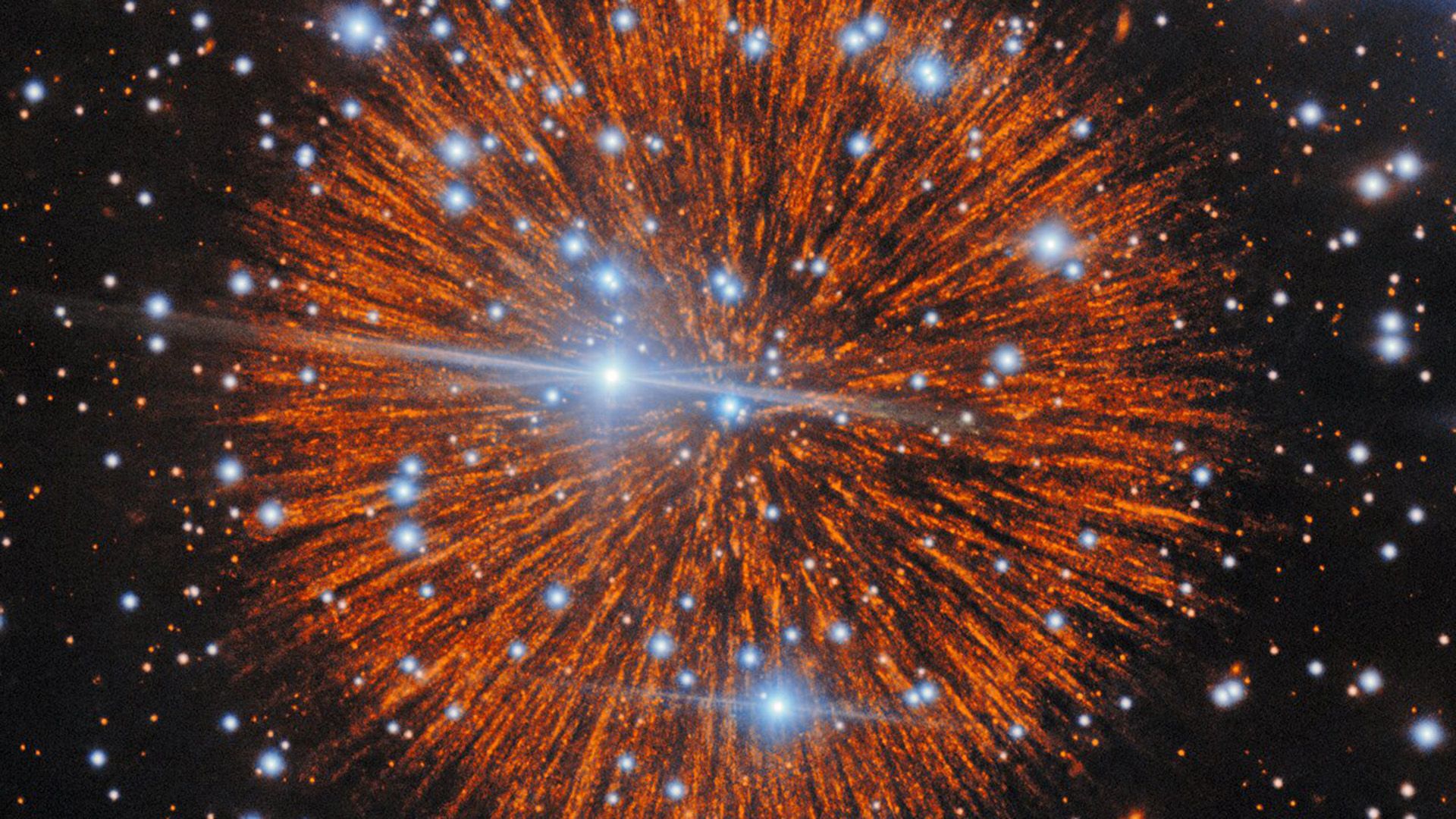
Medieval “Guest Star” Reveals New Secrets in Clearest Image Yet of Supernova Remnant Pa 30
Simple facts
What is it: Pa 30, a supernova remnant
Where is it: Cassiopeia, about 7,500 light-years away
When shared: October 6, 2026
A mysterious “guest star” recorded by medieval astronomers about 850 years ago has revealed new secrets after scientists obtained the clearest image yet of the aftermath of its explosion.
New observations of Pa 30, thought to be the remnant of the historic supernova SN 1181, show that its spectacular, firework-like filaments are not smooth streams of material. Instead, they are made up of chains of small gas knots.
Medieval astronomers recorded SN 1181
Chinese and Japanese astronomers recorded SN 1181 as a naked-eye object in the constellation Cassiopeia between Aug. 4 and 6, 1181. The mysterious object remained visible for 185 days, according to eight surviving documents.
“It’s rare to have such detailed information about a supernova during a particular week in history,” Timothy Cunningham, associate professor of astronomy and astrophysics at the University of Warwick, said in a statement.
SN 1181 is one of only five supernovae observed from Earth in the Milky Way before the invention of the telescope. Telescopes first appeared in the Netherlands in 1608, according to the Library of Congress.
Gemini North reveals unexpected gas knots
Advanced ground-based telescopes can now produce remarkably detailed images of historic supernova remnants. The latest image of Pa 30, captured by the Gemini North telescope on Mauna Kea, Hawaii, reveals about 10 times more filamentary structures than previous observations.
The unexpected detail is giving astronomers new clues about the unusual explosion and the environment surrounding the star before it erupted.
“These images provide the clearest picture yet of the structure of Pa 30, but it’s not what we expected,” Cunningham said. His team presented the findings in The Astrophysical Journal.
“Filaments are made of chains of tiny knots rather than smooth streaks, placing new constraints on the nature of the space around the star before it explodes and on the physical processes that shaped the expanding ejecta,” Cunningham said.
The hump-like structure seen in Pa 30 may have formed because of changes in the temperature or density of the material surrounding the star as the explosion debris expanded.
A surviving “zombie star” at the center
Pa 30 has another unusual feature: a surviving star located almost exactly at the center of the debris. This is highly unusual because supernovae typically blast stars away from their original positions.
The star’s central position suggests that the initial explosion was highly symmetrical, the researchers said.
Pa 30 is also thought to be the remnant of a type Iax supernova. Unlike standard type Ia supernovae, which completely destroy their stars, type Iax supernovae are low-energy, incomplete explosions of white dwarf stars.
The surviving object has been described as a “zombie star.” Pa 30 is currently the only known example of a type Iax supernova.
Topics
Source: www.livescience.com