


NASA Glenn Aeroacoustic Research Facilities and Aircraft Noise Testing
Research teams at NASA Glenn Research Center conduct aircraft engine, propulsion, aerodynamics, and acoustic experiments in world-class facilities. These include the 9-by-15-Foot Low-Speed Wind Tunnel (9 x 15 LSWT), Aeroacoustic Propulsion Laboratory (AAPL), Small Hot Jet Acoustic Rig (SHJAR), Nozzle Acoustic Test Rig (NATR), DGEN Air Propulsion Research Turbofan (DART), and Acoustic Test Laboratory (ATL).
9-by-15-Foot Low-Speed Wind Tunnel
The 9-by-15-Foot Low-Speed Wind Tunnel provides a controlled environment for studying the aerodynamics and acoustics of aircraft engines during takeoff and landing. Research conducted in the tunnel helps engineers develop ways to reduce aircraft noise in communities near airports.
Extensive renovations completed in 2019 improved tunnel airflow and reduced background noise. A new five-sensor traverse microphone rake measures sound produced by scale experimental propulsors. To learn more about the 9 x 15 LSWT, visit the NASA Glenn facilities page.
Aeroacoustic Propulsion Laboratory
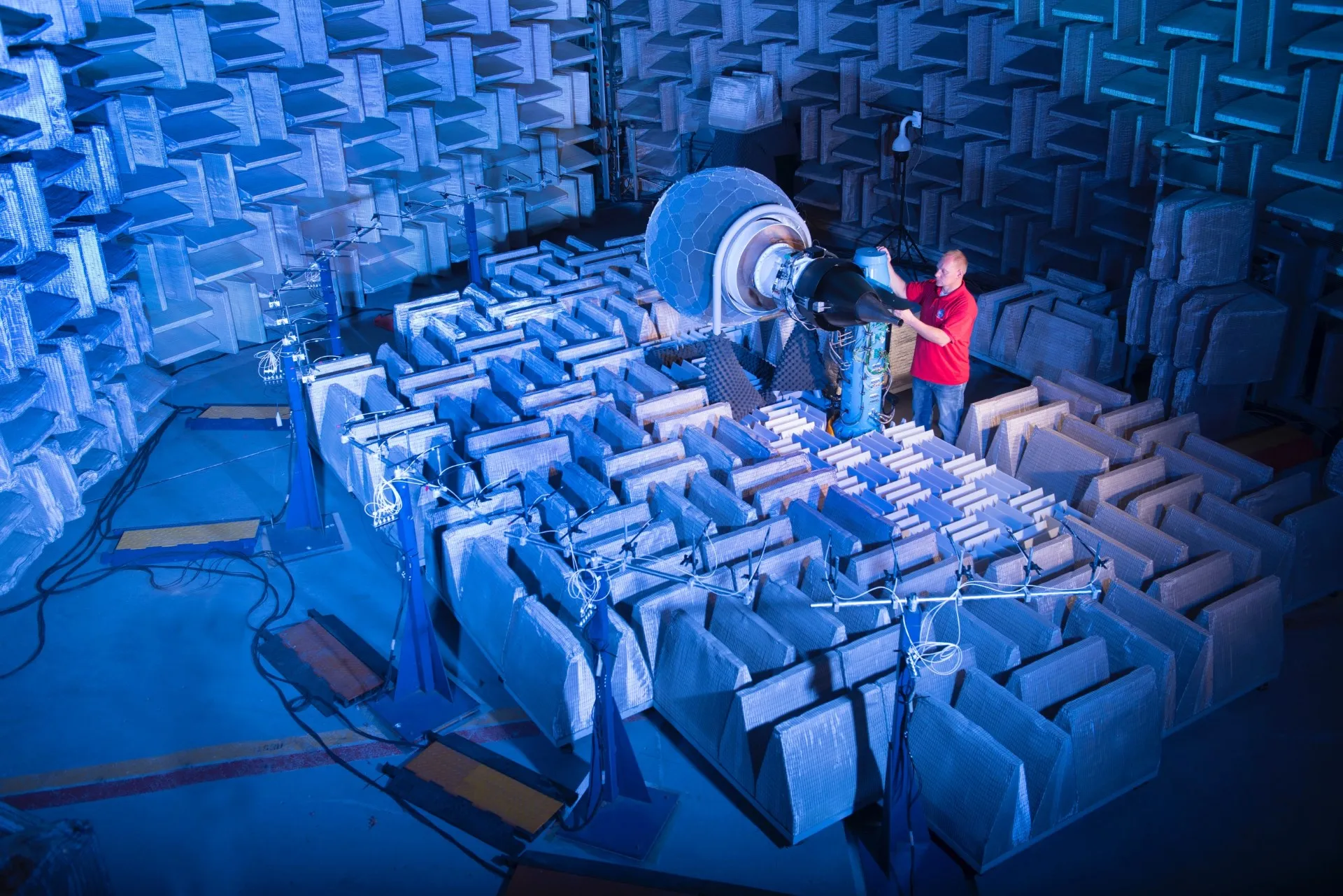
The Aeroacoustic Propulsion Laboratory (AAPL) is a dual-purpose, 65-foot-radius geodesic dome used for community-noise research and aeroacoustic testing of aircraft engines and engine components.
The test area can be configured as either a semi-anechoic chamber or a fully anechoic chamber. Approximately 17,000 custom-designed, 2-foot-thick fiberglass wedges cover the inner dome walls and surround the floor and test rig. These wedges absorb sound and prevent reflections, creating an environment without echoes during testing.
When AAPL was built in 1993, it was the first known freestanding geodesic dome designed to reduce sound transmission through its walls while incorporating sound-absorbing materials into the structure. The laboratory currently houses the Nozzle Acoustic Test Rig (NATR), Small Hot Jet Acoustic Rig (SHJAR), and DGEN 380 Aero Propulsion Research Turbofan (DART).
Small Hot Jet Acoustic Rig
The Small Hot Jet Acoustic Rig (SHJAR) is one of three rigs installed inside AAPL’s anechoic dome. It can test single-stream nozzles up to 5 centimeters in diameter at conditions reaching Mach 2.0 and 800 K.
SHJAR connects nozzle geometry, jet flow, and noise. Researchers can create unique nozzle designs at relatively low cost and measure their effects on airflow and sound with advanced instrumentation. NASA Glenn researchers have used the rig to develop flow-measurement techniques including Rayleigh scattering, Raman scattering, digital Schlieren, and real-time particle image velocimetry. A three-dimensional microphone array also maps noise sources.
These techniques can help researchers understand how nozzle-generated turbulence creates noise. Data from SHJAR is used to validate computer codes designed to calculate jet noise. Improved noise-prediction codes help engineers design quieter nozzles.
Among SHJAR’s research milestones, NASA researchers performed time-resolved measurements of turbulent temperature using Raman-based optical techniques. These high-frequency measurements of thermodynamic temperature fluctuations support turbulence models used for heat transfer and jet noise.
In 2006, researchers used time-resolved particle image velocimetry to measure the spatiotemporal correlation of hot-jet turbulent velocities. This measurement is important for understanding the flow statistics associated with noise generation. Time-resolved velocity measurements also mapped the convective velocity of turbulent flow, another metric required by jet-noise theory that had not previously been available for hot jets.
SHJAR also supports research into how jet noise changes when a nozzle is installed on an aircraft. Testing identified jet-surface interaction, in which the jet plume interacts with an aircraft’s wings, flaps, and tail, as a fundamentally different noise-generation mechanism.
Many of the measurement techniques and practical noise insights first developed at SHJAR were later implemented in the High-Fidelity Nozzle Acoustic Tester (NATR) housed in AAPL. To learn more about SHJAR, visit the NASA Glenn facilities page.
Nozzle Acoustic Test Rig
The Nozzle Acoustic Test Rig (NATR) is a free-jet wind tunnel used to evaluate jet-noise reduction concepts. The most promising concepts can then be selected for full-scale engine testing.
NATR tests scale models of military and commercial aircraft engine nozzles and can simulate takeoff and landing conditions up to Mach 0.35. Its jet-engine simulator provides up to three air streams at different pressures and temperatures to replicate turbofan engine flow and evaluate advanced nozzle designs.
Overhead, arc-shaped microphones measure far-field noise at all angles. These measurements can be accurately translated into the sound produced by an aircraft flying overhead. NATR allows engineers to evaluate numerous nozzle noise-reduction concepts with less time and cost than full-scale engine testing.
During its 30-year history, NATR has supported important advances in jet-noise research. The facility was originally built for jet-noise testing under the Commercial Supersonic Aircraft High Speed Research Program and has hosted NASA and industry-led test programs.
Chevron nozzles used on modern aircraft were first discovered during a NASA-led 1997 test campaign at the facility. Industry researchers have also used NATR to develop noise-prediction methods for short-term designs. NASA has investigated low-noise concepts for future engines, including engines with dual-fan systems. Recent tests measured the noise produced by supersonic airliners, helping reduce the risk that these aircraft could be unable to operate from existing airports. The tests also identified noise-reduction techniques that could help aircraft designers improve efficiency and environmental performance.
Testing a nozzle in flight is important because the relative velocity between the jet and surrounding air strongly affects the noise produced. This capability allows researchers to directly translate noise measurements into the sounds heard from actual aircraft flying overhead.
The large anechoic space surrounding NATR is also important for measuring the true acoustic far field of a jet nozzle. AAPL’s NATR is one of the few facilities in the world capable of making these measurements and the only facility that performs both flow diagnostics and acoustics on the same rig. This capability is critical for understanding the relationship between jet flow and noise.
View an image of the Nozzle Acoustic Test Rig.
To learn more about NATR, visit the NASA Glenn facilities page.
DGEN Air Propulsion Research Turbofan
The DGEN 380 is a key component of NASA Glenn’s DGEN Air Propulsion Research Turbofan (DART). DART provides a flexible experimental aeroacoustics and performance testbed for NASA technology development and interdisciplinary research into turbofan noise, engine control, installation effects, and measurement techniques.
Testing completed in August 2019 examined propulsion-noise sources and supported improvements to turbofan noise-prediction methods and noise-mitigation techniques. Researchers collected simultaneous acoustic measurements using a circumferential infinite-tube probe array at the core-nozzle exit, along with sideline and far-field microphone arrays.
The resulting dataset supports advanced source-separation and phased-array techniques. These methods help researchers study the structure of core noise and the propagation characteristics of other propulsion-noise sources. To learn more about DART, visit the NASA Glenn facilities page.
Acoustic Test Laboratory
NASA Glenn’s Acoustic Test Laboratory (ATL) supports human space exploration and aeronautical research missions. The versatile test chamber can be configured as either an anechoic or semi-anechoic chamber.
Dense rubber material on the ATL’s walls and ceiling absorbs or reflects sound from outside the facility. Thirty-four-inch-deep fiberglass wedges along the walls and floor absorb 99 percent of incident sound above 100 Hz, helping create a controlled environment for acoustic measurements. A separate control room houses noisy equipment and personnel needed to conduct testing.
ATL has been used to measure noise emissions from experiments on the International Space Station, study noise sources and levels from electric motors, calibrate microphones, measure the performance of acoustic liners on aircraft engine models, and evaluate on-wing engine placement for reducing takeoff and landing noise.
Recent ATL testing has also included scale models of supersonic aircraft engine intakes and spacecraft cabin ventilation fans.
To obtain NASA technical reports related to Acoustic Test Laboratory research, visit the NASA Technical Reports Server (NTRS).
Learn More About NASA Glenn Research
For more information about NASA Glenn research, software, and data, contact NASA using the appropriate facility or research information link.
Source: www.nasa.gov