


What Is Phobos Made Of? Stickney Crater May Reveal the Origin of Mars’ Mysterious Moon
Phobos, the innermost and larger of Mars’ two moons, has puzzled planetary scientists for decades. The central mystery is its origin: Was Phobos an asteroid captured by Mars, or did it form from debris blasted into orbit after a giant impact on Mars?
Solving that mystery may depend on something scientists still know surprisingly little about: Phobos’ interior structure.
Researchers are narrowing down the possibilities by studying subtle features such as the moon’s gravity, density and motion. At the European Geosciences Union General Assembly in Vienna, scientists presented models of geophysical measurements around Phobos’ most dramatic feature, Stickney Crater.
Stickney Crater Could Hold Clues to Phobos’ Origin
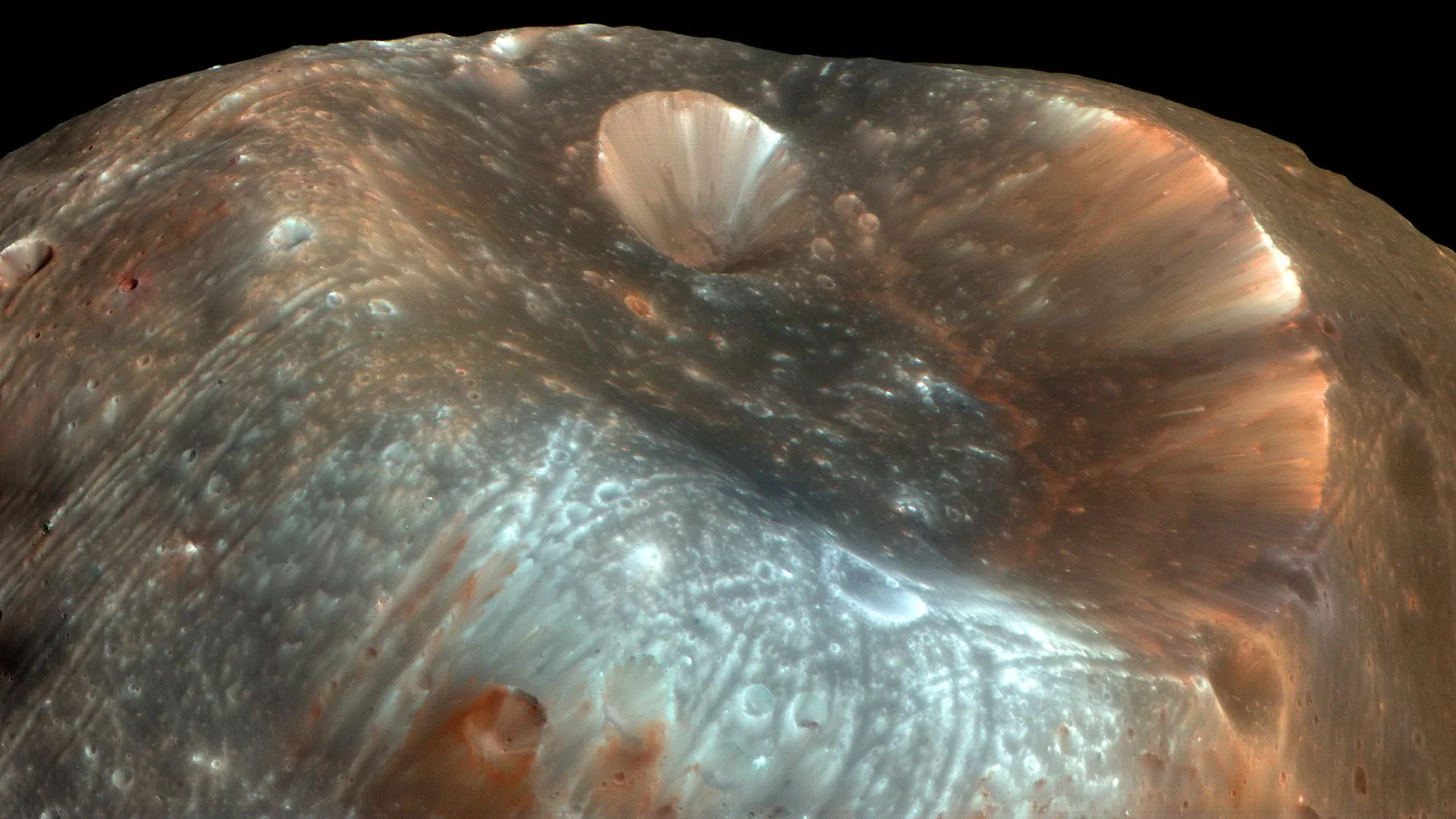
Stickney Crater is at the center of the debate over Phobos’ history. The enormous crater measures about 9 kilometers (5.6 miles) across. If Phobos formed from debris produced by a giant impact on Mars, the crater may have formed around 4.2 billion years ago. If Phobos was captured as an asteroid, the impact could have occurred much later, approximately 2.6 billion years ago.
A paper published in 2026 in Monthly Notices of the Royal Astronomical Society suggests that Phobos may have a porous interior that could contain water ice.
One promising way to investigate these possibilities is to map Phobos’ gravity in greater detail. Researchers are particularly interested in whether the Stickney impact created a region of compressed, denser material beneath the crater.
The impact that formed Stickney Crater is one of the most important events in Phobos’ history. Learning more about it could help scientists determine where the moon came from.
Phobos Is More Than an “Orbital Rock”
Although Phobos is small and irregularly shaped, scientists say it should not be viewed as simply a rock orbiting Mars.
Phobos has an average diameter of just 22.2 kilometers (13.8 miles) and completes one orbit around Mars every 7 hours and 39 minutes.
Scientists have developed two leading explanations for its origin.
In one scenario, a huge object collided with Mars, ejecting material into orbit. That debris eventually formed a disk around Mars, which later gave rise to Phobos and Deimos, according to the MNRAS research.
The competing theory is that the moons began as asteroids that were later captured by Mars’ gravity. Phobos’ spectral properties and asteroid-capture models support that possibility.
Understanding Phobos’ gravitational field is therefore an important step toward determining how mass is distributed inside the moon—and how the moon formed. Current estimates indicate that Phobos may have a porous interior, possible water ice and a relatively high concentration of material near its equator.
Could Phobos Be Like a Giant Sponge?
Stickney Crater raises another difficult question. An impact large enough to produce such a massive scar might be expected to destroy a moon as small as Phobos.
Phobos may have survived because its density is unusually low and relatively uniform. Such a structure could allow it to absorb the force of an impact in a way that resembles a sponge.
“You would think that such an impact would have shattered Phobos, unless it had a very low uniform density, like a sponge that could absorb that kind of impact,” one researcher said.
The collision is also thought to have generated intense heat around the impact site.
“There must have been very high temperatures in that impact region that melted and compressed the stone underneath,” the researcher said.
That compression may have created a denser region beneath Stickney Crater, producing a subtle gravitational signature that scientists could detect.
Could Phobos Be a Captured Asteroid?
Some features of Phobos are consistent with a captured asteroid. Its irregular appearance resembles the shape of asteroids, which can be collections of rock fragments held together relatively loosely by gravity.
However, it remains difficult to explain all the evidence with a single theory.
Scientists must reconcile Phobos’ gravitational field, shape, density, spectral properties and changing orbit within one geophysical model. Its highly irregular shape and close proximity to Mars make interpretations of its gravity and internal structure especially challenging.
The research examines how compressed material beneath Stickney Crater could affect Phobos’ gravitational signal, moment of inertia and oscillation amplitude—essentially, the way the moon rocks and moves.
These small changes in Phobos’ motion could ultimately reveal how matter is arranged inside the moon.
Phobos Is Slowly Spiraling Toward Mars
Phobos is unusual not only because of its mysterious past, but also because of what is happening to it today.
The moon’s orbit is extremely close to Mars, and Phobos is gradually spiraling inward. It is expected to eventually break apart or collide with Mars.
“Phobos’ orbit is dynamically very unique. It’s very close to Mars, slowly spiraling inward, and eventually it will be disturbed or collide with Mars,” a researcher said.
Phobos is therefore both a preserved record of events from billions of years ago and an actively changing satellite.
“This means that Phobos is not only a record of the past, but also an actively evolving geophysical system,” the researcher said.
Japan’s MMX Mission Will Study Phobos Directly
Scientists may soon have an important opportunity to study Phobos at close range. Japan’s next Mars Moon Exploration (MMX) mission is targeted for launch at the end of 2026. The mission aims to study Phobos and return samples of its surface to Earth.
The spacecraft will attempt to operate in a metastable orbit around the small moon. This will be extremely difficult because Phobos does not provide the stable orbital environment found around larger worlds.
There is no stable orbit around Phobos itself. Part of the challenge comes from Mars, whose much stronger gravity overwhelms Phobos’ relatively weak gravitational field.
Despite these difficulties, the MMX spacecraft is expected to use two systems to collect material from Phobos.
One core sampler will collect material from a depth of up to 2 centimeters. The second system, a pneumatic sampler provided by NASA, will use pressurized gas to lift surface material into a sample container, according to Japan’s space agency, JAXA.
The samples are expected to return to Earth by mid-2031 in a capsule designed to withstand re-entry through Earth’s atmosphere.
What Is Inside Phobos?
The biggest question is not simply what materials make up Phobos. Scientists must determine what kind of internal structure can explain all of the moon’s unusual properties at once.
Determining Phobos’ internal structure will be essential to distinguishing between competing explanations for its origin: capture as an asteroid, formation from debris after a giant impact on Mars, or a more complex scenario that combines elements of both possibilities.
Source: www.sciencedaily.com