


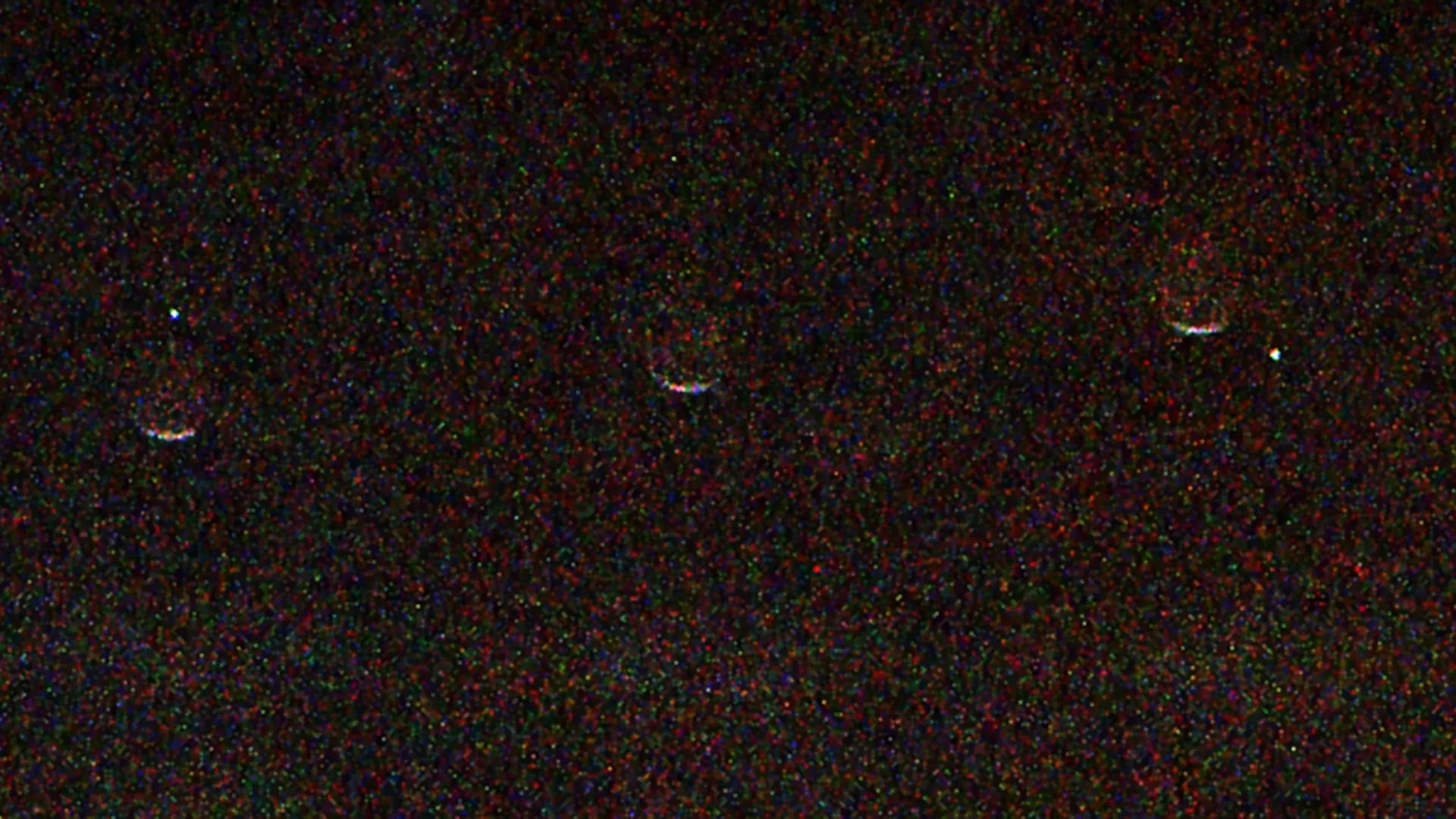
NASA’s Perseverance rover captured a rare celestial event on Mars when Earth briefly disappeared behind Phobos, the Red Planet’s larger moon, in the Martian evening sky.
A newly released sequence of images shows Phobos moving across the sky and passing directly in front of Earth, which appears as a tiny point of light. The observation marks the first time humans have documented Earth disappearing behind another celestial body from the surface of another planet.
Earth vanishes behind Phobos in the Martian sky
NASA’s Perseverance Mars rover recorded the sequence with its Mastcam-Z camera at approximately 7:00 p.m. local solar time on Mars. The images were captured on July 2, during the mission’s 1,907th Martian day, or sol.
In the composite image, Earth moves diagonally from the upper left toward the lower right, while Phobos travels in the opposite direction, from the lower left toward the upper right. By the third frame, the two objects align, causing Earth to briefly disappear behind the edge of Phobos.
“This composite image will be a unique self-portrait of Earth taken from the surface of another planet using the Phobos light bomb,” said Justin Maki, deputy principal investigator for Mastcam-Z and a Perseverance imaging scientist at NASA’s Jet Propulsion Laboratory in Southern California.
Earth appears as a tiny point from 195 million miles away
From Perseverance’s location near the rim of Mars’ Jezero Crater, Earth and Phobos appeared dramatically different in size and distance.
Phobos is an irregular, potato-shaped moon measuring approximately 17 miles (27 kilometers) across. It orbits Mars at a distance of about 4,850 miles (7,800 kilometers). From Earth, Phobos would appear roughly one-third the apparent width of the Moon as seen during the observation.
Earth, by contrast, was approximately 195 million miles (314 million kilometers) from Perseverance. At that vast distance, our planet appeared in the rover’s images as a single pixel-sized point of light.
“Phobos crosses the Martian sky three times a day, and Earth is visible for months at a time, but it takes planning and a little bit of luck to see Phobos right behind the other,” said Mark Lemon, a Mastcam-Z co-investigator at the Space Science Institute in Boulder, Colorado. Lemon planned the observations and assembled the composite image.
Occultation, transit, and eclipse: What is the difference?
Astronomers describe the event captured by Perseverance as an occultation. An occultation occurs when a nearby object appears large enough from an observer’s perspective to completely block a more distant object from view.
A solar eclipse is different because it occurs when one object moves into the shadow cast by another. When the Moon passes through Earth’s shadow, the event is called a lunar eclipse. When the Moon passes in front of the Sun and appears close to the Sun’s apparent size, it is known as a solar eclipse.
A transit occurs when a smaller-looking object moves across the face of a larger-looking object. Perseverance has also observed transits of Mars’ moons, Phobos and Deimos, as they pass in front of the Sun from the rover’s position on Mars. These events are sometimes informally called “Martian eclipses.”
NASA’s Perseverance rover continues studying Mars
NASA’s Jet Propulsion Laboratory in Southern California, managed by the California Institute of Technology, built Perseverance and oversees rover operations for NASA’s Science Mission Directorate in Washington. The rover is part of NASA’s broader Mars Exploration Program.
Arizona State University leads operations for Perseverance’s Mastcam-Z instrument. The university works with Malin Space Science Systems of San Diego to design, manufacture, test, and operate the rover’s cameras.
Source: www.sciencedaily.com