


AI Model Reconstructs Earth’s Biodiversity History from Millions of Fossils
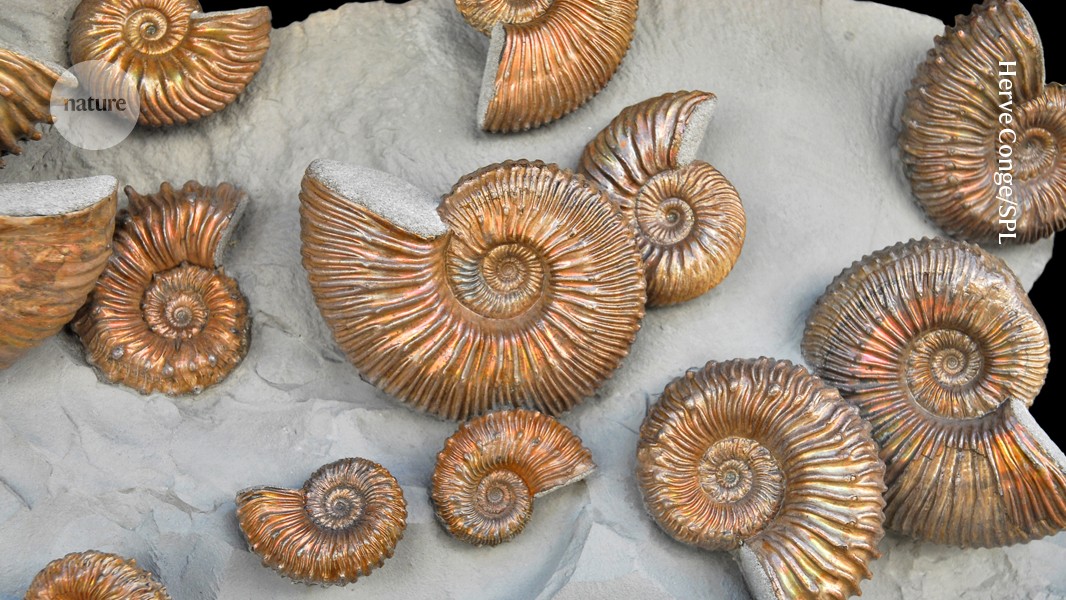
Ammonite fossils preserved in limestone. Fossil deposits like this help scientists understand biodiversity across Earth’s history.
Credit: Herve Conge/Science Photo Library
Large language models (LLMs), such as OpenAI’s ChatGPT, are trained to recognize patterns in written text and predict statistically likely words. Paleontologists are now applying a similar approach to the fossil record, using machine learning to reconstruct changes in Earth’s biodiversity over hundreds of millions of years in unprecedented detail.
This big-data approach to interpreting the rock record, known as stratigraphy, could lead scientists to rethink major upheavals in the history of life. The model suggests that three of the “Big Five” mass extinction events were gradual declines in biodiversity rather than the sudden catastrophes described in some previous reconstructions.
The model is “a real revolution for studying stratigraphy and past diversity changes,” says Shuzhong Shen, a paleontologist at China’s Nanjing University. The study was presented at the Geological Society of America meeting in Denver, Colorado, on October 12th.
Other researchers say the reconstruction, called OneStrata, appears to be the most detailed global record yet. However, scientists have already reconstructed biodiversity changes in specific locations at high resolution, including records that shed light on mass extinctions.
“We might be able to do more with this, but I don’t know if it would be earth-shaking,” says Matthew Clapham, a paleontologist at the University of California, Santa Cruz.
Why reconstructing the fossil record is so difficult
The history of life is recorded in the fossil record. By identifying the depths at which species occur in layers of sedimentary rock, called strata, researchers can reconstruct the story of adaptation and extinction across Earth’s history. The depth indicates when a fossil was deposited in geological time.
However, combining sequences from tens of thousands of sites and involving tens of thousands of species into a single, consistent timeline of changing biodiversity is computationally difficult.
To simplify the task, stratigraphers divide fossil sequences by species into time intervals of several million years. This makes it easier to assemble many sequences into a unified record, but it can obscure biodiversity changes that occur over shorter periods.
For the past 20 years, Shen and his colleagues have worked to create a clearer picture by compiling extensive fossil and geological datasets. OneStratigraphy includes the depths of millions of fossil specimens in rock sequences from tens of thousands of sites around the world.
How OneStrata uses machine learning to analyze fossils
In 2020, Shen and his colleagues used an algorithmic method on a supercomputer to connect thousands of fossil sequences. This allowed them to estimate when species appeared and went extinct with a resolution of 26,000 years—far more detailed than previous estimates.
The researchers then reconstructed a high-resolution timeline of 11,000 marine species spanning roughly 300 million years.1 Including more species at shorter intervals, however, would require an unrealistic amount of computational power.
To overcome that limitation, Shen’s colleagues at the Zhejiang Research Institute, an AI-focused research institute in Hangzhou, China, used OneStratigraphy data to train machine-learning models on statistical patterns in the fossil record.
Just as an LLM uses patterns in language to predict the next word in a sentence, OneStrata uses patterns in fossil data to predict when a particular fossil was most likely deposited.
Source: www.nature.com