


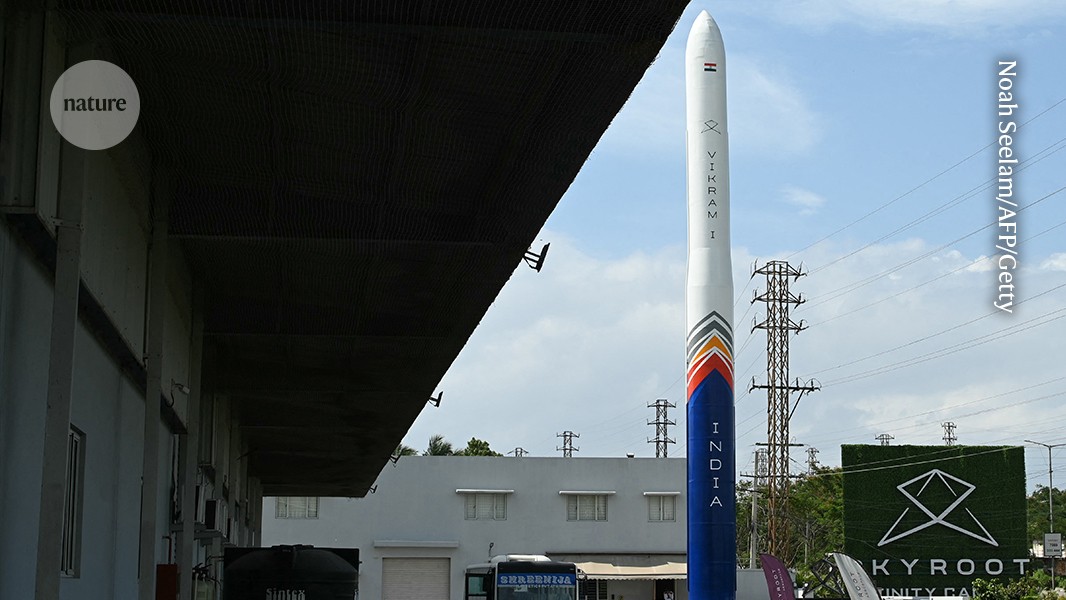
India invests heavily in space research through government and private funding, including investment by Skyroot Aerospace.
Credit: Noah Seelam/AFP/Getty
Scientists in the US, UK and Germany Are Less Optimistic About Their Careers
Scientists in several high-income countries are becoming less optimistic about their career prospects, while researchers in countries such as India and China report a more positive outlook, according to a new survey of nearly 4,000 scientists.
Since 2010, Nature has regularly surveyed researchers around the world about their careers. The survey asks whether scientists are satisfied with their work, how optimistic they are about the future and what influences their views. The latest results, published on October 13, contain notable changes compared with the 2018 and 2021 surveys (Nature 658, 825–829; 2026).
Career optimism is falling in major research countries
The survey, conducted in May and June, found that respondents in several major research-intensive countries—including the United States, Germany and the United Kingdom—were less optimistic about the future of their careers than respondents in previous surveys. More scientists in these countries also said that their career prospects were worse than those of previous generations.
In 2018 and 2021, during the COVID-19 pandemic, a larger proportion of scientists in these countries had answered positively to questions about their career outlook.
Researchers in middle-income countries were less pessimistic, particularly in China and India, which are becoming increasingly attractive destinations for scientists. In this year’s survey, 70% of Indian respondents said they were optimistic about their future.
Among Chinese respondents, 55% said they felt positive about the future—close to the global average of 52%, but substantially higher than the figures for Germany (38%), the UK (33%) and the US (34%). One caveat is that the responses from Indian scientists were collected before nationwide student protests in July.
Research funding and politics are creating pressure
Many high-income countries are experiencing political and economic upheaval. In the United States, the government has cut funding for some grant programmes and redirected funds towards its priorities, creating uncertainty for some projects and research fields.
European scientists could also face major changes to research funding. European countries are directing a large share of public funds towards defence, contributing to cuts in other budgets, including science. Several universities have been asked to take part in defence research.
Job satisfaction is higher in several wealthy countries
Although scientists in India and China are more optimistic about their careers, they report relatively low levels of job satisfaction compared with researchers in several high-income countries.
Only 51% of Chinese scientists and 59% of Indian scientists said they were satisfied with their jobs. By comparison, 65% of respondents in the US, 67% in Germany and 63% in the UK reported being satisfied. Canadian scientists had the highest job satisfaction among the countries surveyed, with 70% satisfied.
Working conditions remain a challenge for researchers
Researchers in some low- and middle-income countries are still working to improve their conditions. For example, as reported in a news feature on Chinese artificial-intelligence research, Chinese scientists face pressure to publish in journals (Nature 658, 598–600; 2026).
Scientists in Europe and the United States generally work in environments that offer greater independence than those available to researchers in low- and middle-income countries. Independence is a strong predictor of job satisfaction.
What the next scientist career survey could show
The research landscape could change again as the US midterm elections approach next month and national elections take place in several countries over the next few years. Nature will conduct its next career satisfaction survey, but the results are impossible to predict.
One conclusion is clear: the next survey is likely to differ from the 2026 results in ways that cannot yet be anticipated.
Source: www.nature.com