


Nature Briefing: AI Philanthropy, Climate Risks and New Discoveries in Evolution
Hello Nature readers. Would you like to receive this briefing free in your inbox every day? Sign up here.
Illustration: Nelson design. Adapted from Min Connors/Bloomberg, Michael Kovach/Breakthrough Prize, Sean Gallup, Angela Weiss/AFP (all via Getty).
With several major AI companies set to go public on the stock market soon, the class of ultra-wealthy philanthropists is likely to expand in the United States. Compared with government funding agencies, ultra-high-net-worth research investors tend to support projects that are higher risk, more personally relevant and subject to fewer constraints.
However, oversight of philanthropy programmes is limited, making it difficult to assess their success. Much of this funding is also directed towards encouraging the use of the same technologies that philanthropists have developed and profited from.
Nature | 15-minute read
This week’s image: An 1822 celestial map
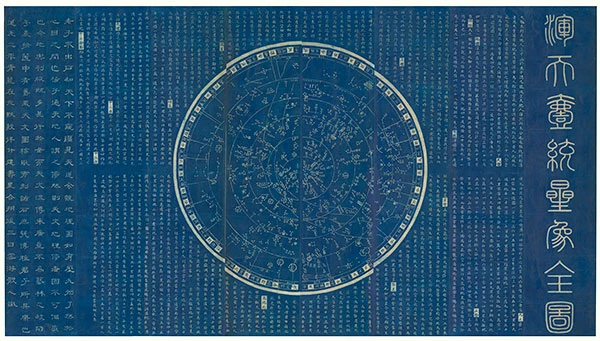
This 1822 celestial map, closely modelled on an earlier stele from 1247, reflects the Taoist concept of the universe as a “heavenly bureaucracy”, in which the heavens are divided into hierarchical offices or classes similar to those on Earth. The huge coloured woodblock print by Yunyou Sanren (Shang Huang 黃裳) is part of the Night Maps exhibition, running until 17 April at the Warburg Institute in London, UK. © Sunderland Collection.
Science and climate news
Global emissions may have peaked, but climate risks remain
Global greenhouse-gas emissions may have peaked last year and renewable-energy capacity is expanding faster than expected, according to the latest United Nations report on climate change. But without a significant acceleration in emissions reductions, average temperatures could rise above 2°C by mid-century — the limit that each country has committed to under the Paris Agreement.
“Definitely good news, but it’s not enough,” says climate scientist Bill Hare. Under current policies, scientists estimate that this century’s warming will peak at 2.6°C to 2.8°C. Although warming is unlikely to exceed 3.4°C on the current trajectory, that outcome would be catastrophic.
Nature | 8-minute read
Reference: United Nations Environment Programme Emissions Gap Report 2026
Machine learning reconstructs hundreds of millions of years of biodiversity
Paleontologists have trained machine-learning models on huge databases of the fossil record to reconstruct the timeline of change in Earth’s biodiversity over hundreds of millions of years in unprecedented detail.
The model, called OneStrata, suggests potential challenges to established ideas about evolutionary history. For example, it indicates that three of the “big five” mass-extinction events were gradual declines in biodiversity rather than the sudden cataclysms described in other reconstructions.
Nature | 7-minute read
Physicists suspend a positron for months
Physicists have suspended a single positron — the antimatter equivalent of an electron — in a near-perfect vacuum for months at temperatures close to absolute zero.
Researchers hope the experiment will reveal subtle differences between matter and antimatter, helping to solve one of physics’ greatest mysteries: why there is something rather than nothing.
Nature | 6-minute read
Reference: Physical Review Letters paper
A new subtype of depression may be linked to the body clock
A study of more than 11,000 people with depression found that one-quarter had a new subtype that made treatment difficult. “Circadian depression” appears to be related to disruption of the body’s internal clock, which can be targeted with treatments such as melatonin and phototherapy.
“Circadian depression is not just depression caused by lack of sleep,” says neuroscientist and study co-author Emiliana Tonini. “There is an underlying biology that is completely different from other forms of depression.”
Reference: British Journal of Psychiatry paper
What happens in a whale fall?
The movie Whalefall, based on Daniel Krauss’s 2023 novel, tells the story of a college student who is accidentally swallowed by a sperm whale while scuba diving.
Joy Lydenberg, a scientific adviser and comparative anatomist, and Ilias Foskolos, who studies deep-diving toothed whales, talk to Nature about glowing guts, stomach acid and why people do not need to worry about these things in real life.
Nature | 8-minute read
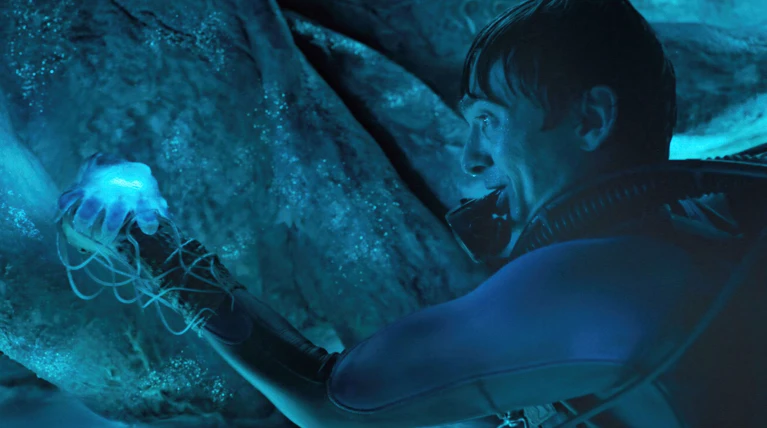
In the film, Jay grabs a glowing jellyfish, which was also swallowed by a whale, to light his way as he searches for the exit. Credit: 20th Century Studios/Everett Collection.
Science storytelling competitions
Can you tell the story of your research in 60 seconds? Or express your doctoral thesis in the form of a dance? If so, you’re in luck.
Nature’s Merck Science in Shorts award is open and offers a prize of 5,000 euros. The annual Science/AAAS Dance Your PhD Contest offers the chance to win up to $2,750.
While you’re thinking about your one-minute explanation of nature — or perhaps a short dance — why not send us feedback about this newsletter? Email us at [email protected] any time.
Thank you for reading,
Flora Graham, Nature Briefing Editor-in-Chief
Source: www.nature.com