


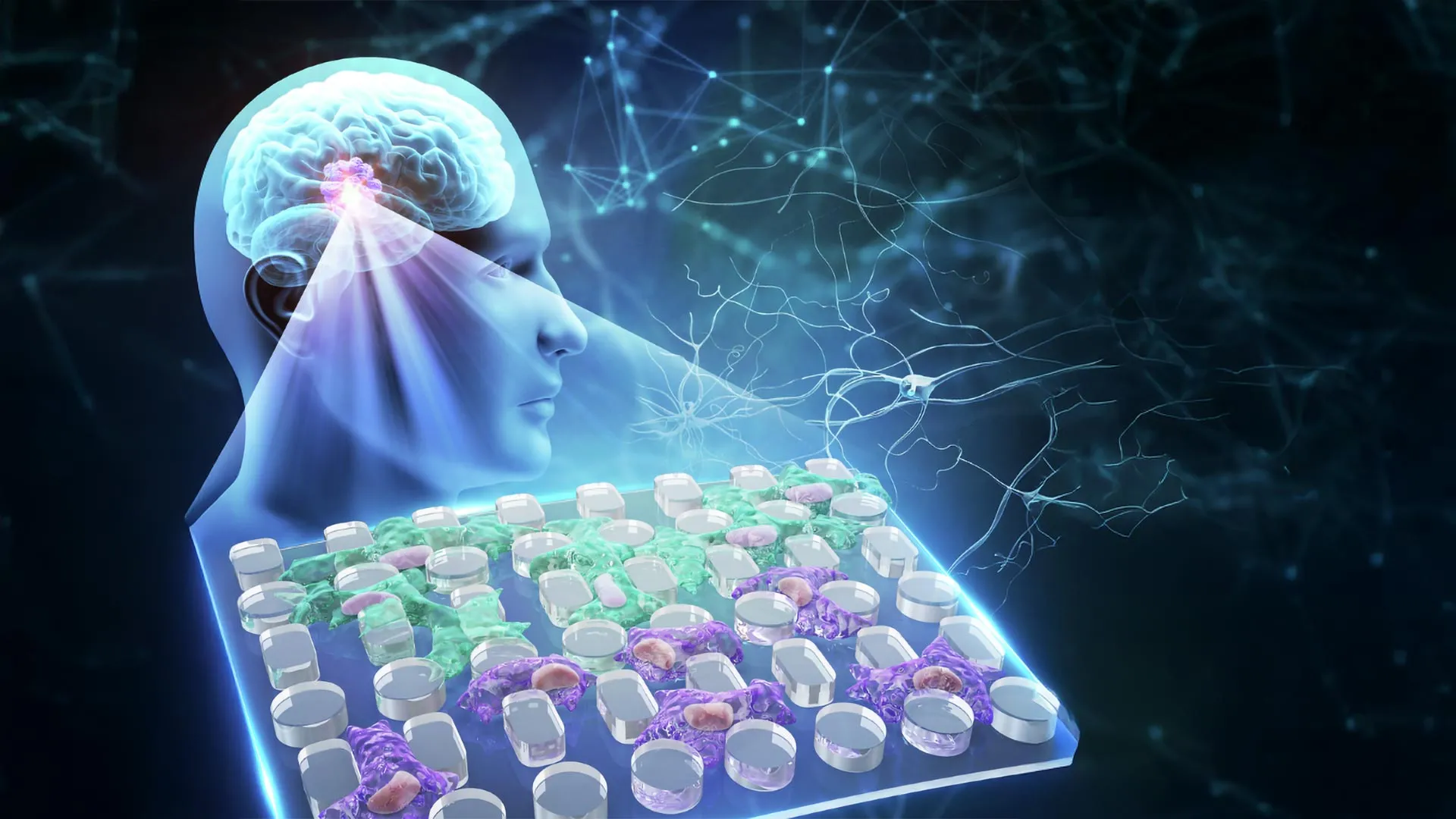
Glioblastoma cells may become more invasive after prolonged exposure to the unusually thick fluid found around the outer edges of tumors. Using a new open microfluidic platform, researchers found that cells grown in a viscous liquid became smaller, more flexible and faster-moving, helping them pass through narrow spaces and migrate into healthy brain tissue. The results suggest that fluid viscosity can do more than hinder cancer-cell movement: it may produce lasting adaptations that support invasion.
How thick fluids may influence glioblastoma invasion
Cancer research has traditionally focused on chemical signals and the stiffness of the tissue surrounding tumors. Much less attention has been paid to the viscosity of the fluids through which cancer cells move.
In glioblastoma, the difference is particularly pronounced. Fluid at the advanced edges of a tumor is about eight times more viscous than fluid from dead tissue in the center. As cancer cells move outward, they encounter an increasingly resistant environment.
Studying this process has been difficult because traditional closed microfluidic devices cannot accurately reproduce these conditions. Sealed channels can restrict access to oxygen and nutrients, while friction against the channel walls adds mechanical forces that can alter cell behavior. These limitations make it difficult to determine how cancer cells respond to long-term exposure to viscous fluids.
Researchers therefore needed a way to isolate the effects of fluid viscosity from other mechanical influences and establish whether prolonged exposure causes lasting changes in glioblastoma cells.
A new device reveals cancer-cell adaptations
Scientists from China’s Chongqing General Hospital and Chongqing University developed a specialized open microfluidic platform to address these challenges. Their findings were reported in Microsystems and Nanoengineering.
The device consists of a two-layer open microfluidic membrane with a removable cap and an array of small pillars. This design allows researchers to control when cancer cells begin moving while observing how their nuclei change shape as they pass through tight spaces.
Unlike traditional closed systems, the platform supports continuous cell culture for up to 1 month. This makes it possible to investigate how long-term mechanical stress affects glioblastoma-cell movement and invasion.
The researchers tested two human glioblastoma cell lines, U-251 and LN-229. Both were grown for 1 month in a thick liquid designed to mimic conditions at the tumor’s invasive rim, with a viscosity of 7.1 cP.
When the cells were examined using the chip, those adapted to the viscous environment moved faster and traveled farther than untreated control cells. This was unexpected because highly viscous liquids would normally be expected to impede movement.
Glioblastoma cells become smaller and more flexible
Microscopic observations showed how the adapted cells overcame this resistance. After prolonged exposure to viscous fluid, they became smaller and more deformable, allowing them to pass through the narrow gaps between the device’s microscopic pillars.
As the cells moved through these restricted passages, their nuclei visibly deformed. The researchers also observed that YAP, a protein involved in sensing mechanical forces, accumulated in the nucleus. This is a recognized sign that cells are activating pathways involved in responding to physical stress.
Although both glioblastoma cell lines developed similar changes in shape and movement, their underlying molecular responses were unexpectedly different.
U-251 cells underwent mesenchymal-like reprogramming and activated genes associated with cancer invasion, including CD44, FN1 and MMP9. By contrast, LN-229 cells became more flexible and mobile without showing substantial, sustained changes in gene expression.
Further analysis using Western blotting showed that protein changes remained detectable even after the cells were returned to a liquid with normal viscosity. This indicates that at least some of the adaptations are long-lasting rather than temporary responses to the environment.
Evidence of cellular memory
One of the most unexpected findings was that exposure to the thick liquid appeared to leave a lasting imprint on glioblastoma cells.
The researchers had expected viscosity to act mainly as a physical barrier. Instead, their experiments showed that prolonged exposure could alter cell behavior even after the original mechanical conditions had been removed.
This phenomenon points to a form of mechanistic memory in which cells retain changes triggered by earlier physical stress.
The open design of the chip was essential to identifying this effect. By separating resistance from the fluid itself from restrictions imposed by channel walls, the researchers could study viscosity without the additional mechanical interference that complicates traditional experiments.
Changes in nuclear shape and migration patterns after several weeks of exposure provided evidence that glioblastoma cells can adapt to a mechanical environment, with at least some of those adaptations persisting after conditions change.
The contrasting molecular responses of the two cell lines were particularly notable. Although both displayed similar physical changes, only one showed significant changes in gene activity. This suggests that glioblastoma cells may acquire comparable invasive properties through different biological mechanisms.
Potential applications in brain-tumor research
Beyond revealing an overlooked influence on glioblastoma invasion, the researchers believe the device could help investigate potential cancer treatments.
The open microfluidic platform fits into standard multiwell plates and can be incorporated into existing cell-culture and imaging procedures. Its accessible design also allows researchers to stain cells directly and observe them over long periods without the clogging problems that can occur in closed systems.
These features could make the platform useful for testing drugs that interfere with cellular pathways involved in detecting and responding to mechanical forces.
For glioblastoma, the findings suggest that a highly viscous environment may favor cancer cells that are better adapted to invasion. Treatments targeting YAP signaling and cytoskeleton remodeling could therefore be studied under conditions that more closely resemble those inside tumors. The cytoskeleton is the internal framework that helps cells maintain and change their shape.
The technique could also be applied to other cancers in which fluid viscosity varies between regions. Examining how tumor cells respond to these mechanical conditions may help researchers understand why some cancers are especially invasive and identify patients whose metastases depend on mechanical adaptations.
Further research is needed to determine how these laboratory results relate to patients’ tumors. Nevertheless, the findings highlight an important and poorly understood aspect of cancer biology: the physical environment surrounding tumor cells may actively shape their ability to invade healthy tissue.
Research support and funding
This study was supported by the Chongqing Glioma Precision Medicine Research Center and the Chongqing Key Research Institute of Neurodegenerative Diseases.
Funding was provided by the National Natural Science Foundation of China (82473430, 22304143, 32501283); Chongqing Talent Project (cstc2022ycjh-bgzxm0081); Chongqing Natural Science Foundation (CSTB2025NSCQ-GPX1077, CSTB2025NSCQ-GPX0309); Chongqing Young Medical Talent Program (YXQN2025088); New Chongqing Project (CSTB2024YCJH-KYXM0115); Chongqing General Hospital research funding (2025022102); Chongqing Municipal Postdoctoral Research Project Special Fund (2024CQBSHTB3131); and China Zhejiang Provincial Natural Science Foundation (LQN25E050020).
Source: www.sciencedaily.com