



Gigantopithecus, the largest primate known to have existed, stood approximately 10 feet (3 meters) tall and weighed about 500 pounds (230 kilograms). Between 2 million and 200,000 years ago, this giant ape lived in the dense tropical forests of Southeast Asia, potentially sharing the region with newly arrived hominins including Homo erectus. Scientists cannot determine whether the two ever met, but they have proposed several possible scenarios for how such an encounter might have unfolded.
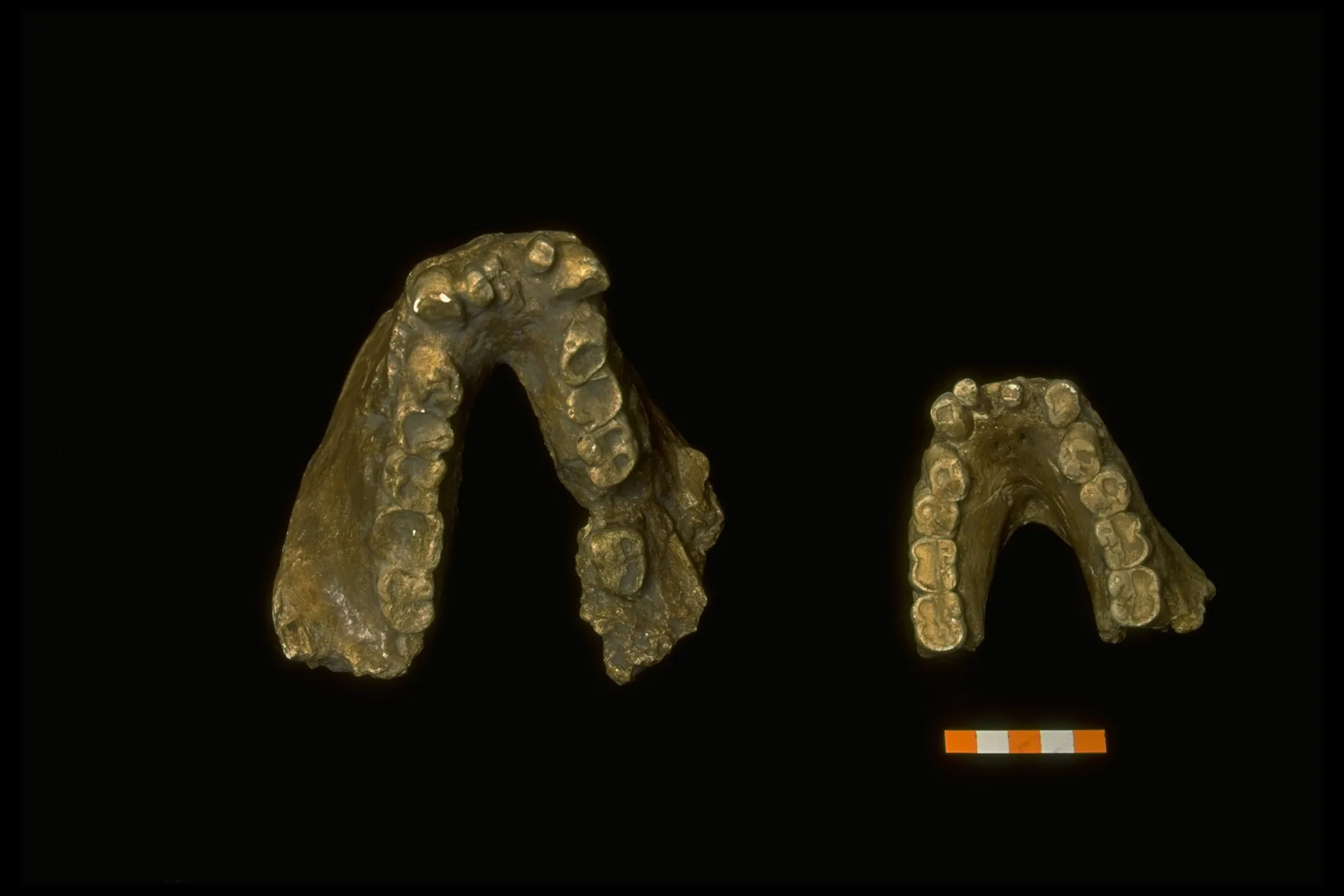
Despite its enormous size, Gigantopithecus was primarily a plant-eater and is closely related to modern orangutans. Its fossil record consists largely of teeth and jawbones, leaving researchers with limited direct evidence about its behavior and interactions with other species.
Would humans and Gigantopithecus have met?
“It’s very difficult to say for sure because we don’t have direct evidence documenting the interaction between Gigantopithecus and the ancestors of humankind,” Renaud Joannes-Boyau, director of advanced research and training at Australia’s Southern Cross University and an archaeologist who has extensively studied human evolution, told Live Science via email.
However, the broader pattern of human evolution offers some clues. “Our lineage [Homo]—humans and our ancestors—has shown a marked tendency to explore, exploit, and sometimes eliminate the large animals they share their environments with,” Joannes-Boyau said. “It’s reasonable to imagine that these interactions were a mixture of indifference, curiosity, and violence, depending on the circumstances.”
Friedemann Schrenk, a professor of paleontology at Germany’s Johannes Gutenberg University Mainz, suggested that Gigantopithecus may have tried to avoid humans. “Humans were, and probably still are, the most aggressive primates on Earth, using tools and weapons to invade Gigantopithecus habitat,” he told Live Science via email. Homo erectus used hatchets and, in some cases, hafted spears.
Schrenk said the relationship might have resembled interactions between humans and orangutans today. Human encroachment on orangutan habitat has contributed to declining ape populations. “In the end, Gigantopithecus was a giant orangutan,” he said, adding that early humans would probably have been the aggressors if the two species had directly encountered one another.
Different environments may have limited encounters
Another possibility is that Gigantopithecus and hominins rarely met because they occupied different environments in Southeast Asia. Hervé Bocherens, a professor of biogeology at the University of Tübingen in Germany, said this ecological separation could have kept interactions to a minimum.
Carbon stable isotope ratios measured in teeth from both taxa suggest that they used different habitats: closed forests for Gigantopithecus and more open savannah environments for Homo erectus, Bocherens told Live Science via email. However, he added that the limited data cannot rule out the possibility that some hominins also lived in more heavily forested environments.
Patterns of tooth wear indicate that Gigantopithecus had a primarily plant-based diet that may have included bamboo.
What caused Gigantopithecus to disappear?
A 2024 study found no evidence that hominins contributed to the extinction of Gigantopithecus. Instead, the researchers concluded that environmental changes reduced the forest habitat where the giant ape lived and foraged.
“Although we may have never met, we can only imagine how humanity would have interacted with Gigantopithecus,” Yingqi Zhang, a researcher at the Chinese Academy of Sciences and lead author of the study, told Live Science via email.
Frido Welker, a professor of biomolecular paleoanthropology at the University of Copenhagen, said the two species might have avoided one another. If they did happen to meet, however, they may have been “in awe” of each other.
The available evidence therefore cannot establish whether Homo erectus and Gigantopithecus ever encountered one another. If they did, their meeting may have involved avoidance, curiosity or conflict—but environmental change, rather than hominin activity, currently appears to be the leading explanation for the giant ape’s disappearance.
Find out how much you know about early humans with our Human evolution quiz!
Topics: life’s little mysteries
Source: www.livescience.com