


Artemis II Moon Data, AI Mathematics and the Latest Science News
Hello Nature readers. Would you like to receive this briefing free in your inbox every day? Sign up here.
NASA releases more than 800GB of Artemis II moon data
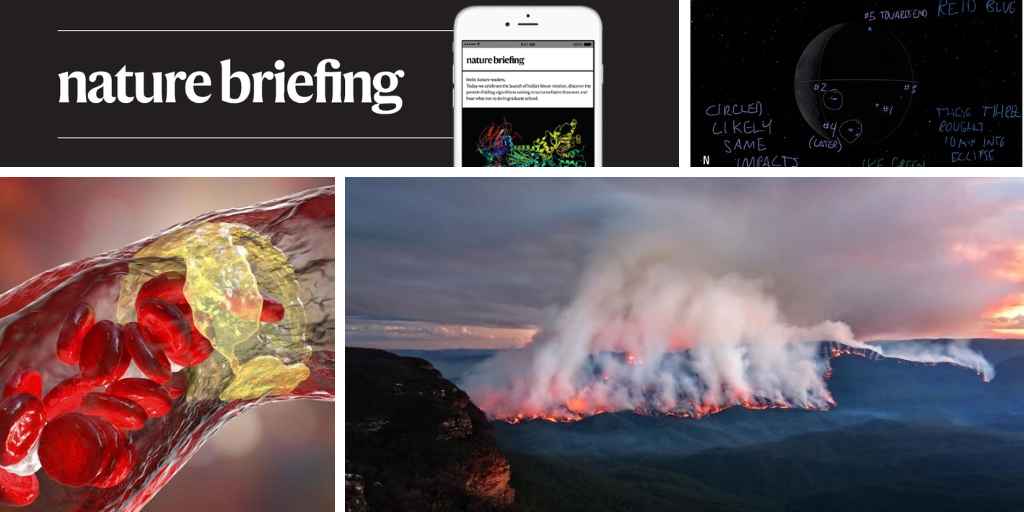
Images of the Moon annotated with micrometeoroid-impact locations recorded by Artemis II astronauts.
Credit: NASA/CSA
NASA has released more than 800 gigabytes of images, audio recordings, notes and other data collected by Artemis II astronauts during their historic flight past the Moon in April.
The material includes details about the colours the crew could distinguish on the lunar surface and the flash they saw when a micrometeorite struck the Moon. The report also explains how changing light conditions affected the astronauts’ ability to assess lunar topography — an issue that could influence future Moon-exploration missions.
Nature | 5-minute read
Read the source: Artemis II Preliminary Science Report
A gut microbe produces a molecule that mimics statins in mice
Bacteroides homogeneity is a common gut microbe that produces molecules capable of lowering cholesterol levels and shrinking fatty plaques in the arteries of mice.
Researchers discovered that a molecule called pentadecanoic acid inhibits a liver enzyme involved in cholesterol production. This is the same biological effect produced by statins. The findings point to a potential way of using the gut microbiota to help prevent cardiovascular disease caused by atherosclerosis, the progressive buildup of inflammatory plaque on artery walls, said microbiologist and study co-author Wenjing Chao.
Nature | 5-minute read
Read the source: Nature paper
OpenAI releases hundreds of AI-generated mathematics preprints
OpenAI has released more than 700 artificial-intelligence-generated preprints addressing hundreds of high-profile problems in mathematics.
The unexpected release has divided mathematicians. Some researchers said they had been scooped, while others lamented what they called a “tilt calypse”. Others celebrated the reported resolution of a long-standing problem dating back more than 100 years.
The release highlights how quickly artificial intelligence is becoming useful in mathematics. “This is clearly the most important moment in the history of mathematics,” said Levent Alpöge, a mathematician at rival AI company Anthropic, in a social-media post.
Nature | 4-minute read
Indigenous cultural burning may help reduce Australia’s wildfire risk
The suppression of Indigenous burning practices in Australia after British colonisation probably contributed to the larger and hotter bushfires occurring today.
Re-enactments of fires in southeastern Australia over the past 1,000 years suggest that the loss of controlled burning transformed large areas of forest from open, grassy woodland into denser, more flammable woodland. Climate change has further increased the risk of intense wildfires.
Researchers suggest that restoring frequent, low-temperature “cultural burning” could reduce the risk of fires spreading out of control.
Nature | 4-minute read
Read the source: Nature paper
Features and impressions
Why a 1940s experiment failed to create a “super dog”
In the 1940s, biologist John Fuller and ethologist John Paul Scott began an ambitious study asking whether humans could breed “super dogs”. For more than 13 years, the team studied around 500 dogs from different breeds, recording their behaviour from birth and testing their intelligence.
The research was funded by proponents of eugenics who hoped it would show that intelligence was predominantly genetic. By the end of the project, however, Fuller and Scott concluded that no breed was smarter than another. Each breed had its own strengths.
A research meeting that begins with 20 minutes of silence
“Every month, members of my lab gather for a video call that begins in silence,” writes neuroscientist Manuel Spitchan. “For 20 minutes, the whole group sits down and reads someone’s notes. Then we spend the remaining 70 minutes discussing them.”
Spitschan adapted the approach from Amazon. It prevents a presentation from acting as a crutch when the speaker is unsure about something and creates space for new topics. One postdoctoral researcher used the opportunity to write a memo titled, “Help! What is my research profile?”
Nature | 7-minute read
A conservation success in New Zealand
Today I am celebrating a conservation success: the population of wetapunga (Deinacrida heteracantha) is officially increasing in New Zealand. A breeding programme has released 11,000 individuals into the wild.
I am also glad that these insects live in New Zealand rather than here in the UK, where I might encounter them. Wetapunga is considered the heaviest insect in the world and can reach 10 centimetres in length.
Source: www.nature.com