


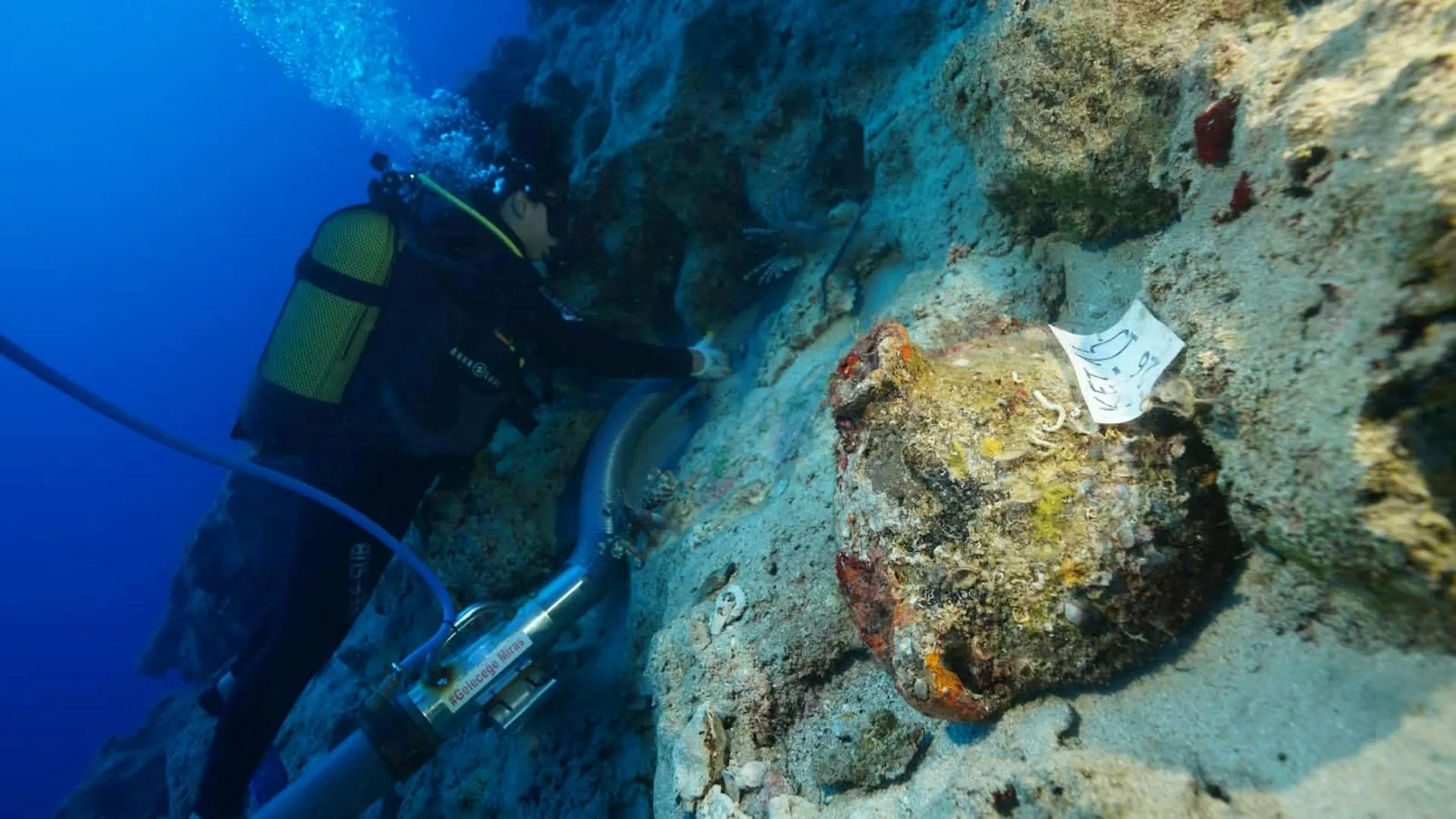
The research team studying a shipwreck off Kekova, on Türkiye’s southern coast, believes it may be the world’s oldest known shipwreck. Although the vessel itself has disappeared, ceramic cargo recovered from the site tentatively dates the wreck to between 2700 and 2400 BC—about 4,500 years ago. The findings have not yet been published in a peer-reviewed journal, and further work is needed, but the discovery could offer new evidence about maritime trade and connections across the eastern Mediterranean during the Early Bronze Age.
Before this discovery, the oldest known shipwreck was located off Dokos, Greece, and was dated to approximately 4,200 years ago. That wreck is therefore somewhat younger than the Kekova find, if the new dating is confirmed.
Searching for clues beneath the water
Hakan Onis, an associate professor at Antalya’s Akdeniz University, has spent decades excavating ancient shipwrecks along Türkiye’s coastline.
Acting on information from local sailors, Onis discovered the wreck in shallow waters off Kekova, west of Antalya, in 2024. Earlier this year, he asked me to help date the ceramic vessels found at the site.
As an archaeologist who specializes in desert ruins, I found the work a particularly unusual experience. Underwater excavation requires different techniques, including flooded excavation methods and painstaking preservation procedures. Learning those methods became part of the process.
The ship’s wooden structure has been exposed to the underwater environment for so long that no visible hull remains. Researchers are currently dating the vessel and its cargo to between 2700 and 2400 BC, although the exact year remains uncertain. The date could eventually move earlier or later as the evidence is examined further.
A time capsule of ancient trade
If confirmed, the discovery could reshape our understanding of trade networks that connected the eastern Mediterranean roughly 4,500 years ago.
The wreck may represent a “missing piece” in the history of regional networks, trade and the exchange of goods. It dates to the era of the Pyramid Age of Giza and the powerful pharaohs of ancient Egypt.
What remains beneath the sea is effectively a time capsule of ancient commerce.
The ship’s exact route is not known, but it appears to have been sailing along the coast of southern Türkiye. The wreck now lies on the seabed between two islands. Its position suggests that the vessel may have sought shelter in relatively calm, leeward waters during a storm before striking the rocks. The sailors—possibly people from the coastal Levant—may have been unable to prevent the disaster.
The ship’s wood has long since disappeared, but parts of its cargo remained buried in rocky slopes along the Kekova coast. Divers have spent the past four months removing pottery from barnacles attached to those underwater slopes.
What pottery can reveal
Pottery can survive for thousands of years. Although ceramic vessels break into smaller pieces, the fragments can retain valuable information about their manufacture, origin and use.
In this case, the cargo included large ceramic storage vessels, or amphorae, that once held products from different parts of the eastern Mediterranean. The vessels were large, oval and relatively flat, with two handles. Many also had a raised horizontal clay “belt” around their widest point.
The vessels can reveal information about their probable place of origin and the goods they carried—products that may have been exchanged across the region.
The shape and manufacturing technique of a pot can also help archaeologists determine its age. That evidence can then be used to estimate the age of associated pottery and, potentially, the ship itself.
The wider Mediterranean context
Compared with later periods, trade and exchange in the eastern Mediterranean during the third millennium BC, from 3000 to 2000 BC, remain poorly understood.
Evidence for long-distance sea voyages during this period comes from Egyptian texts, pottery and raw materials recovered from ancient tombs. Around the time the Kekova shipwreck occurred, ancient Egyptians were trading in the eastern Mediterranean through the port of Byblos, in present-day Lebanon.
Materials including cedar, tin and lead, oil, tree resin, lapis lazuli and silver were scarce in Egypt and were imported by the Egyptian state.
Recent research has shown that the Egyptian state acquired silver around 2600 BC. The analysis indicated that the silver came from the Lavrion mine east of present-day Athens.
Egyptian ships may not have made the entire journey themselves, but vessels such as the Kekova ship could have travelled along parts of the same route as components of an expanding international maritime network.
Residue is still visible inside some of the pottery. Scientific analysis is pending, but the material could be the remains of products mentioned in Egyptian texts, such as olive oil, wine or tree resin.
The ship may have collected pottery from several ports during its voyage. At this stage, the best assessment is that some of the “belted” vessels—or the clay used to make them—may have originated in the central Jordan Valley.
A coastline rich in shipwrecks
The coast of southern Türkiye is dotted with ancient shipwrecks. Maritime archaeology is a relatively recent field, but some of the world’s most famous wrecks have been found in the region.
The Kekova site may therefore be only one of many sources of evidence about ancient seafaring. Further excavation and analysis could reveal what other secrets remain preserved beneath these waters.
The research underlying this article was led by Associate Professor Hakan Onis, head of the Mediterranean Underwater Cultural Heritage Research Department and the Cultural Heritage Restoration and Conservation Department at the Faculty of Arts of Akdeniz University in Antalya, Türkiye.
Source: www.sciencedaily.com