


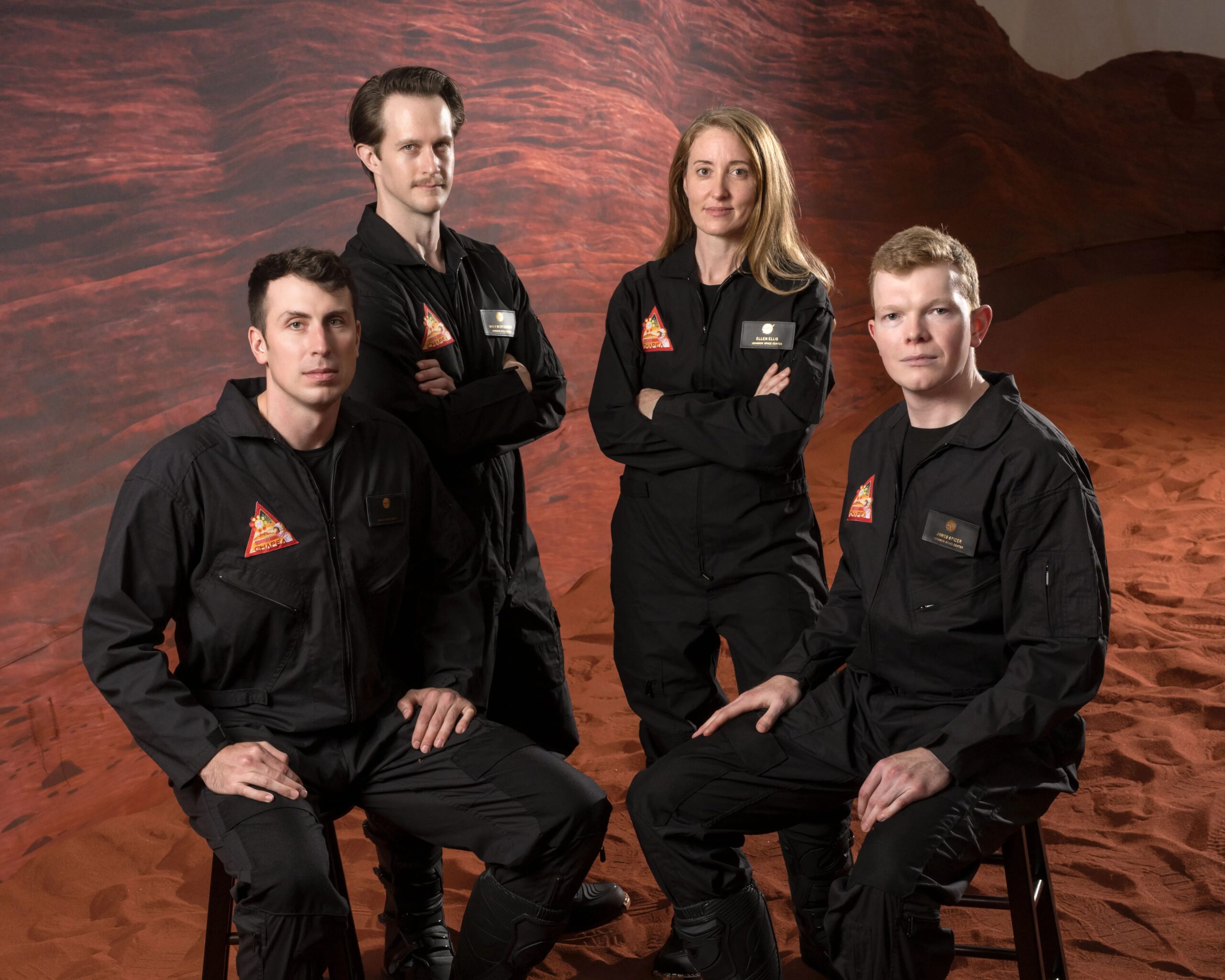
Four volunteers who spent more than a year living and working inside NASA’s simulated Mars habitat are scheduled to emerge on Saturday, October 31, after 378 days of isolation at the Johnson Space Center in Houston. Data gathered during the Crew Health and Performance Exploration Analog (CHAPEA) Mission 2 will help NASA address the health, performance and operational challenges of future Artemis and lunar missions.
CHAPEA crew to leave habitat after 378 days
NASA will livestream the crew’s departure from the CHAPEA habitat beginning at 3 p.m. ET. The ceremony will be broadcast on NASA Johnson’s YouTube channel and social media accounts.
Johnson Center Director Vanessa Wich and NASA astronaut Jack Hathaway will deliver presentations. CHAPEA crew members Ross Elder, Ellen Ellis, James Spicer and Matthew Montgomery will also speak.
Media representatives will be able to watch the CHAPEA Mission 2 ceremony on screens outside the hangar containing the facility. A subject-matter expert will answer questions afterward, and members of the media will have an opportunity to film the crew leaving the building for the first time in more than a year.
U.S. media interested in attending in person or speaking virtually with the CHAPEA Mission 2 crew in the days after the mission ends should contact the NASA Johnson Newsroom at [email protected] by 2 p.m. on Friday, October 30.
A simulated deep-space mission
The second CHAPEA mission began on October 19, 2025. The four-person crew lived in a 1,700-square-foot, 3D-printed facility while facing stressors expected during future deep-space missions.
The simulation included Mars mission operations, mock spacewalks, exercise, habitat maintenance and plant cultivation. The crew also worked under communication delays, resource limitations and prolonged isolation, among other constraints.
NASA will use the mission’s data to prepare for lunar missions by studying areas such as food-system design, efficient use of crew time and the bandwidth requirements of NASA’s deep-space network.
The results will also help flight doctors and psychologists improve medical care and behavioral support for space crews, with the goal of maintaining crew readiness and performance during long-duration missions.
NASA contacts
Rachel Craft
Headquarters, Washington
202-358-1600
[email protected]
Kelsey Spivey
Johnson Space Center, Houston
281-483-5111
[email protected]
Source: www.nasa.gov