


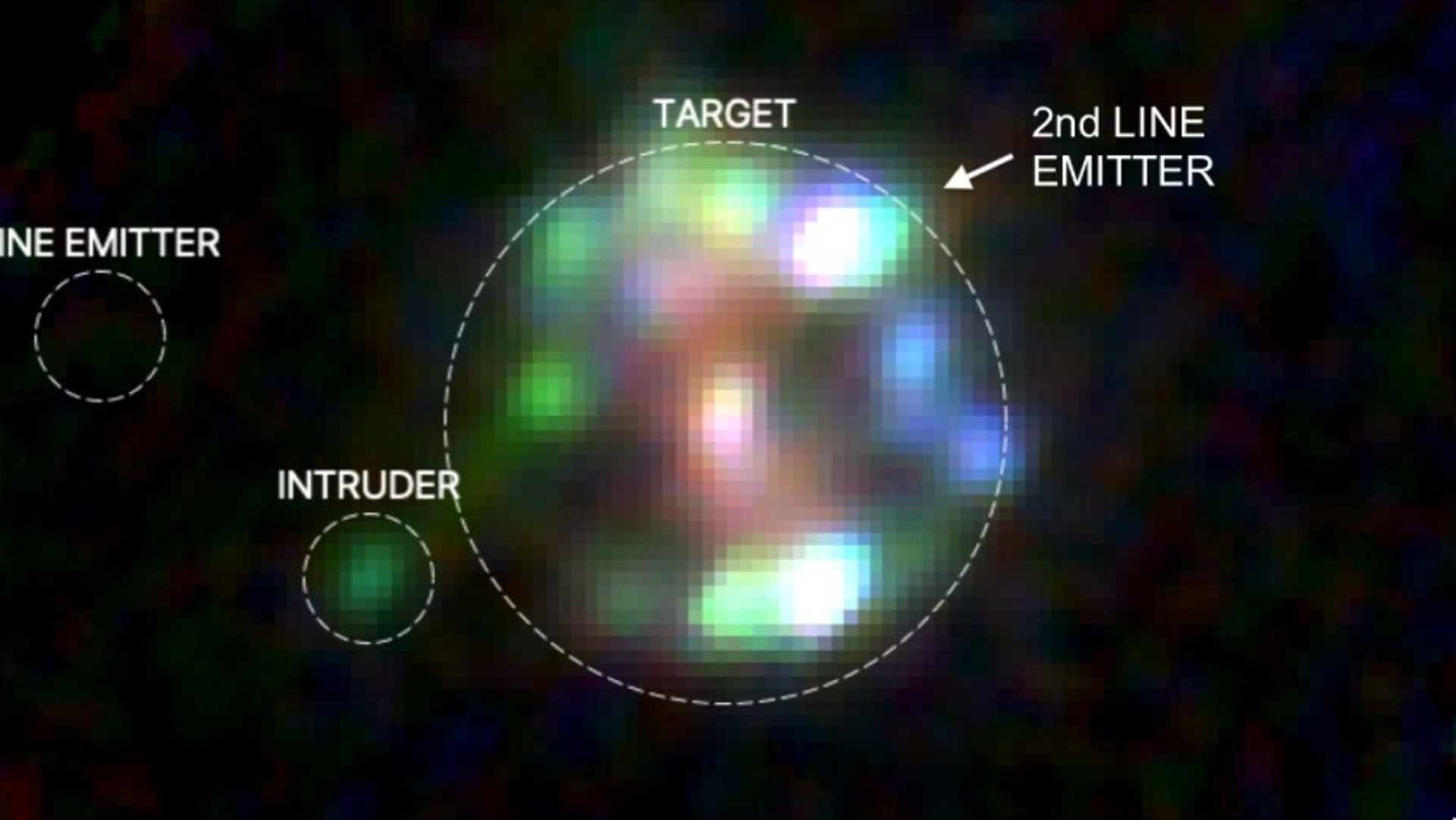
Using the James Webb Space Telescope (JWST), astronomers have identified a possible ring galaxy that existed just 2.1 billion years after the Big Bang. Known as GS18660, it is the most distant ring galaxy discovered so far and may have formed when a smaller “intruder” galaxy passed through the center of a larger one. Researchers stress that the collision interpretation remains a preferred scenario rather than a confirmed conclusion.
Image credit: Pera et al./Astronomy and Astrophysics
The findings were reported in a study published in Astronomy and Astrophysics on September 8. Because potential mergers occur over relatively short timescales, snapshots of galaxies during such events are rare.
“Although interactions between galaxies may have been common in the early universe, the formation of such ring systems is thought to be rare,” Christopher Conselice, a professor of extragalactic astronomy at the University of Manchester in the U.K. who was not involved in the study, told Live Science.
“In this sense, this galaxy is quite unique and may give us important information about early galaxy formation,” Conselice said in an email.
A surprising discovery
Researchers originally selected GS18660 because older images from the Hubble Space Telescope showed a stretched-looking galaxy. They were not specifically searching for a ring galaxy.
“Therefore, we did not specifically target GS18660 as a ring galaxy,” said Michele Perna, a postdoctoral fellow at the Spanish Center for Astrobiology and the study’s lead author.
“We’re trying to figure out what’s going on,” Perna told Live Science via email. “When I observed it with JWST, more detailed data revealed a prominent ring structure, allowing us to study the galaxy in three dimensions.”
The team used JWST to examine GS18660’s unusual shape, track the movement of its hot gas, analyze the gas’s chemistry and reconstruct the galaxy’s history of star formation.
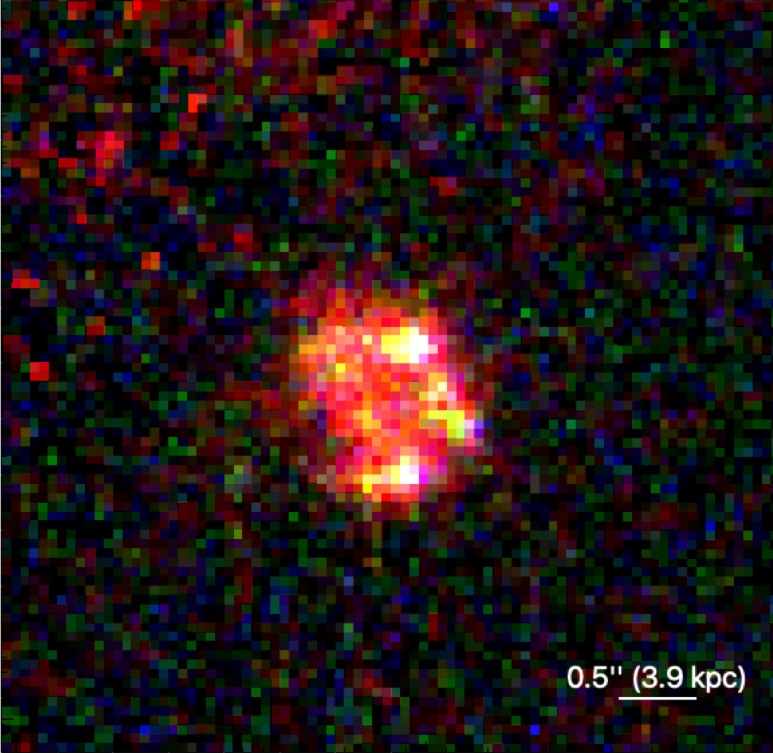
Image credit: Pera et al./Astronomy and Astrophysics
How an intruder could create a ring
When a small galaxy passes through the center of a larger galaxy, the impact can generate a wave of dense gas that travels outward, much like ripples spreading across a pond after a stone is dropped into it. As gas accumulates along the wave, new stars can form in a ring.
These collision-driven ring galaxies are rare in the nearby universe, and the few candidates identified in the distant universe have been difficult to confirm.
Several clues support the idea that GS18660 is a collision ring galaxy. Researchers found a small companion galaxy moving away from GS18660 at about 264 miles per second (425 kilometers per second). Perna also detected a gas bridge connecting the two galaxies, with the gas speed changing along the bridge. That variation suggests the companion and GS18660 may be interacting.
The companion’s position provides another clue. It lies roughly along the minor axis of the host galaxy, where an invading galaxy might be expected to appear after entering the host’s disk nearly head-on.
Evidence from newly formed stars
The team used the speed and distance of the companion to estimate that the collision occurred approximately 17 million to 42 million years ago in the galaxy’s history. Conselice said that timescale appeared reasonable.
Although the ages of past galactic interactions are difficult to determine directly, Conselice explained that any interaction would have had to occur near the beginning of a rapid episode of star formation. The age of that interaction should therefore be consistent with the average age of the resulting star cluster.
After measuring the star-formation rate with several instruments, the researchers estimated that 10% to 20% of the stars’ mass in the ring formed during the past tens of millions of years. Perna said this suggests that the collision and the burst of new star formation in the ring may have occurred at the same time and were probably caused by the same event.
“Although by itself it is not conclusive evidence of a collision, together with the morphology of the bridge and ring it strengthens the case for a recent collision,” Perna said.
Earlier estimates suggested that collision rings in the early universe may have been about as rare as they are today, occurring in roughly 1 in 10,000 galaxies. The new findings raise the possibility that head-on collisions capable of producing ring galaxies were more common in the early universe.
“Thus, if GS18660 is confirmed as a collisional ring, it would suggest that we need to reconsider our estimates of how often these systems occur in the distant universe,” Perna said.
Another possible explanation
The researchers cautioned that the data do not prove a collision. “It’s actually a combination of several pieces of evidence rather than a single observation,” Perna said. “We therefore view the collision interpretation as our preferred scenario rather than a final conclusion.”
Conselice said the evidence presented in the study is consistent with a collisional origin. “Given the nearby galactic invaders and the stability of the invader and host galaxies themselves, the merger hypothesis seems more likely to me,” he said. “Overall, based on the distribution of light, this is convincing evidence of past interactions and mergers in our galaxy.”
A competing explanation involves a bar-like structure extending from north to south across GS18660. Such a bar could funnel gas and stars into a ring at a particular distance from the galaxy’s center, without requiring an external intruder. Perna said the team cannot yet determine whether the structure is a true stellar bar or the result of an interaction.
Bars would also be significant because JWST has already found barred galaxies in the early universe, including CEERS-2112. However, researchers have not yet found a clear example of a ring driven by a bar in the early universe.
“Whether the ring was caused by another galaxy or by the internal dynamics of GS18660, the results will tell us something important about how galaxies were becoming structurally organized when the universe was only a few billion years old,” Perna said.
Reference: Perna, M., Arribas, S., Costantín, L., Pérez-González, P.G., Prieto-Jimenez, C., Rodríguez del Pino, B., Dugenio, F., Lamperti, I., Manucci, F., Übler, H., Cressi, G., Böker, T., Bunker, A.J., Carniani, S., Charlot, S., Maiolino, R., Bertola, E., Ceverino, D., Circosta, C., … Venturi, G. (2026). “GA-NIFS: Ring galaxy with the highest redshift thought to have resulted from a head-on collision.” Astronomy and Astrophysics, 713, A86.
Topic: James Webb Space Telescope
Source: www.livescience.com