


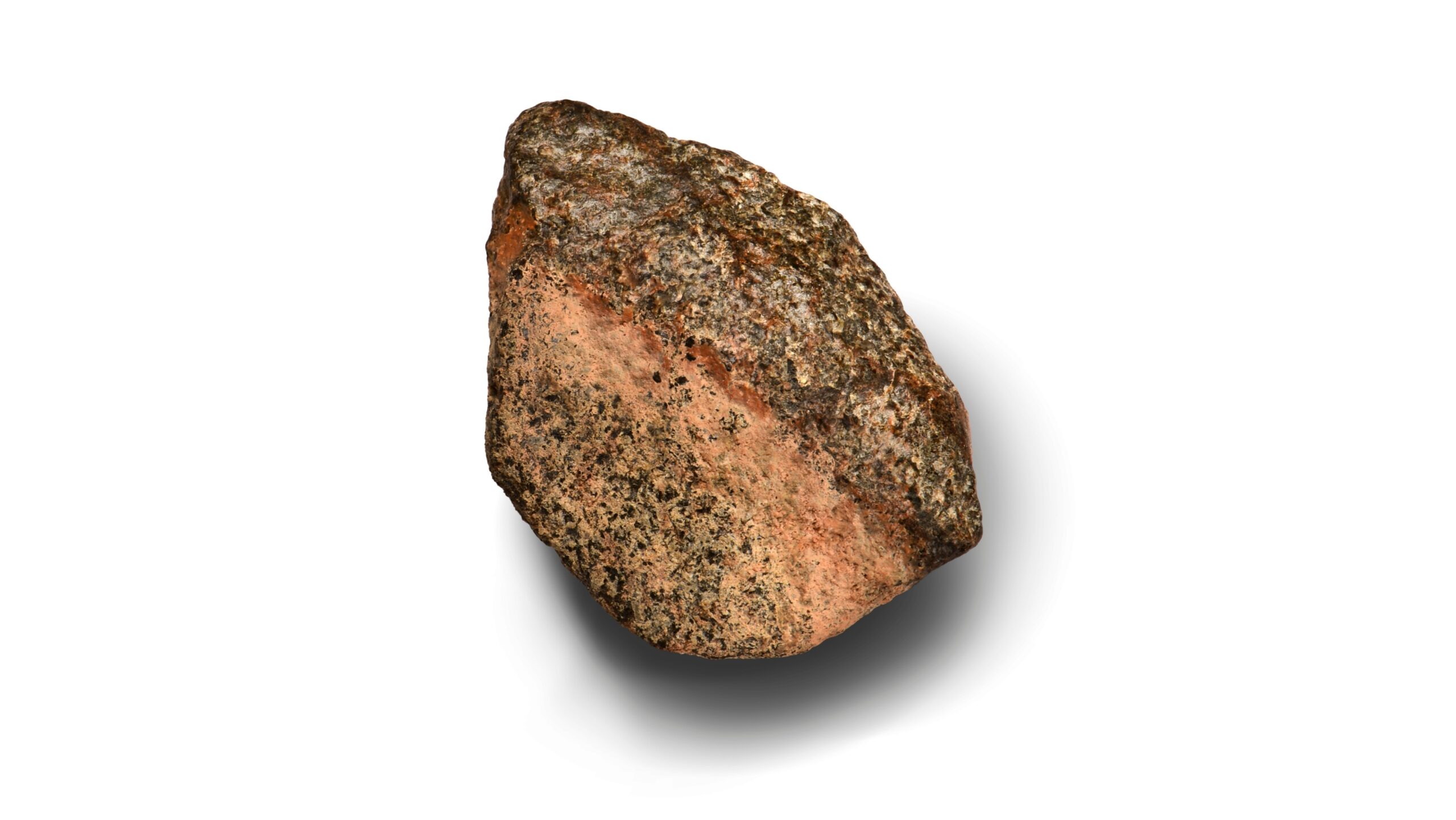
A rose-colored meteorite found in the Sahara in 2022 has been identified as one of the oldest pieces of Martian rock ever discovered. Named Tegaza 001 after the salt flats in Mali where it was found, the roughly 2-pound (800-gram) meteorite formed more than 4.1 billion years ago and offers scientists a rare view of Mars’ ancient crust, including how magma cooled and later interacted with groundwater.
In a paper published Thursday in Science, researchers presented an initial characterization of Tegaza 001. Future studies could help answer questions about how water and rock interacted on early Mars. A separate paper published in June in Science Advances examined the water content of meteorites and described how water shaped the surfaces of early planets.
“It wasn’t until we started looking at it carefully that we realized that this meteorite was truly unique,” said lead author Yang Liu of NASA’s Jet Propulsion Laboratory in Southern California. “One of the paper’s reviewers called it the Rosetta Stone of Mars.”
A rare record of Mars’ ancient crust
Tegaza 001 stands out from other Martian meteorites because of its age, texture and unusual mixture of igneous, or volcanic, minerals. It is one of only three of the oldest Martian meteorites discovered on Earth.
Other ancient Martian rocks provide more limited views of the planet’s geological history. ALH84001, for example, is composed almost entirely of one mineral and is similar in age to Tegaza 001. Another meteorite, known as “Black Beauty,” formed about 2.1 billion years ago and consists of small fragments of volcanic rock.
Unlike those meteorites, Tegaza 001 contains a combination of igneous minerals that records how Mars’ crust formed as magma cooled and was later altered by groundwater. Its distinctive mineralogical features match minerals observed by NASA’s Mars Reconnaissance Orbiter in the planet’s heavily cratered southern highlands.
Scientists will never know precisely where on Mars Tegaza 001 originated, but the paper identifies several possible regions whose mineralogy and chemistry match the meteorite.
“This is actually the first Martian crust from a part of Mars that has never been sampled before,” said Lee Saper, second author of the paper and currently a scientist at NASA’s Ames Research Center in Silicon Valley. “It records interactions between water and rocks, and perhaps even traces of the Martian atmosphere where water is being lost.”
Dating a meteorite with a tiny sample
All Martian meteorites found on Earth share a broad history: an impact blasted them from Mars’ surface, after which they traveled through space and eventually fell to Earth. Collectors often find meteorites in deserts and snowy plains, where the rocks stand out against the barren landscape.
Scientists can confirm a meteorite’s Martian origin by comparing its mineral and chemical composition with data gathered by NASA missions, including the Viking landers and the Curiosity and Perseverance rovers.
Researchers at the University of New Mexico initially identified Tegaza 001 as Martian by studying its oxygen isotopes, which serve as geochemical fingerprints for different planetary bodies. The meteorite’s isotopes matched those found in other Martian meteorites, and its initial characteristics suggested that it was a shergottite, the most common type of Martian meteorite.
When Liu was first asked to examine the rock, she nearly passed up the opportunity. But its unusual textures and minerals caught her attention. Liu and her colleagues found zircon crystals in Tegaza 001. These crystals preserve clues about how the rock formed and allow geologists to determine its age. Further analysis also revealed when the rock underwent changes, including alteration by water.
Co-author François Tissot of the California Institute of Technology helped the team apply an age-dating method developed by his group. Unlike bulk-analysis techniques that completely dissolve a sample, the team’s in situ rubidium-strontium dating analyzed a single mineral grain on the surface of a fragment smaller than a fingernail.
The method is both precise and fast, while preserving rare material such as Martian meteorites for future research.
“Right now, we are one of the few laboratories in the world that can perform this type of age determination, and we are the first researchers to date an ancient Martian meteorite like this,” Tissot said. “Our hope is to pave the way for dating even more Mars meteorites, or samples brought back from other planets, their moons, and asteroids.”
Evidence of an active water cycle
The dating results surprised Liu. They showed that Martian water altered the rock about 4.1 billion years ago, indicating that Tegaza 001 originally formed even earlier. Its oxygen isotopes, texture and chemistry point to a more dynamic water cycle on early Mars than the meteorite’s initial classification suggested.
The researchers said the new paper is only a beginning. Further work by Liu and other scientists could reveal more about Tegaza 001’s formation and the ancient Martian environment it records.
“We’ve just scratched the surface,” Liu said.
Source: www.nasa.gov