


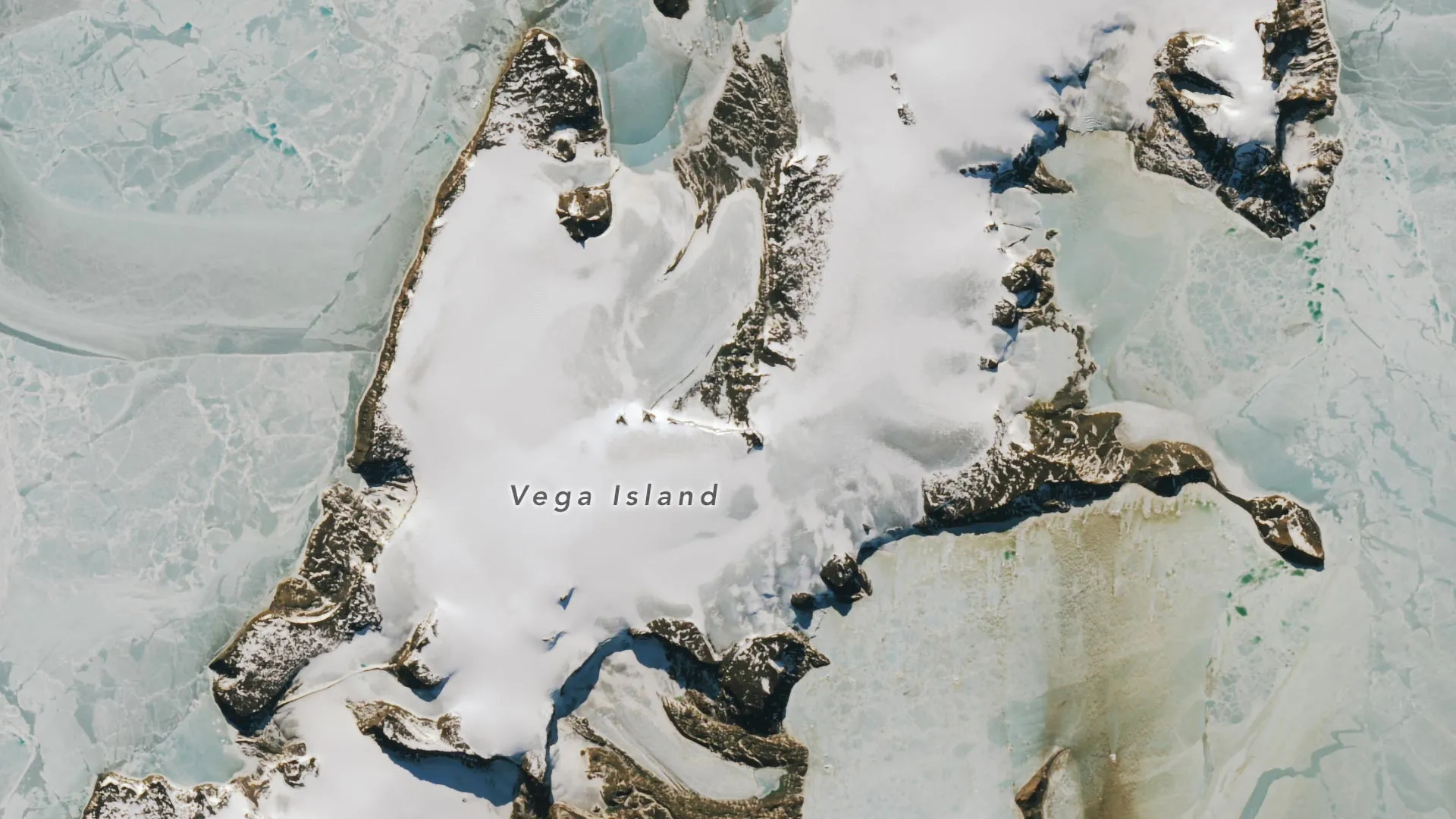
Vega Island, in the Weddell Sea east of the Antarctic Peninsula, has a striking shape when viewed from above: rocky peaks and icy formations resemble a grinning skull facing nearby Devil’s Island. NASA satellite imagery shows that this unusual landscape is also changing as snowfall, exposed ice and glacier retreat reshape the island.
NASA satellite images reveal Antarctica’s “ice skull”
Images captured by the Operational Land Imager (OLI) aboard Landsat 9 show Vega Island in different seasons. The first was taken on March 22, 2025, and the second on October 10, 2026. (Clouds covered the island in March 2026.) The March image shows the island in autumn, while the October image shows it in spring.
Several natural features create the skull-like appearance. Nunataks—rocky peaks rising above the surrounding ice—look like eye sockets from above. Transverse moraines, ridges of material deposited along glacier margins, outline the mouth. The Bahia del Diablo, or Devil’s Bay, Glacier forms what appears to be the skull’s lower jaw.
The two images also show a marked difference in snow cover. In March 2025, snow covered much of the island, consistent with March being the wettest month in the region. By October 2026, large areas were snow-free, exposing darker glacier ice.
Nichols College glaciologist Mauri Pelto said the unusually warm winter of 2026, particularly in June, contributed to the unusually large areas of exposed glacier ice observed in October. Pelto reported that exposed ice on Vega and nearby islands suggests that relatively little new snow accumulated during the winter. Snow can also be lost through sublimation, when ice changes directly into water vapor, or blown away by strong winds.
“Winter was not a special season for these glaciers.”
Why exposed ice can accelerate glacier melting
As Antarctica enters its warmer seasons, the lack of snow could have important consequences. Fresh snow reflects much of the sunlight that reaches it, while darker exposed ice absorbs more solar energy. Under stronger sunlight and warmer temperatures, these dark surfaces can heat more quickly, potentially increasing glacier melt.
Even a small amount of fresh snow can temporarily slow the process by covering exposed ice.
“Even a light layer of fresh snow from spring storms will help in the short term,” Pelto said.
If melting continues, Vega Island’s distinctive appearance could gradually change. The ice and rock formations that create the skull shape are affected as the glaciers retreat.
“If buried in snow or ice, the skull will be preserved. But if exposed to melt, it will weather, changing the jawline and enlarging the eye sockets.”
Decades of glacier loss on Vega Island
Scientists have studied Vega Island’s glaciers for decades, with satellite observations providing an important record of their condition.
One of the earliest detailed investigations was a 1982 study that used early Landsat data, aerial photographs and topographic maps to examine the island’s ice cover. The researchers identified four ice caps, rocky cliffs rising above the ice and glaciers flowing outward from the ice caps. In total, they recorded 29 glaciers on Vega Island.
One of those glaciers is Devil’s Bay Glacier, which has been closely monitored since the Antarctic summer of 1998–1999. Measurements collected during that period show a decrease in the glacier’s overall mass.
The changes are not limited to Devil’s Bay Glacier. Satellite observations from recent decades show that other glaciers on Vega Island have also lost ice, exposing more of the underlying rock.
Vega Island’s remarkable Antarctic survival story
Long before satellites began monitoring the island’s ice, Vega Island played an unexpected role in one of Antarctica’s dramatic early exploration stories.
Members of the Swedish Antarctic expedition, which took place from 1901 to 1903, visited the region to study the geography, geology, climate and wildlife of the eastern Antarctic Peninsula and surrounding areas. What began as a scientific mission became a desperate struggle for survival.
The explorers were divided into three groups, each forced to endure the Antarctic winter in a different location. Their situation became even more dangerous when ice floes destroyed their ship, leaving them stranded in one of the world’s harshest environments.
Despite the hardships, Vega Island became the setting for a moment of hope. In the spring of 1903, two of the separated groups reunited at a location later named Cape Wellmet, near what now resembles the “forehead” of the island’s giant skull.
Shortly afterward, an Argentine expedition arrived to rescue the survivors and bring their extraordinary Antarctic ordeal to an end.
Today, Vega Island brings together dramatic natural formations, a remarkable history of exploration and the effects of climate change. Its ghostly skull may be one of Antarctica’s most unusual sights, but the gradual changes in the ice that shapes it tell an even more important story.
NASA Earth Observatory image by Lauren Dauphin using Landsat data from the U.S. Geological Survey.
Source: www.sciencedaily.com