


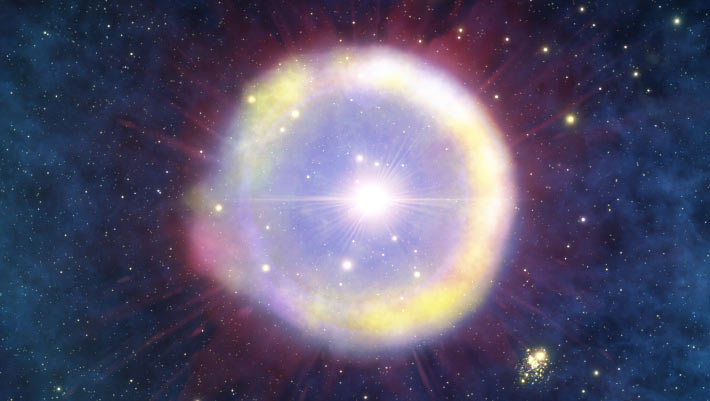
Dense star clusters in the early universe may have produced extremely massive stars, seeded intermediate-mass and supermassive black holes, and generated the dense gas that makes “little red dots” (LRDs) appear so unusual, according to astrophysicists led by the University of California, Los Angeles. The team developed an analytical model of stellar collisions in high-redshift systems and compared its predictions with Monte Carlo simulations and observations from the NASA/ESA/CSA James Webb Space Telescope.
Modeling stellar collisions
“Little red dots are a hot topic in astronomy,” said Smadar Naoz, an astrophysicist at the University of California, Los Angeles. “You can compare the work of people trying to understand LRD to the story of blind people trying to describe an elephant by touching it, but each person gives a different explanation based on what part they’re touching.”
“Our study may help bring together some of these perspectives and help us understand more about elephants.”
The researchers built a radially resolved analytical model of stellar collisions in a dense, high-redshift system. Their model applies to several types of systems, including the ancestors of globular clusters, nuclear clusters such as those surrounding the Milky Way’s central black hole, and compact, reddish LRDs.
Rather than beginning with observations, the team derived the model’s initial conditions from high-resolution cosmological simulations. They then tested its predictions against Monte Carlo simulations, finding good agreement between the main regimes.
In clusters that do not contain black holes, collisions generally produce gentle mergers rather than destructive encounters. Dynamical friction causes the merger products to sink toward the cluster’s center, where repeated collisions can build what astronomers call very massive stars.
For clusters with densities greater than approximately 100,000 solar masses per cubic parsec, nearly all of the low-mass systems tested by the team have the potential to form very massive stars exceeding 200 solar masses. In the densest model, a star grew to more than 100,000 solar masses. Stars of this scale can collapse into intermediate-mass or even supermassive black holes.
“Perhaps the strangest result of our simulation is that star clusters can repeatedly merge within star clusters until they form one massive star with a mass equal to the mass of the entire cluster,” said Claire E. Williams, a doctoral student in Los Angeles.
“Models suggest that when a star this massive reaches the end of its life, it may have no choice but to collapse itself and form a massive black hole.”
“One place in the nearby universe where star collisions often occur is the galactic center,” Williams added.
“In our model, when these very massive stars turn into intermediate-mass black holes, the system begins to resemble our own galactic center, a black hole surrounded by dense star clusters.”
Link to little red dots
The astronomers also compared their model with lensed star clusters observed at high redshift by the James Webb Space Telescope. Most of these systems form only very massive stars, but the most compact can produce objects with masses of 1,000 to 10,000 solar masses.
The outcome changes when a supermassive black hole is already present. Its gravity accelerates stars in the inner regions so strongly that collisions become destructive, tearing the stars apart and scattering their material into the surrounding space.
This process can rapidly build up extremely dense gas around the black hole, with densities matching or exceeding those estimated for LRDs. The gas could provide a ready source of fuel and may help explain the appearance of these objects.
“We show that a high frequency of destructive collisions can quickly build up a very dense gas environment around a massive black hole,” the researchers concluded, “potentially similar to the observed LRD population.”
The study was published on October 26 in The Astrophysical Journal.
Claire E. Williams et al. 2026. “A cosmological framework for stellar collisions at high redshifts in protoglobular clusters, nuclear clusters, and small red spots.” APJ 1012, 1. doi:10.3847/1538-4357/aea577
Source: www.sci.news