


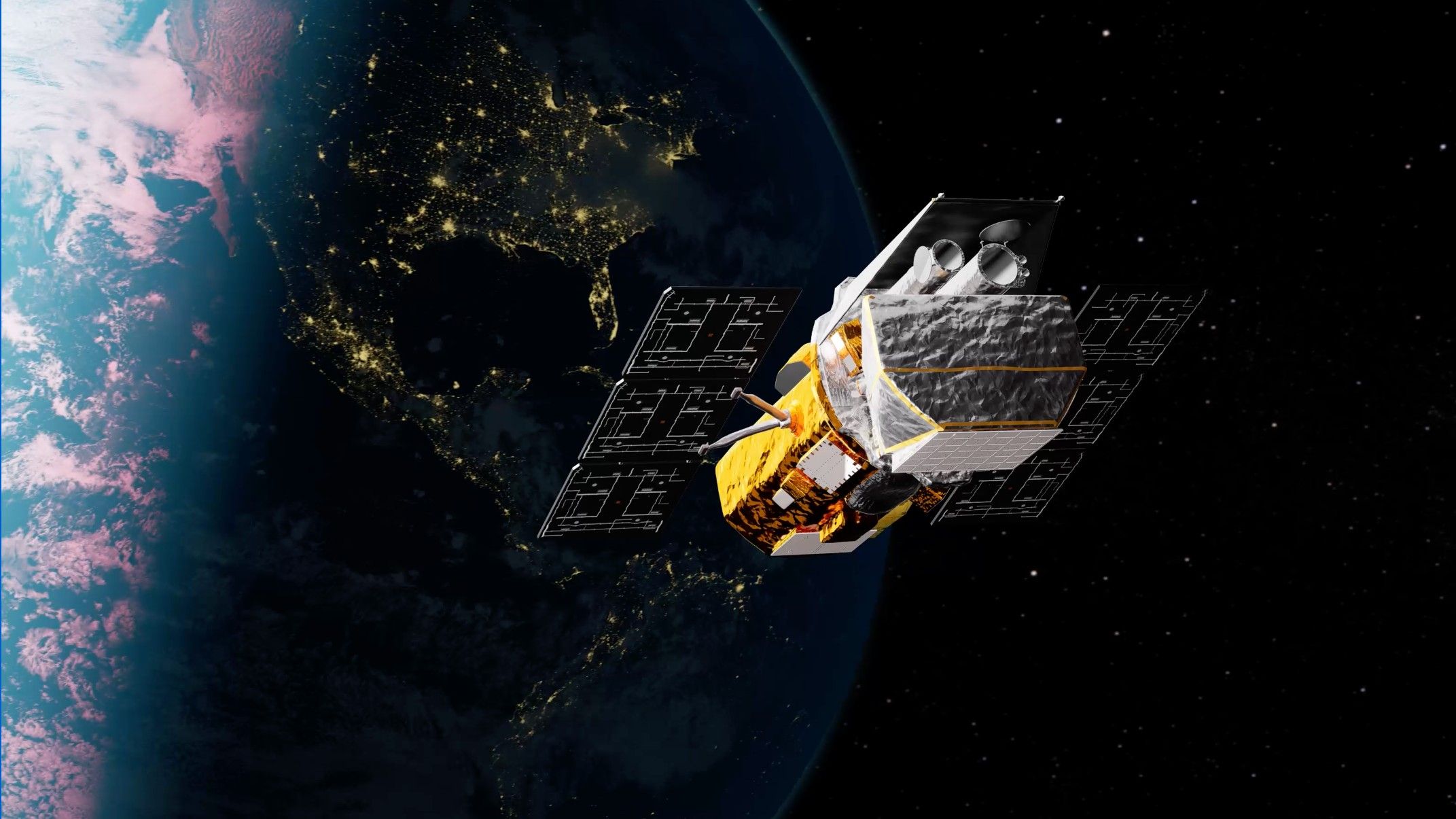
NASA’s Neil Gehrels Swift Observatory has reached the end of its nearly 22-year mission after re-entering Earth’s atmosphere. The space telescope studied some of the universe’s most powerful and mysterious events, including gamma-ray bursts, supernovas and black holes, far exceeding its original two-year mission plan.
Swift re-enters Earth’s atmosphere
According to NASA, the spacecraft re-entered the atmosphere “at 7:39 a.m. Eastern Time on Wednesday over the North Sumatra region of Indonesia, approximately 3.4 degrees north latitude and 98.6 degrees east longitude.”
NASA expected much of the telescope’s structure to burn up during its passage through the atmosphere. The agency estimated that the chance of any surviving debris falling into a populated area was 1 in 2,100. No damage or injuries were reported.
A mission that exceeded expectations
Weighing approximately 3,200 pounds (1,450 kilograms), the Neil Gehrels Swift Observatory was originally designed for a two-year mission. Instead, it operated for more than 20 years and became an important research tool for studying gamma-ray bursts, supernovas, black holes and other cosmic phenomena.
Launched in November 2004, Swift was designed to detect gamma-ray bursts: powerful explosions that occur throughout the universe. Its three telescopes allowed scientists to observe cosmic events at ultraviolet, optical and X-ray wavelengths.
The observatory could rotate and focus on different targets in the sky within minutes, enabling it to quickly track sudden events such as supernova explosions.
NASA estimates that Swift’s scientific observations contributed to approximately 7,000 research papers. The mission also produced an extensive collection of data that scientists can continue to study for years.
Why did Swift’s mission end?
Swift’s return was caused by atmospheric drag, which gradually slowed the spacecraft and lowered its orbit. Increased solar activity intensified the drag, accelerating the space telescope’s descent toward Earth.
Earlier this year, NASA considered an ambitious rescue mission that could have extended Swift’s operational life. In August 2026, a privately developed robotic spacecraft built by Catalyst Space Technologies was intended to rendezvous with Swift and propel it into a higher orbit.
However, the rescue mission failed after launch, leaving the observatory on course for re-entry.
NASA officially ended Swift’s scientific activities on October 20th. Observations had become difficult because of the spacecraft’s declining altitude. For NASA and the broader astronomical community, Swift’s story is a reminder that missions designed to last only a few years can fundamentally change our understanding of the universe.
Source: www.livescience.com