


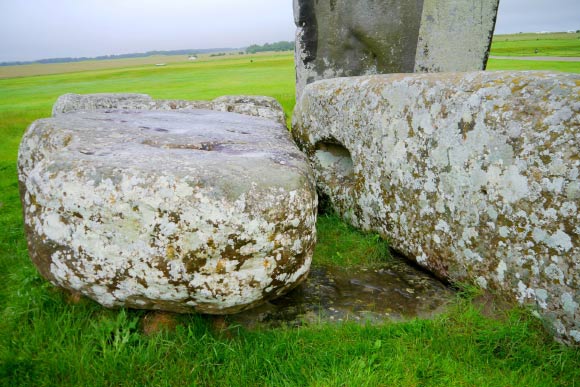
New research led by Professor Duncan Pirie of the University of South Wales challenges the prevailing theory that Stonehenge’s six-tonne altar stone came from north-east Scotland. The findings do not completely rule out a Scottish origin, but the researchers say that none of the locations examined so far matches the stone’s full set of geological characteristics.
The altar stone is a slab approximately 4.9 metres long and estimated to weigh 6 tons. It is largely buried beneath two fallen sarsen stones at the centre of the monument.
For decades, researchers thought the stone, like other small bluestones at Stonehenge, came from West Wales. In 2020, geologists showed that this interpretation was incorrect.
In 2024, a team led by Curtin University researcher Anthony Clarke analysed the ages of tiny mineral particles in fragments of the stone. The team concluded that it had travelled more than 700 kilometres from the Orcadian Basin in north-east Scotland.
Evidence points to an unresolved origin
Professor Pirie and his co-authors do not dispute earlier dating studies indicating that the stone’s heavy minerals are of Laurentian origin, meaning they are associated with ancient crust in the Scottish Highlands. However, they argue that age data alone cannot identify the stone’s source.
“This is the most comprehensive geological survey of the altar stone ever undertaken,” Professor Pirie said.
“By combining a wide range of analytical techniques, we have built the clearest picture yet of the stone’s composition and tested leading theories about its origin.”
“So far, none of the sites investigated have the same set of characteristics as the altar stone.”
“This shows that the search is not over yet, but we are now much better equipped to focus on the areas that are most likely to yield answers.”
Because the altar stone itself cannot be sampled, the researchers examined eight museum fragments confidently associated with it. They also carried out portable X-ray measurements on three small sections of stone exposed at Stonehenge.
Geological clues narrow the search
The stone is unusual because it contains interspersed barite, a barium mineral that hardens sandstone grains and gives the stone unusually high barium readings.
Old Red Sandstone, found across much of the Orcadian Basin—including the Orkney Islands, Caithness, the Moray Firth and the Shetland Islands—also contains the rare heavy mineral chromium spinel.
The stone’s mixed-layer illite/smectite clay contains about 20% expansion layers, indicating that it was not deeply buried or heated. Rocks from Caithness and the Orkney Islands have values below 10%, excluding those areas as possible sources.
The stone also contains the rare clay mineral tosudite and shows no evidence of the low-grade metamorphism found in Scotland’s southern Highlands, ruling out that region as well.
Its rippled, laminated structure is consistent with deposition by running water, while its calcite cement appears to have formed during burial rather than near the surface.
West Wales and the wider Anglo-Welsh Basin had previously been ruled out as potential sources. The researchers also found no suitable location in Scotland’s Midland Valleys, where rock fragments are abundant.
Carboniferous sandstones in southern and central Britain have a weaker isotopic match than the Old Red Sandstones. However, the isotopic record of the Old Red Sandstones remains incomplete because strontium data are missing.
Further surveys could identify the source
Professor Richard Bevins of Aberystwyth University said: “For almost a century the prevailing view was that the altar stone came from west Wales.”
“Our previous research overturned that assumption and instead pointed to Scotland as the most likely source.”
“This latest study significantly improves our survey by identifying specific geological features we need to look for, allowing us to conduct future surveys more effectively.”
“With each new piece of evidence, we get closer to solving one of Stonehenge’s most enduring mysteries.”
“In geological mystery novels like this, ruling out potential source areas is just as important as identifying new source areas,” added Professor Nick Pearce, also from Aberystwyth University.
“Each time you remove a location, you narrow your search and get closer to discovering the origin of the altar stone.”
“This stone is unique among the stones at Stonehenge, and tracing its source will provide valuable new insight into the remarkable journey to Salisbury Plain thousands of years ago.”
The study was published today in the Journal of the Geological Society.
Duncan Pirie et al. 2026. “Exploring the origin of Stonehenge’s altar stones: new sedimentological, petrographic, mineralogical, geochemical, and isotopic constraints.” Journal of the Geological Society 183. doi: 10.1144/jgs2026-090.
Source: www.sci.news