


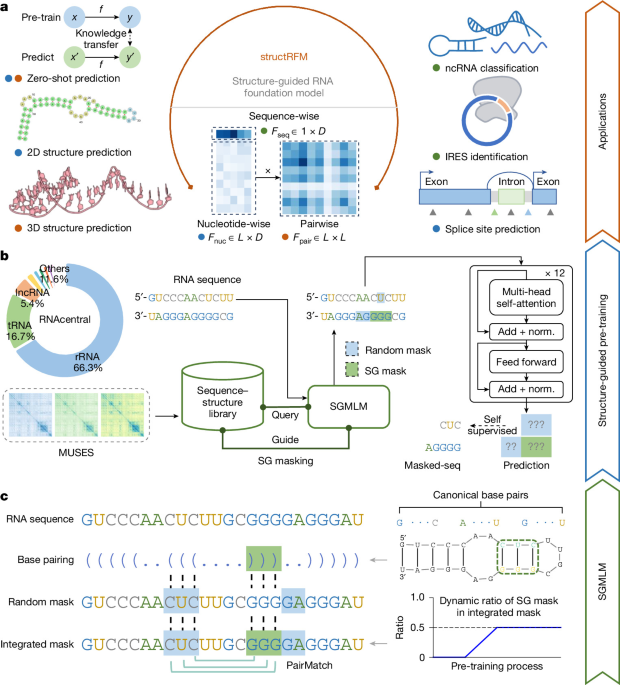
The source material is a bibliography of research on RNA structure, function and language models, spanning foundational folding algorithms, deep-learning methods, RNA databases, three-dimensional structure assessment and applications such as splicing, translation and non-coding RNA classification. It includes peer-reviewed studies, conference papers, preprints, software and datasets published from 1981 through 2026, with particular attention to modern foundation models and structure-prediction systems.
RNA structure and function research
RNA molecules perform biological functions that depend on how their sequences fold into secondary and three-dimensional structures. The references below cover computational methods for predicting those structures, models for learning RNA sequence patterns and resources for evaluating predicted models.
Foundation models and deep learning
- Abramson, J. et al. “Accurate structure prediction of biomolecular interactions with AlphaFold 3.” Nature 630, 493–500 (2024). Article.
- He, Y. et al. “Generalized biological foundation model with unified nucleic acid and protein language.” Nature Machine Intelligence 7, 942–953 (2025). Article.
- Brixi, G. et al. “Genome modelling and design across all domains of life with Evo 2.” Nature 652, 1349–1361 (2026). Article.
- Shen, T. et al. “Accurate RNA 3D structure prediction using a language model-based deep learning approach.” Nature Methods 21, 2287–2298 (2024). Article.
- Chen, K. et al. “Self-supervised learning on millions of primary RNA sequences from 72 vertebrates improves sequence-based RNA splicing prediction.” Briefings in Bioinformatics 25, bbae163 (2024). Article.
- Wang, H., Zhang, Y., Chen, J., Zhan, J. & Zhou, Y. “Zero-shot benchmarking of RNA language models in structural, functional, and evolutionary learning.” Briefings in Bioinformatics 27, bbag098 (2026). Article.
- Chen, J. et al. “Interpretable RNA foundation model from unannotated data for highly accurate RNA structure and function predictions.” Preprint at arXiv (2022), doi: 10.48550/arXiv.2204.00300.
- Penić, R. J., Vlašić, T., Huber, R. G., Wan, Y. & Šikić, M. “RiNALMo: general-purpose RNA language models can generalize well on structure prediction tasks.” Nature Communications 16, 5671 (2025). Article.
- Wang, N. et al. “Multi-purpose RNA language modelling with motif-aware pretraining and type-guided fine-tuning.” Nature Machine Intelligence 6, 548–557 (2024). Article.
- Zou, S. et al. “A large-scale foundation model for RNA function and structure prediction.” Preprint at bioRxiv (2024), doi: 10.1101/2024.11.28.625345.
- Yu, H. et al. “An interpretable RNA foundation model for exploring functional RNA motifs in plants.” Nature Machine Intelligence 6, 1616–1625 (2024). Article.
- Akiyama, M. & Sakakibara, Y. “Informative RNA base embedding for RNA structural alignment and clustering by deep representation learning.” NAR Genomics and Bioinformatics 4, lqac012 (2022). Article.
- Yin, W. et al. “ERNIE-RNA: an RNA language model with structure-enhanced representations.” Nature Communications 16, 10076 (2025). Article.
- Yang, H. & Li, K. “MP-RNA: unleashing multi-species RNA foundation model via calibrated secondary structure prediction.” In Findings of the Association for Computational Linguistics: EMNLP 2024 (eds Al-Onaizan, Y., Bansal, M. & Chen, Y.) 5278–5296 (ACL, 2024).
- Zhang, Z. et al. “RNAGenesis: Foundation model for enhanced RNA sequence generation and structural insights.” Preprint at bioRxiv (2024), doi: 10.1101/2024.12.30.630826.
- Gu, A. & Dao, T. “Mamba: linear-time sequence modeling with selective state spaces.” Preprint at arXiv (2023), doi: 10.48550/arXiv.2312.00752.
- Vaswani, A. et al. “Attention is all you need.” In 31st Conference on Neural Information Processing Systems (eds Guyon, I. et al.) 5998–6008 (NeurIPS, 2017).
- Devlin, J., Chang, M., Lee, K. & Toutanova, K. “BERT: pre-training of deep bidirectional transformers for language understanding.” In Proceedings of the 2019 Conference of the North American Chapter of the Association for Computational Linguistics: Human Language Technologies (eds Burstein, J., Doran, C. & Solorio, T.) 4171–4186 (ACL, 2019).
- Paszke, A. et al. “PyTorch: An imperative style, high-performance deep learning library.” In Advances in Neural Information Processing Systems 32: Annual Conference on Neural Information Processing Systems 2019 (eds Wallach, H. M. et al.) 8024–8035 (2019).
Secondary-structure prediction
- Hofacker, I. L. et al. “Fast folding and comparison of RNA secondary structures.” Monatshefte für Chemie 125, 167–188 (1994). Article.
- Lorenz, R. et al. “ViennaRNA package 2.0.” Algorithms for Molecular Biology 6, 26 (2011). Article.
- Do, C. B., Woods, D. A. & Batzoglou, S. “CONTRAfold: RNA secondary structure prediction without physics-based models.” Bioinformatics 22, e90–e98 (2006). Article.
- Zhu, H. et al. “Deep generalizable prediction of RNA secondary structure via base pair motif energy.” Nature Communications 16, 5856 (2025). Article.
- Sato, K., Akiyama, M. & Sakakibara, Y. “RNA secondary structure prediction using deep learning with thermodynamic integration.” Nature Communications 12, 941 (2021). Article.
- Tan, Z., Fu, Y., Sharma, G. & Mathews, D. H. “TurboFold II: RNA structural alignment and secondary structure prediction informed by multiple homologs.” Nucleic Acids Research 45, 11570–11581 (2017). Article.
- Singh, J., Hanson, J., Paliwal, K. & Zhou, Y. “RNA secondary structure prediction using an ensemble of two-dimensional deep neural networks and transfer learning.” Nature Communications 10, 5407 (2019). Article.
- Singh, J. et al. “Improved RNA secondary structure and tertiary base-pairing prediction using evolutionary profile, mutational coupling and two-dimensional transfer learning.” Bioinformatics 37, 2589–2600 (2021). Article.
- Fu, L. et al. “UFold: fast and accurate RNA secondary structure prediction with deep learning.” Nucleic Acids Research 50, e14 (2022). Article.
- Chen, X., Li, Y., Umarov, R., Gao, X. & Song, L. “RNA secondary structure prediction by learning unrolled algorithms.” In 8th International Conference on Learning Representations, ICLR 2020 (OpenReview.net, 2020).
- Zuker, M. & Stiegler, P. “Optimal computer folding of large RNA sequences using thermodynamics and auxiliary information.” Nucleic Acids Research 9, 133–148 (1981). Article.
- Huang, L. et al. “LinearFold: linear-time approximate RNA folding by 5′-to-3′ dynamic programming and beam search.” Bioinformatics 35, i295–i304 (2019). Article.
- Zakov, S., Goldberg, Y., Elhadad, M. & Ziv-Ukelson, M. “Rich parameterization improves RNA structure prediction.” Journal of Computational Biology 18, 1525–1542 (2011). Article.
- Zhang, C., Zhang, Y. & Pyle, A. M. “rMSA: a sequence search and alignment algorithm to improve RNA structure modeling.” Journal of Molecular Biology 435, 167904 (2023). Article.
- Altschul, S. F., Gish, W., Miller, W., Myers, E. W. & Lipman, D. J. “Basic local alignment search tool.” Journal of Molecular Biology 215, 403–410 (1990). Article.
Three-dimensional structure prediction and assessment
- Das, R. et al. “Assessment of three-dimensional RNA structure prediction in CASP15.” Proteins 91, 1747–1770 (2023). Article.
- Kretsch, R. C. et al. “Assessment of nucleic acid structure prediction in CASP16.” Proteins 94, 192–217 (2026). Article.
- Wang, W. et al. “trRosettaRNA: automated prediction of RNA 3D structure with transformer network.” Nature Communications 14, 7266 (2023). Article.
- Cruz, J. A. et al. “RNA-Puzzles: a CASP-like evaluation of RNA three-dimensional structure prediction.” RNA 18, 610–625 (2012). Article.
- Popenda, M. et al. “Entanglements of structure elements revealed in RNA 3D models.” Nucleic Acids Research 49, 9625–9632 (2021). Article.
- Gren, B. A., Antczak, M., Zok, T., Sulkowska, J. I. & Szachniuk, M. “Knotted artifacts in predicted 3D RNA structures.” PLOS Computational Biology 20, e1011959 (2024). Article.
- Carrascoza, F., Antczak, M., Miao, Z., Westhof, E. & Szachniuk, M. “Evaluation of the stereochemical quality of predicted RNA 3D models in the RNA-Puzzles submissions.” RNA 28, 250–262 (2022). Article.
- Miao, Z. et al. “RNA-Puzzles Round IV: 3D structure predictions of four ribozymes and two aptamers.” RNA 26, 982–995 (2020). Article.
- Yang, H. et al. “Tools for the automatic identification and classification of RNA base pairs.” Nucleic Acids Research 31, 3450–3460 (2003). Article.
- Xu, J. & Zhang, Y. “How significant is a protein structure similarity with TM-score = 0.5?” Bioinformatics 26, 889–895 (2010). Article.
- Zemla, A. “LGA: a method for finding 3D similarities in protein structures.” Nucleic Acids Research 31, 3370–3374 (2003). Article.
- Parisien, M., Cruz, J. A., Westhof, E. & Major, F. “New metrics for comparing and assessing discrepancies between RNA 3D structures and models.” RNA 15, 1875–1885 (2009). Article.
- Chaudhury, S., Lyskov, S. & Gray, J. J. “PyRosetta: a script-based interface for implementing molecular modeling algorithms using Rosetta.” Bioinformatics 26, 689–691 (2010). Article.
RNA biology, translation and splicing
- Cooper, T. A., Wan, L. & Dreyfuss, G. “RNA and disease.” Cell 136, 777–793 (2009). Article.
- Fan, X., Yang, Y., Chen, C. & Wang, Z. “Pervasive translation of circular RNAs driven by short IRES-like elements.” Nature Communications 13, 3751 (2022). Article.
- Jaganathan, K. et al. “Predicting splicing from primary sequence with deep learning.” Cell 176, 535–548 (2019). Article.
- Ozsolak, F. & Milos, P. M. “RNA sequencing: advances, challenges and opportunities.” Nature Reviews Genetics 12, 87–98 (2011). Article.
- Chu, Y. et al. “A 5′ UTR language model for decoding untranslated regions of mRNA and function predictions.” Nature Machine Intelligence 6, 449–460 (2024). Article.
- Chen, C.-K. et al. “Structured elements drive extensive circular RNA translation.” Molecular Cell 81, 4300–4318.e13 (2021). Article.
- Weingarten-Gabbay, S. et al. “Systematic discovery of cap-independent translation sequences in human and viral genomes.” Science 351, aad4939 (2016). Article.
- Zhao, J. et al. “IRESfinder: Identifying RNA internal ribosome entry site in eukaryotic cell using framed k-mer features.” Journal of Genetics and Genomics 45, 403–406 (2018). Article.
- Zhao, J. et al. “DeepIRES: a hybrid deep learning model for accurate identification of internal ribosome entry sites in cellular and viral mRNAs.” Briefings in Bioinformatics 25, bbae439 (2024). Article.
- Fiannaca, A., La Rosa, M., La Paglia, L., Rizzo, R. & Urso, A. “nRC: non-coding RNA classifier based on structural features.” BioData Mining 10, 27 (2017). Article.
- Chantsalnyam, T., Siraj, A., Tayara, H. & Chong, K. T. “ncRDense: a novel computational approach for classification of non-coding RNA family by deep learning.” Genomics 113, 3030–3038 (2021). Article.
Databases, annotation and visualization
- Berman, H. M. et al. “The Protein Data Bank.” Nucleic Acids Research 28, 235–242 (2000). Article.
- Rose, P. W. et al. “The RCSB Protein Data Bank: integrative view of protein, gene and 3D structural information.” Nucleic Acids Research 45, D271–D281 (2017).
- RNAcentral Consortium. “RNAcentral 2021: secondary structure integration, improved sequence search and new member databases.” Nucleic Acids Research 49, D212–D220 (2021). Article.
- NCBI Resource Coordinators. “Database resources of the National Center for Biotechnology Information.” Nucleic Acids Research 41, D8–D20 (2013). Article.
- Frankish, A. et al. “GENCODE 2021.” Nucleic Acids Research 49, D916–D923 (2021). Article.
- Kalvari, I. et al. “Non-coding RNA analysis using the Rfam database.” Current Protocols in Bioinformatics 62, e51 (2018). Article.
- Kalvari, I. et al. “Rfam 14: expanded coverage of metagenomic, viral and microRNA families.” Nucleic Acids Research 49, D192–D200 (2021). Article.
- Sweeney, B. A. et al. “R2DT is a framework for predicting and visualising RNA secondary structure using templates.” Nature Communications 12, 3494 (2021). Article.
- Kerpedjiev, P., Hammer, S. & Hofacker, I. L. “Forna (force-directed RNA): Simple and effective online RNA secondary structure diagrams.” Bioinformatics 31, 3377–3379 (2015). Article.
- Danaee, P. et al. “bpRNA: large-scale automated annotation and analysis of RNA secondary structure.” Nucleic Acids Research 46, 5381–5394 (2018). Article.
Additional methods, benchmarks and resources
- Mortimer, S. A., Kidwell, M. A. & Doudna, J. A. “Insights into RNA structure and function from genome-wide studies.” Nature Reviews Genetics 15, 469–479 (2014). Article.
- Cao, X., Zhang, Y., Ding, Y. & Wan, Y. “Identification of RNA structures and their roles in RNA functions.” Nature Reviews Molecular Cell Biology 25, 784–801 (2024). Article.
- Van der Maaten, L. & Hinton, G. “Visualizing data using t-SNE.” Journal of Machine Learning Research 9, 2579–2605 (2008).
- Zhang, Y. et al. “Multiple sequence alignment-based RNA language model and its application to structural inference.” Nucleic Acids Research 52, e3 (2024). Article.
- Ren, Y. et al. “BEACON: benchmark for comprehensive RNA tasks and language models.” Advances in Neural Information Processing Systems 37, 92891–92921 (2024). Article.
- Sloma, M. F. & Mathews, D. H. “Exact calculation of loop formation probability identifies folding motifs in RNA secondary structures.” RNA 22, 1808–1818 (2016). Article.
- Yang, H. et al. “Tools for the automatic identification and classification of RNA base pairs.” Nucleic Acids Research 31, 3450–3460 (2003). Article.
- Bottaro, S., Di Palma, F. & Bussi, G. “The role of nucleobase interactions in RNA structure and dynamics.” Nucleic Acids Research 42, 13306–13314 (2014). Article.
- Institute of Systems and Physical Biology, Shenzhen Bay Laboratory, Shenzhen 518107, China. “RNA language models: zero-shot evaluations in RNA secondary structure and function classification” [data set]. Zenodo (2024), doi: 10.5281/zenodo.14430869.
- Zhu, H. “structRFM pre-training data.” Zenodo (2026), doi: 10.5281/zenodo.18272040.
- Zhu, H. “heqin-zhu/structRFM: v0.0.8 (version v0.0.8)” [computer software]. Zenodo (2026), doi: 10.5281/zenodo.18274292.
Source: www.nature.com