


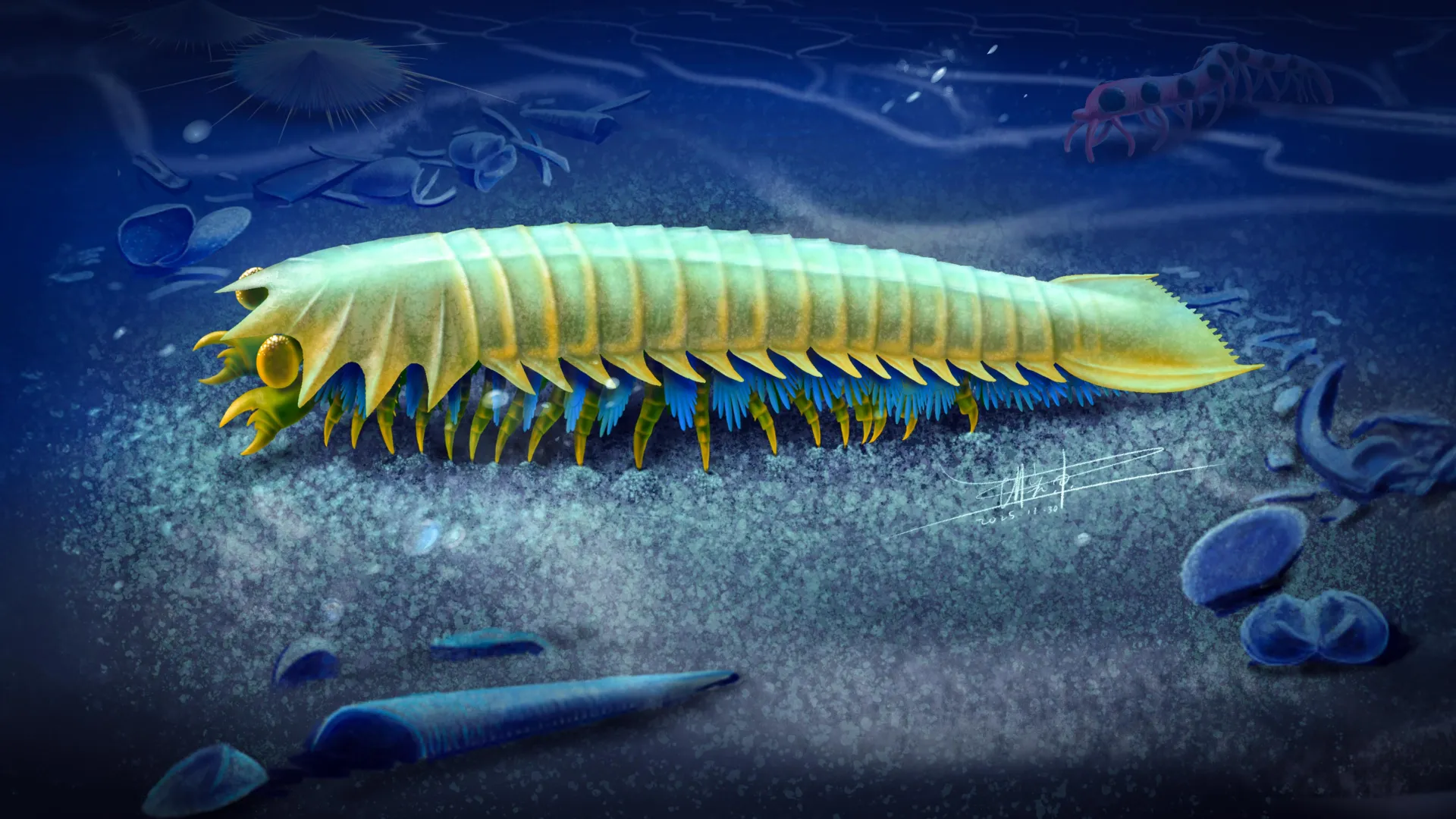
Scientists have identified the earliest known evidence of the structures that eventually evolved into spider fangs in a 518-million-year-old fossil. Researchers from Yunnan University and the University of Leicester made the discovery while studying the ancient marine animal Urokodia.
From the venomous bite of a black widow to the fictional powers of Spider-Man, spider fangs are among the most recognizable features in the animal kingdom. Their evolutionary history, however, began hundreds of millions of years before modern spiders appeared.
A new study published in Nature traces the origins of spider fangs and other chelicerae to Urokodia, a small marine creature that lived during the early Cambrian Period.
The Evolutionary Origins of Spider Fangs
Spiders belong to a major group of invertebrates known as chelicerates. This group also includes scorpions, ticks, horseshoe crabs, and other related animals. More than 100,000 chelicerate species have been described.
Chelicerates are characterized by jointed limbs and hard external skeletons. Their defining feature is a pair of specialized appendages called chelicerae, located at the front of the body. In different species, these structures have evolved into pincers, claws, or fangs used to grasp, pierce, and subdue prey.
Fossils of Urokodia were discovered at the renowned Chengjiang fossil site in Yunnan Province, southern China. The study was published on the 42nd anniversary of the discovery of this important fossil site.
The ancient creature measured approximately 2–3 centimeters long. It had large eyes on stalks at the front of its body, a segmented exoskeleton, and jointed limbs attached beneath its narrow frame. Although it looked very different from modern spiders and scorpions, it belonged to an early branch of the evolutionary lineage that produced today’s chelicerates.
X-Ray Scans Reveal Preserved Soft Tissue
Researchers from Yunnan University in China and the University of Leicester used X-ray tomography to examine the rock surrounding the fossil. The scans revealed that much of Urokodia’s soft anatomy had been preserved in a mummified state for hundreds of millions of years.
Most significantly, the researchers identified two pincer-like appendages positioned just behind the animal’s eyes. These structures represent an early form of chelicerae and provide important evidence about the evolutionary origins of the pincers and fangs found in modern chelicerates.
The fossil also preserves features on Urokodia’s legs that may have functioned as book gills, respiratory structures that allowed the animal to breathe underwater. Similar structures remain in aquatic chelicerates, including horseshoe crabs.
An Ancient Lineage of Successful Predators
Chelicerates eventually became one of the most successful animal groups in marine and terrestrial ecosystems. Species that adapted to life on land evolved into highly effective predators, while fossil evidence shows that their ancient relatives had already been hunting for hundreds of millions of years.
Despite the frightening portrayal of spiders in films such as Arachnophobia, most spider species pose little threat to humans. Their venom and fangs evolved primarily to capture and subdue prey much smaller than people.
The research was led by Professor Yu Liu of Yunnan University, who is also a visiting professor at the University of Leicester.
Professor Liu said: “We were using X-ray tomography analysis of these fossils to reveal their soft anatomy buried in the rocks for hundreds of millions of years, when suddenly we noticed the pincer-like limbs at the front of the animal. We knew immediately that this was a very exciting fossil and indeed a distant ancestor of living chelicerates like scorpions and spiders.”
A Fossil Window Into the Dawn of Animal Life
Urokodia lived in a diverse marine ecosystem during a pivotal period in animal evolution. Fossils from the Chengjiang site preserve evidence of more than 200 types of animals that inhabited the oceans more than 500 million years ago.
Co-author Professor Mark Williams of the University of Leicester’s School of Geography, Geology and the Environment said: “Urokodia was part of an ancient ecosystem of over 200 different types of animals living in the seas over 500 million years ago. These spectacularly preserved fossils provide real insights into how life was evolving on our planet at the very dawn of animals.”
The study was supported by a grant from the Department of Science and Technology of Yunnan Province (202401BC070012) to Professor Yu Liu. His research is also supported by the Yunnan Revitalization Talent Support Program.
Source: www.sciencedaily.com