


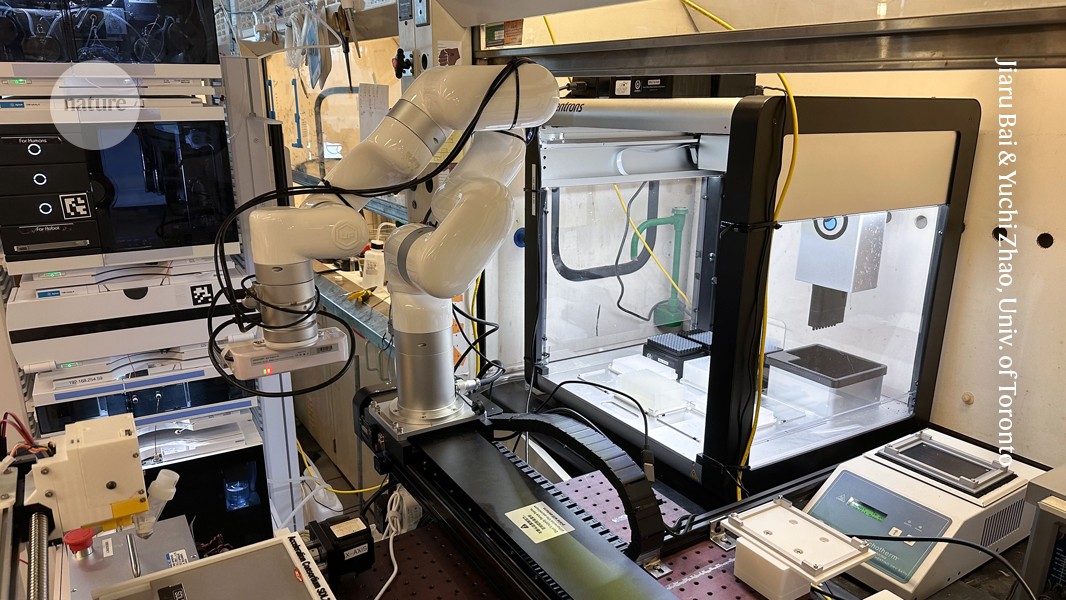
Artificial-intelligence agents could help experimental robots overcome their limited mobility and narrow skill sets by planning, testing and coordinating laboratory work before experiments begin. A scientist can describe a research programme and laboratory setup, after which the agent creates a step-by-step protocol, tests it in a virtual version of the laboratory and instructs a real robot to carry out the experiment.
Agents can also use virtual laboratories to investigate the ideal placement of equipment and robots, or to design an entire laboratory from scratch.
Testing experiments in a virtual laboratory
In one test, the agent generated more than 200 commands directing a robotic arm to move between and interact with equipment in an existing laboratory. It simulated the procedure in the virtual laboratory to check that the steps worked smoothly, and then instructed the physical arm to perform the experiment, which involved measuring the optical properties of nanocrystals.
The work has been reported as a preprint and has not been peer reviewed.
Evan Collins, a bioengineer at the Massachusetts Institute of Technology in Cambridge, described the concept as “very cool”. He said it could substantially reduce the labour needed to set up automated laboratories. However, integrating the cameras and sensors required for agents to direct experiments effectively can demand more resources than setting up a laboratory manually, Collins said.
Avoiding collisions
Virtual simulations make it easier to plan a robot’s movements and prevent collisions with other objects in the laboratory, Collins said.
Automated laboratories are often built through a time-consuming process of trial and error, followed by extensive testing and troubleshooting. The simulations could simplify that process. Yuchi (Alan) Zhao, a roboticist at the University of Toronto in Canada and a co-author of the preprint, said researchers would not need to “babysit the system” once it had been built because the agent carries out the planning and testing in a simulated environment.
Source: www.nature.com