


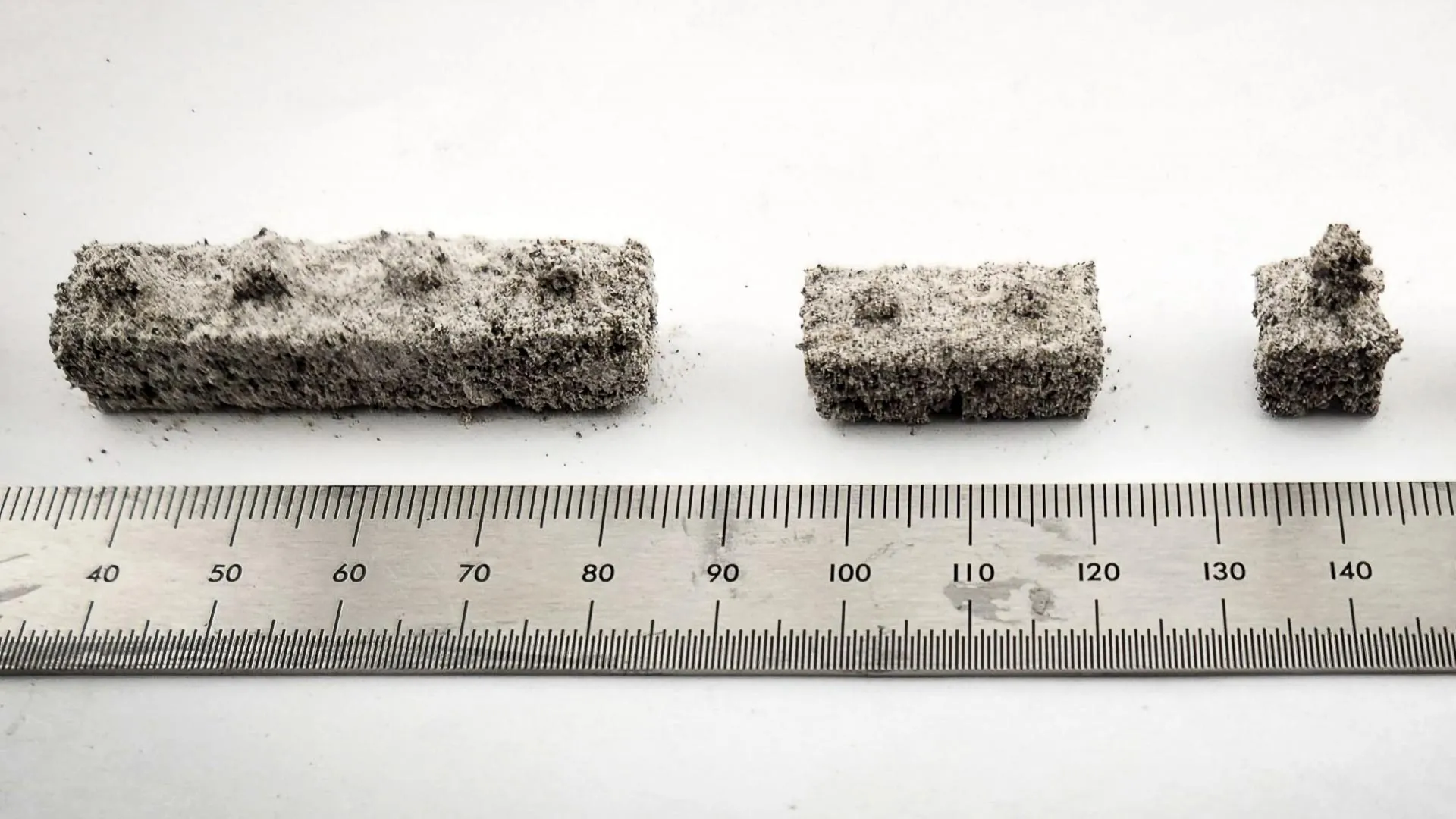
Researchers at the University of Arkansas have 3D-printed simulated lunar dust into interlocking, Lego-like bricks without adding binders. The technique could eventually enable NASA to manufacture construction materials on the Moon, reducing the equipment and supplies that would need to be transported from Earth to build a permanent lunar base.
The study was published in NPJ Advanced Manufacturing. Cole McCallum was the first author and was an undergraduate at the University of Arkansas when the research was conducted. Wang Shaw, an assistant professor of mechanical engineering at the university, was the lead author.
Turning moon dust into bricks without binders
The team used a 3D-printing method called laser powder bed fusion. The process starts by spreading a thin layer of powder across a flat surface. A focused light source heats the particles until they fuse, a process known as sintering. The printing platform then moves downward, another layer of powder is added and the particles are fused again. Repeating these steps gradually produces a three-dimensional object.
Unlike Earth’s soil, lunar regolith contains no organic matter. It consists instead of sharp, irregular debris created by billions of years of impacts from asteroids, micrometeorites and other material. Because actual lunar material is difficult to obtain, the researchers used a commercially available substitute called Lunar Highlands Regolith Simulant, or LHS-1. The material is designed to resemble samples returned by NASA’s Apollo missions in the 1960s and early 1970s.
Earlier efforts to 3D-print structures from lunar regolith relied on binders to hold the particles together. Although binders can increase the strength of printed objects, they would create a major logistical challenge because they would have to be shipped from Earth.
The University of Arkansas team used a different approach. The researchers became the first to directly bond and fuse simulated lunar regolith into reconfigurable building blocks without adding binders, using a relatively low-power light source. The lunar dust particles bond directly to one another rather than being held together by another material.
“There’s nothing else that’s bound to it. The regolith powder is bound to itself,” McCallum said.
The researchers produced small bricks a few centimeters in diameter, including pieces shaped like a cross and the letter H. Their interlocking designs allow the blocks to fit together similarly to Lego pieces, potentially enabling larger structures to be assembled from individually printed components.
However, the experimental bricks are not yet ready for demanding construction applications. Compared with objects made using binders, blocks produced solely from simulated lunar regolith have more internal pores and lower structural strength.
“These structures that we’re building can be self-supporting,” McCallum said. “However, I would hesitate to say that our process can be used for anything supporting other loads just yet.”
Challenges for building a lunar base
Several questions must be answered before the technology could be used on the Moon. Shaw said researchers still need to understand how the printing process would operate in the Moon’s low-gravity environment and vacuum. The strength and durability of the finished bricks must also be improved before they can be used in practical construction.
Despite these challenges, Shaw believes the technology could eventually offer an efficient way to manufacture construction components and larger structures for lunar settlements. The ability to produce interlocking bricks from locally available material could be particularly valuable as NASA works toward establishing a sustained human presence on the Moon.
How undergraduate research supported the project
For McCallum, the project also provided early experience in scientific research. A native of Little Rock, Arkansas, he joined Shaw’s laboratory during the early stages of his undergraduate studies at the University of Arkansas.
“He had a strong belief that undergraduates should be more involved in research,” McCallum said.
McCallum graduated in May with dual degrees in mechanical engineering and physics. His academic achievements also led to his selection as one of the first Lafayette Fellows, a competitive program that selected 30 students from more than 3,400 applicants. Established to commemorate the 250th anniversary of the United States, the fellowship supports students pursuing master’s degrees in France.
He is now studying aerospace engineering at the Institute of Advanced Studies in Aerospace Engineering, also known as ISAE-SUPAERO, in Toulouse. The institute is one of France’s leading aerospace engineering institutions.
Although his current research differs from the additive-manufacturing work he conducted in Shaw’s laboratory, McCallum said the experience helped him develop important research skills. Working through experimental difficulties and learning from failed attempts gave him a foundation for future scientific research.
“It helps you improve and overcome all the problems you face as a researcher. There are a lot of first-time failures,” he said. “It was really good to get a start before the other guys and make some mistakes early on.”
Source: www.sciencedaily.com