


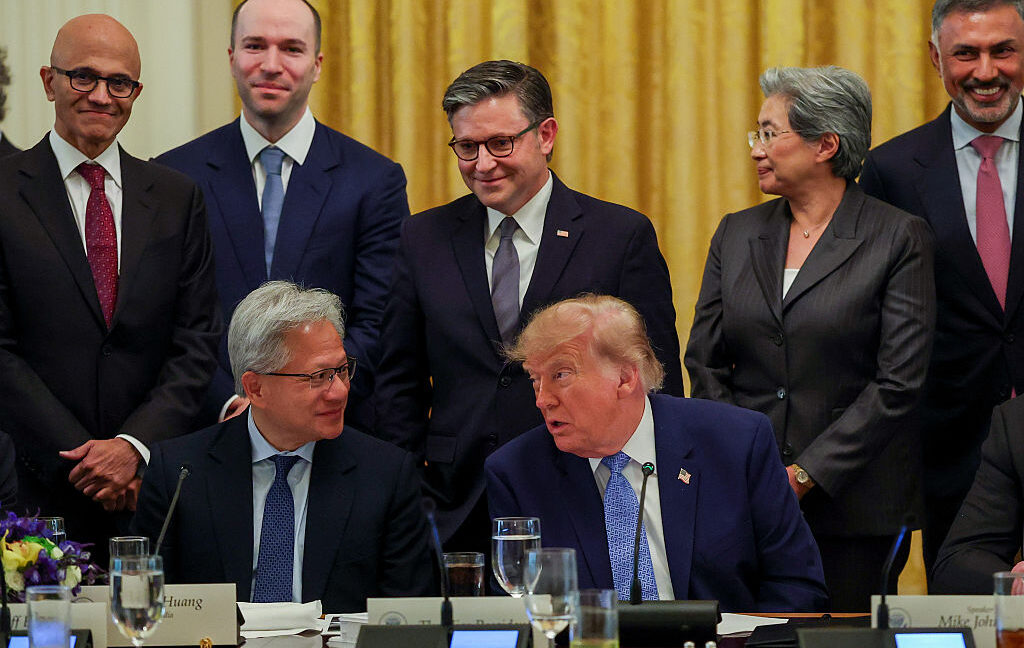
Jensen Huang’s return to Nvidia has failed to end questions about the company’s leadership, governance and exposure to the increasingly contested artificial intelligence market. Although President Trump said a US attorney general’s investigation had “exonerated” Hwang, lawmakers from both parties remained angry, and Huang and Nvidia general counsel Tim Teter are expected to appear at a congressional hearing next week.
Questions over Huang’s authority
One longtime employee said people who had known Jensen for years were shocked by the circumstances of his ouster, particularly the wave of reports about his famously brutal management style.
“He’s always had this attitude. People of a certain generation wonder why now,” the person said.
Huang has run Nvidia for 33 years and owns 3.5 percent of the company. However, he does not hold the supervoting stock that allows founders and CEOs such as Mark Zuckerberg to overrule their boards.
“If I’m a Jensen fan, my first question today is, ‘How can I get super voting stock so I can tell people to fuck off next time?’” said a person who has worked with Fan in Washington.
Political and congressional scrutiny
Hwang’s return does not signal an end to the company’s problems. President Trump said on Monday that the US attorney general’s office had “conducted a very thorough investigation” into Hwang’s conduct and had “exonerated” him. On the same day, however, both Democratic and Republican lawmakers expressed fury.
Huang and Nvidia general counsel Tim Teter will be summoned to a congressional hearing next week.
As of Monday, no Cabinet member other than Vance had publicly supported Hwang’s return. Commerce Secretary Howard Lutnick was monitored for Nvidia’s ability to sell to Megaspeed and was not involved in board discussions, according to people close to him.
Governance concerns persist
Inside the company, Hwang’s personal management style has drawn scrutiny. Concerns include the absence of a formal succession plan and his tight control over subordinates, with help from his daughter and son-in-law.
One of Jones’ longtime colleagues said Hwang’s decision to return would do little to ease public and market concerns about artificial intelligence.
“The midterm elections showed that a broad swath of the public is deeply skeptical of all things related to AI,” the official said. “The Jensen case masks a growing market consensus that speculative data center construction using debt is highly vulnerable.”
The development also does not reduce scrutiny of Nvidia’s board, whose membership overlaps with Huang’s longtime allies and lacks key technology and national security figures.
“We’re happy to have Mr. Jensen back, but the board’s on-and-off reactions again are frankly clown-like,” Bernstein analysts wrote on Monday. They added: “It raises legitimate questions about their judgment and process, and you can’t help but wonder how they make other important decisions.”
Other critics were more direct. “Corporate governance is going the same way as the Dodo,” said one large Nvidia investor.
© 2026 Financial Times Company. Unauthorized reproduction prohibited. May not be redistributed, copied or modified in any way.
Source: arstechnica.com