


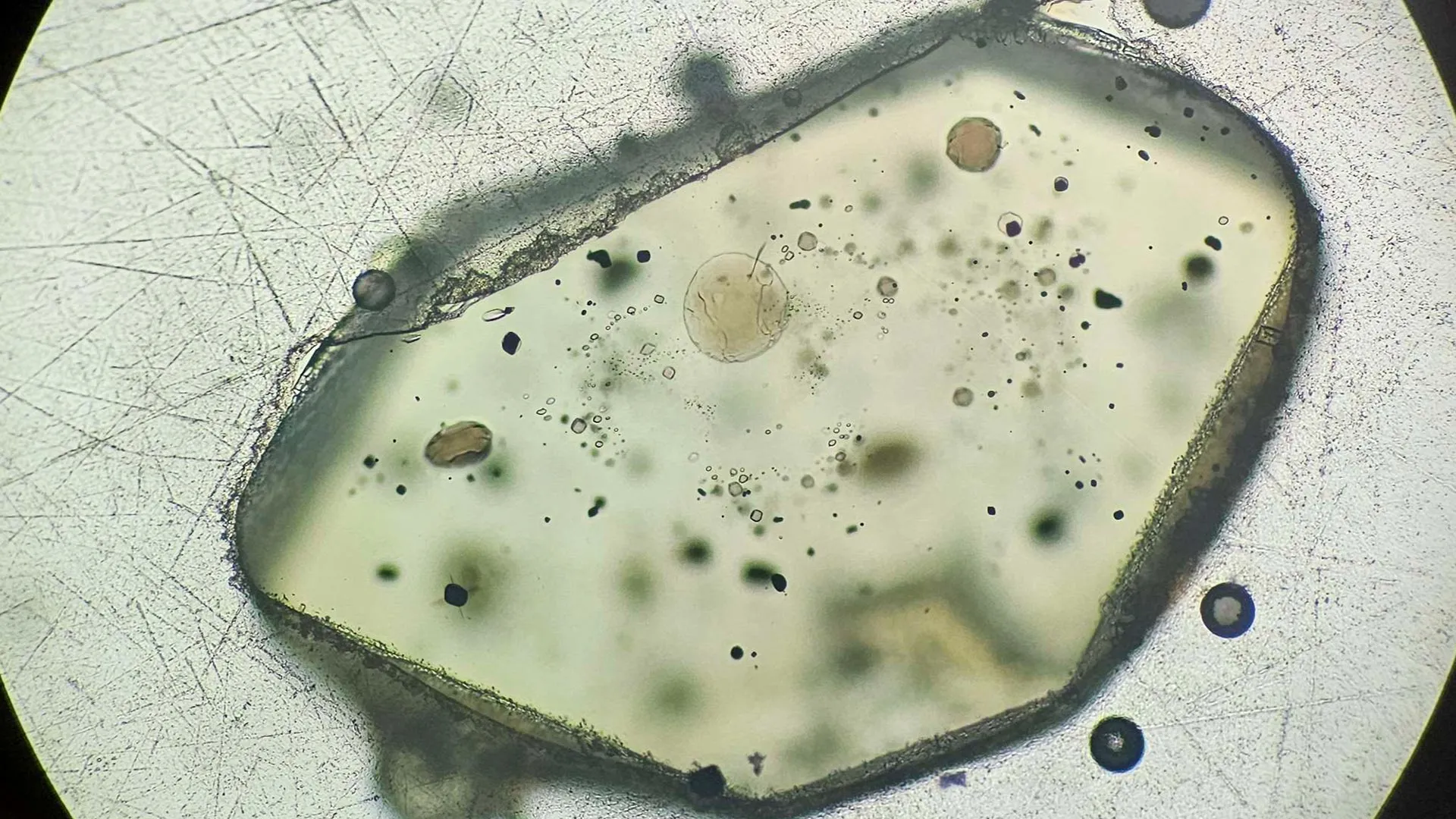
Carbon is essential to life, but scientists are still investigating where Earth’s carbon originally came from. A new study of volcanic rocks from Hawaii has found an unusual carbon-isotope signature that may point to carbon delivered by ancient carbonaceous chondrites, meteorites that formed in the outer solar system. The findings also raise the possibility that some of this carbon became trapped in Earth’s core before slowly returning toward the surface through mantle plumes and volcanic eruptions.
The study, published in Proceedings of the National Academy of Sciences, focuses on rare carbon dioxide signatures preserved in volcanic rocks. Researchers say these chemical fingerprints could represent carbon that originated in Earth’s core and migrated upward through the planet’s interior.
“We think we have found evidence that carbon from the Earth’s core is leaking into the core-mantle interface and moving to the surface,” said lead author Eve Musallam, an associate professor in the Department of Earth and Environmental Sciences at Columbia University’s Lamont-Doherty Earth Observatory.
How carbon could escape from Earth’s core
Understanding how carbon might travel from Earth’s deepest interior to the surface requires a look at the planet’s internal structure.
Beneath Earth’s thin outer crust lies the mantle, a vast region of mostly solid rock that extends about 1,800 miles downward. Beneath the mantle is the outer core, a layer of molten metal roughly 1,400 miles thick that surrounds a very hot, dense solid inner core.
Scientists believe that most of Earth’s carbon is stored in the core. Directly studying that material, however, is beyond current technology, and researchers may never be able to obtain samples from such extreme depths.
Volcanic activity provides an indirect way to investigate what lies below. Recent research suggests that some elements can escape from the outer core and enter the overlying mantle. From there, they may be transported toward the surface by giant columns of hot rock known as mantle plumes.
These plumes begin near the core-mantle boundary. As they rise, portions of the rock can partially melt and form magma, which may eventually erupt from a volcano.
As magma cools, crystals begin to form. In some cases, the crystals trap tiny droplets of molten material before dissolved gases can escape. These droplets, known as ungasified molten inclusions, preserve chemical information about the original magma.
“These melts are magma fossils,” Musallam said.
Because magma contains dissolved gases such as carbon dioxide, the microscopic inclusions give scientists a rare opportunity to examine carbon that may have traveled upward from Earth’s core.
A Hawaiian volcano reveals an unusual carbon signature
Hawaii is well suited to this kind of research. Previous studies have shown that its volcanoes receive magma associated with deep mantle plumes, potentially providing access to material originating near the core-mantle boundary.
Musallam and her colleagues studied volcanic rocks from eruptions in Kilauea and the Tantalus Rift. Using recently developed analytical techniques, they measured carbon isotopes preserved inside ungasified molten inclusions.
Carbon isotopes are forms of the same element with slightly different masses. Comparing their relative abundance can reveal chemical signatures that provide clues about where carbon came from and what processes it experienced.
The Tantalus Rift samples are thought to represent magma that originated near the outer edge of the mantle plume. Previous studies have found that typical mantle carbon has an isotopic signature of about -5 to -7 permil, a measurement of small differences in isotope ratios. The Tantalus Rift samples closely matched that expected range.
The Kilauea sample showed a markedly different result.
Magma beneath Kilauea is thought to originate near the center of the mantle plume, where material may be rising from near the core-mantle boundary. The researchers detected carbon in these samples with a much heavier isotopic signature of about -1 permil.
This value has rarely been observed and differs substantially from the signature normally associated with Earth’s mantle.
“This signature is very different from normal mantle,” Musallam said. “This means it must be contaminated by another carbon source, and that carbon source is probably carbon from the core.”
The team considers Earth’s core the most likely source, but Musallam emphasized that the evidence is not conclusive. More measurements are needed to determine whether the carbon truly came from the core.
Ancient meteorites may explain Earth’s carbon
The unusual carbon signature may also provide clues about events more than 4.5 billion years ago, when Earth was forming.
Musallam said the carbon isotopic composition of Earth’s core should preserve “a trace of the building blocks from when the Earth was created.”
To explore that possibility, the researchers compared the Kilauea measurements with carbon signatures found in ancient meteorites. They found similarities with a group known as carbonaceous chondrites.
Chondrites are among the oldest materials known in the solar system, dating back more than 4.5 billion years. They preserve clues about the primordial material from which the planets formed.
“The Earth is made entirely of chondrites,” Musallam explained. “They are the building blocks of all terrestrial planets.”
Scientists generally divide chondrites into two broad categories. Non-carbonaceous chondrites formed in the inner solar system, while carbonaceous chondrites, which contain more carbon, formed in the outer regions.
How much each type contributed to Earth’s formation remains an open scientific question. The new findings support the possibility that carbonaceous chondrites made an important contribution during the later stages of Earth’s development.
According to the researchers’ proposed explanation, carbon-rich meteorites struck the growing planet at a time when Earth was better able to retain carbon delivered by incoming material. Some of that carbon may have accumulated deep inside the planet and become part of its vast internal carbon reservoir.
Over billions of years, carbon from that reservoir may have migrated upward through mantle plumes and emerged in volcanic eruptions.
If this interpretation is correct, some of the carbon essential to life today may have arrived from the outer solar system on meteorites early in Earth’s history.
From space to the biosphere
Important questions remain unanswered. The researchers have not conclusively demonstrated that the anomalous carbon came from Earth’s core, and they have not determined exactly how much of Earth’s carbon originated in carbonaceous meteorites.
“We don’t really know. We need to measure more,” Musallam said.
Even so, the discovery suggests a possible connection between the formation of the solar system, the inaccessible depths of Earth, and the carbon that makes life possible.
It also raises the possibility that some carbon in living organisms followed an extraordinary path. After arriving on Earth billions of years ago, it may have become incorporated into the planet’s metallic core, moved slowly upward through the mantle, and eventually returned to the surface through volcanic eruptions.
“It’s fun to think about it. We’re made of carbon, right? It’s very interesting to think that at some point some of this carbon could have combined with the iron in the planet’s core and made its way from the volcanoes to the surface and is now part of the biosphere.”
The study was co-authored by Guillaume Georgeais, HyunJoo Lee and Bridgett Holman of the Lamont-Doherty Earth Observatory; Damanveer S. Grewal of Yale University; Estelle F. Rose Koga of the Orléans Scientific Institute; Alan Lerner of the U.S. Geological Survey; Paul J. Wallace of the University of Oregon; and Natalia Gower.
Source: www.sciencedaily.com