


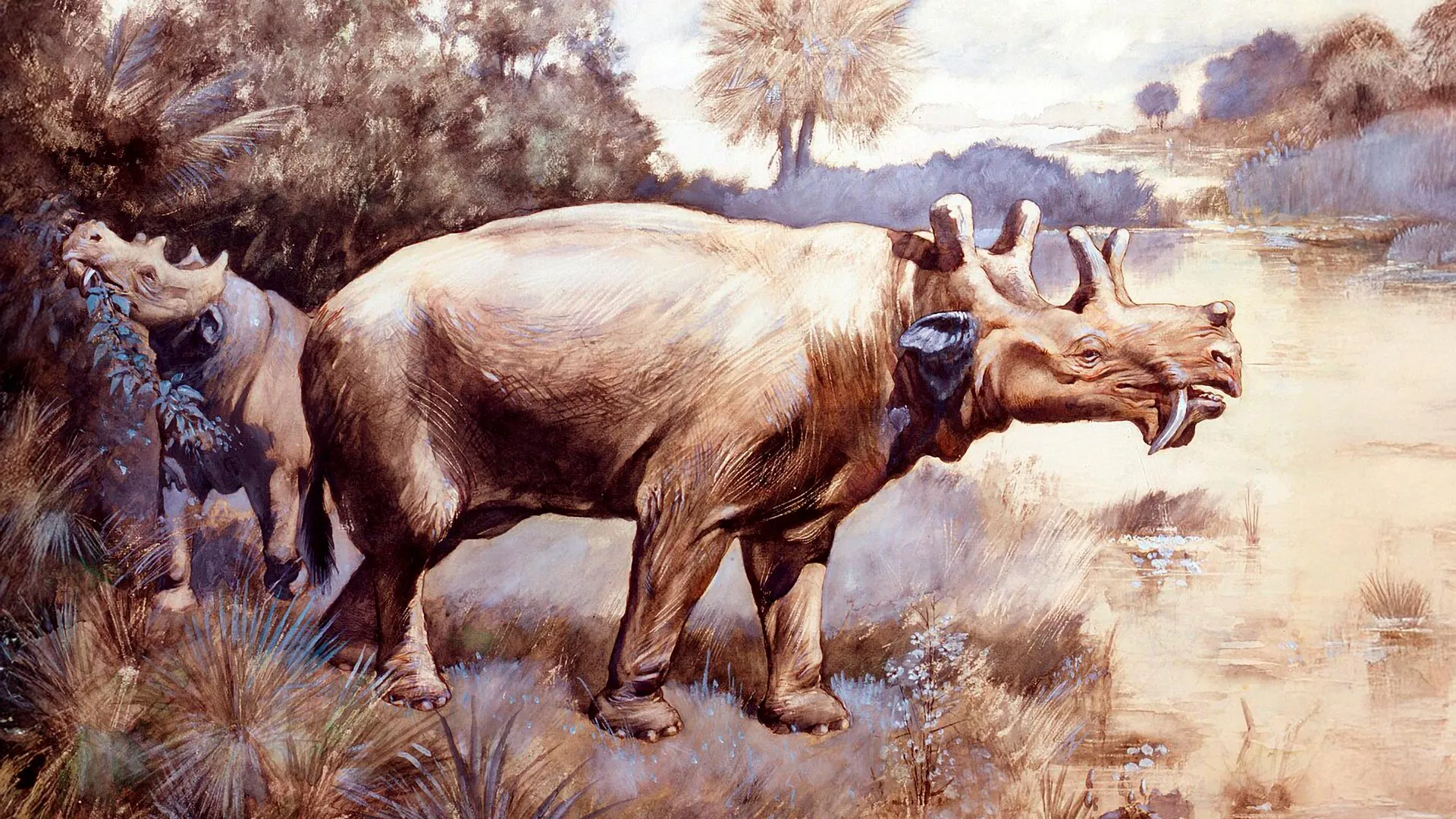
For generations, paleontologists have treated uintatheres—extinct giant mammals known for their huge bodies, cranial horns and oversized canine teeth—as a classic example of sexual dimorphism, in which males and females of the same species have different physical traits. New research from the University of Kansas, however, suggests that these differences may have been far less pronounced than scientists have assumed.
Uintatheres first appeared about 58 million years ago, less than 10 million years after an asteroid wiped out the dinosaurs, and survived for roughly 20 million years. Researchers have traditionally interpreted males as substantially larger than females, with more prominent horns and canine teeth.
“Males are interpreted to be much larger and have much more prominent cranial features than females,” said study author Kevin Mulcahy, a doctoral student at the KU Biodiversity Institute and Museum of Natural History.
A broken fossil tooth prompts a broader investigation
The investigation began when Mulcahy and K. Christopher Beard, the institute’s senior curator and Mulcahy’s doctoral adviser, tried to identify a broken upper molar recovered during fieldwork in Montana. They suspected that it belonged to a uintathere but needed to compare it with additional fossil specimens.
“We did a research visit to the American Museum of Natural History in New York, and our main goal there was just to compare the tooth to teeth from other areas and figure out what kind of animal it was,” Mulcahy said. “They have such a large collection, an entire shelf occupied by these skulls, each almost a meter long. These are well-known specimens in the literature, and I originally only looked at them to compare teeth, but I realized there was a huge amount of variation in ways that didn’t seem binary.”
That unexpected variation led Mulcahy to measure skulls in the museum’s collection.
“While I was there, I really quickly used a ruler to collect a bunch of measurements of the skull,” he said. “I started playing around with statistics. There are ways to look at different measurements and see if they best fit a classic unimodal distribution. Or, if you think you’re dealing with something that exhibits strong sexual dimorphism, you’ll see something that has a bimodal distribution. So you have two modes, one for males and one for females.”
Skull measurements do not show two distinct groups
If male and female uintatheres differed as dramatically as previously suggested, researchers would expect skull measurements to form two relatively distinct groups. Mulcahy’s initial analysis did not reveal that pattern.
“Just because one group of specimens looked larger than another didn’t mean there was another group with smaller horns or canines,” he said. “So I was kind of curious: Are these really good examples of sexual dimorphism? Is there any actual evidence that that’s happening in the morphology of these skulls, especially in the distribution of the range of morphology that we’re observing?”
Mulcahy collected additional measurements from fossils held at other institutions and expanded the analysis with new statistical techniques. The final dataset contained about 30 skulls from a single extinct species, Uintatherium anceps.
The results provided some suggestion of physical differences between males and females, but the evidence was much weaker than expected. A major difficulty in studying extinct animals is that researchers generally cannot independently determine the sex of individual fossil specimens.
“Maybe there were little signs of dimorphism here and there, but nothing really concrete,” Mulcahy said. “I had an idea: Maybe the techniques I’m using aren’t robust enough to actually measure sexual dimorphism. With fossil animals, we don’t actually know which specimens are male and which are female. You could infer and test whether the samples you guessed are different, but that would be very circular, because you might choose the most extreme sample as one gender and the least extreme one as the other gender. Of course they would be different.”
Modern bison offer a test of the method
To determine whether the statistical methods could reliably detect sexual dimorphism, Mulcahy turned to a living mammal: the bison. Unlike fossil specimens, modern bison can be confidently classified by sex.
Bison also offered a useful comparison because they are large, horned herbivores with an ecology that researchers have proposed may be comparable to that of uintatheres.
“When you’re working with live animals, all you have to do is take out the males and females and compare them,” Mulcahy said. “Bison are also very large herbivores, they have a similar ecology to uintatheres, and they also have large horns. What I noticed was that the dimorphic signals that we were finding in bison were much clearer. As we were looking at bison, it was almost perfect that all the females were most similar to females and all the males were most similar to males.”
Using the same method, the researchers identified much clearer physical differences between male and female bison. That contrast suggests that the weak signal in Uintatherium was not solely the result of shortcomings in the statistical techniques.
Victorian assumptions may have influenced interpretations
Mulcahy believes that historical and cultural attitudes may help explain why paleontologists came to accept such pronounced differences between male and female uintatheres. Many extinct species were first identified and described in the late 19th and early 20th centuries, when prevailing ideas about gender may have influenced scientific interpretation.
“That was the time when evolution, sexual selection, natural selection, all of those things were really starting to come into play,” he said. “I think it’s really important to remember that these things were first discovered in the late 1800s by male paleontologists who were working with a very Victorian mindset. This idea was basically assumed at that point that men were going to be bigger and scarier than women, which is very interesting. When you step back and actually test that hypothesis, it doesn’t actually hold true.”
Uintatheres have long been considered one of the clearest examples of sexual dimorphism in the fossil record. The findings therefore could have implications beyond these rare prehistoric mammals, suggesting that other extinct species may also have had less pronounced differences between males and females than scientists once believed.
Rethinking the evolution of mammalian sex differences
The study adds to growing evidence that challenges the assumption that mammalian males are generally larger than females. Dramatic differences in body size and appearance may have evolved independently in several mammalian lineages rather than being traits inherited from the earliest common ancestor of mammals.
Research on living mammals similarly suggests that strong male-biased differences are not as widespread as historically assumed.
“Strong, large-male sexual dimorphism is probably not something that runs at the root of the mammalian tree, and it is almost certainly something that has evolved independently and several times in the mammals where this pattern is seen today,” Mulcahy said. “It has long been thought that sexual dimorphism is the norm and that most species exhibit males being larger than females. But just a few years ago, a paper was published showing that most species of modern mammals either do not exhibit dimorphism or are actually larger than females. The idea that males are always larger than females is really just a choice of which animals people were looking at and what biologists of the past were interested in.”
Source: www.sciencedaily.com