


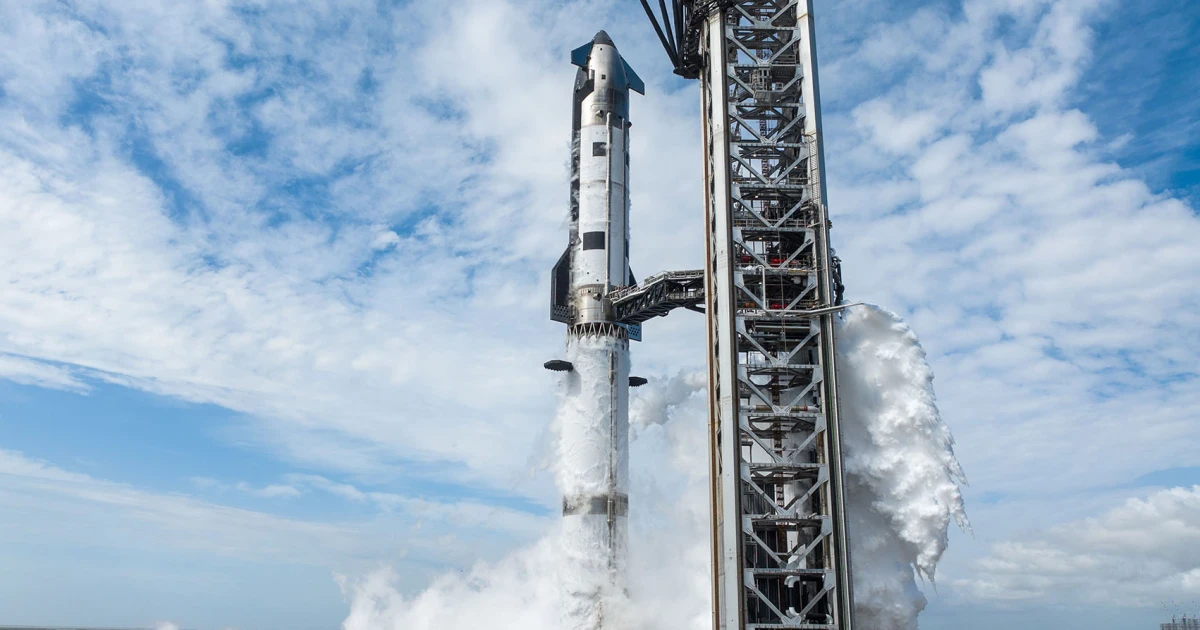
SpaceX is gearing up for the launch of its latest Starship megarocket prototype, which is integral to NASA’s mission of sending astronauts to the moon within the next two years. This pivotal test flight is scheduled for Tuesday.
Subscribe to read this story without ads
Get unlimited access to ad-free articles and exclusive content.

The stakes for SpaceX’s Starship are higher than ever. Developed as part of NASA’s Artemis program, SpaceX is in competition with Jeff Bezos’ Blue Origin for the opportunity to create a lunar lander intended for NASA’s 2028 moon landing mission.
In parallel, SpaceX is preparing for a highly anticipated IPO set to take place next month, potentially marking the largest IPO in history. Reuters reported that a prospectus could be available as soon as Wednesday, right after the Starship test flight, in anticipation of a mid-June market debut.
This development comes in the wake of Starship’s previous setbacks, which included uncontrolled re-entries and mid-flight explosions during tests last year.
The latest test flight of Starship, its 11th, was conducted seven months ago. Since then, significant redesigns have been made to both the Super Heavy booster and the upper stage, referred to as Ship. This upcoming launch will be the first test of SpaceX’s new third-generation Starship, dubbed V3, which promises to be larger, more powerful, and closer to full reusability. Starship V3 stands at an impressive 408 feet when fully stacked, surpassing its predecessor.
The launch is set to occur from a new pad at SpaceX’s Starbase facility in southern Texas, within the launch window that opens at 6:30 p.m. ET.
This flight plan is similar to prior missions. According to SpaceX, during the suborbital test, Starship will aim to deploy 22 mock Starlink satellites and reignite one of the six Raptor engines in the upper stage, showcasing the technology required for a deorbit burn when returning to Earth.
Tuesday’s mission is expected to last around 65 minutes, with the upper stage targeting a splashdown in the Indian Ocean if all goes as planned. SpaceX aims to make the vehicle reusable by catching it with a mechanical arm on the launch tower at the Starbase facility in Texas.
While SpaceX successfully demonstrated a similar catch maneuver using the Super Heavy booster, this time, the booster will land offshore in the Gulf of Mexico, as opposed to returning to the launch site, per SpaceX’s information.
Starship’s development has progressed more slowly than NASA had hoped. Initially slated for a debut flight in 2023, setbacks delayed progress. NASA had originally planned for astronauts to land on the moon during the Artemis III mission, but this was postponed earlier this year to allow for more experiments in low Earth orbit and provide SpaceX and Blue Origin additional time to develop their lunar landers.
In a House subcommittee hearing last month, NASA Administrator Jared Isaacman informed lawmakers that the Artemis III mission is now expected to launch in late 2027, instead of mid-2027 as previously stated.
SpaceX faces a tight timeline as it races to prepare Starship for the Artemis III mission next year, which will require Starship’s upper stage to rendezvous with NASA’s Orion spacecraft—the same vessel that carried Artemis II astronauts around the moon while orbiting Earth last month. The objective is to qualify Starship to transport astronauts to the moon in the coming year.
Plans for the Artemis IV mission in 2028 envision Starship’s upper stage orbiting the moon and docking with Orion, subsequently shuttling a crew down to the lunar surface. Following this, the spacecraft will launch from the moon with astronauts aboard, dock with Orion once more, and ensure the crew’s safe return to Earth.
Noteworthy upgrades made to Starship V3 include new Raptor 3 engines for both the Super Heavy and Ship, generating an impressive 18 million pounds of thrust when combined.
Additionally, SpaceX has enhanced the propellant tank volumes in Starship and decreased the number of grid fins on the booster, which help guide the spacecraft’s return to Earth.
“These upgrades are designed to significantly enhance Starship’s capabilities, facilitating successful reuse, propellant transfer in space, Starlink satellite deployment, and establishing orbital data centers, enabling travel to the Moon and Mars,” SpaceX states on its website.
Successfully achieving propellant transfer in space will be crucial, as Starship’s upper stage will need to refuel for lunar missions. While SpaceX has yet to attempt this maneuver, a successful test flight on Tuesday could pave the way for these vital advancements.
Source: www.nbcnews.com