


Close Menu
HitechubHitechub
    What's Hot
    Science

    Ancient DNA Uncovered: How Frozen Squirrel Feces Is Preserving Genetic Material from Hundreds of Species

    Science

    Exploring the Risks of an AI Hallucination-Based Encyclopedia: What Could Go Wrong?

    Science

    Is the Arctic Ocean Mitigating or Intensifying Global Warming? Insights from Cyworthy

    Important Pages:
    • About Us
    • Privacy Policy
    • Terms & Conditions
    Facebook X (Twitter) Instagram Pinterest
    Facebook X (Twitter) Instagram
    HitechubHitechub
    Tuesday, June 9
    • Technology
      1. AI
      2. Gadgets
      3. View All

      This is the most popular CEO in the world

      Sectors in which “Chat-GPT” is most often used

      AI Pioneer Expresses Concern About Potential for AI to Surpass Humanity

      Artificial intelligence has begun to “swallow” professions

      What’s new in Android 14

      Europeans have about 700 million old mobile phones in their drawers

      Here’s how you can tell if your phone is being tapped

      “Sneaker X” – computer case in the shape of a sneaker

      Russian Gamers Unite to Prevent Nuclear War: Join the Fight Online

      Challenges of Space Travel: Why Journeying to Space is So Difficult

      NASA Astronaut Casts Historic Vote from Space

      Discover the Future of Comfort: What If You Could Wear a Chair?

    • Science
      1. Space
      2. Wheels
      3. View All

      Galaxies in the universe are growing more slowly than they should

      “Espace” presented the new lander “Apex 1.0”

      The largest asteroid sample ever collected has arrived on Earth

      (VIDEO) Incredible flight of the Parker Solar Probe

      Toyota wants to make a new generation battery with a range of up to 1,200 km

      Meet Toyota’s lunar “baby” that could make exploring the Moon easier

      Microlino – Is this the perfect city car?

      Alfa Romeo 4C gets an electric successor

      NASA Unveils Astronauts for Artemis III Mission to Test Innovative Lunar Lander

      Ancient DNA Uncovered: How Frozen Squirrel Feces Is Preserving Genetic Material from Hundreds of Species

      How Increasing Individualism is Impacting Modern Love Lives

      Unlock the Benefits of Sleep Without Actually Sleeping

    HitechubHitechub
    Home » Unraveling a Cosmic Case of Mistaken Identity: The Time to Solve It is Now
    Science

    Unraveling a Cosmic Case of Mistaken Identity: The Time to Solve It is Now

    Share Facebook Twitter Pinterest WhatsApp
    Share
    Facebook Twitter LinkedIn Pinterest WhatsApp
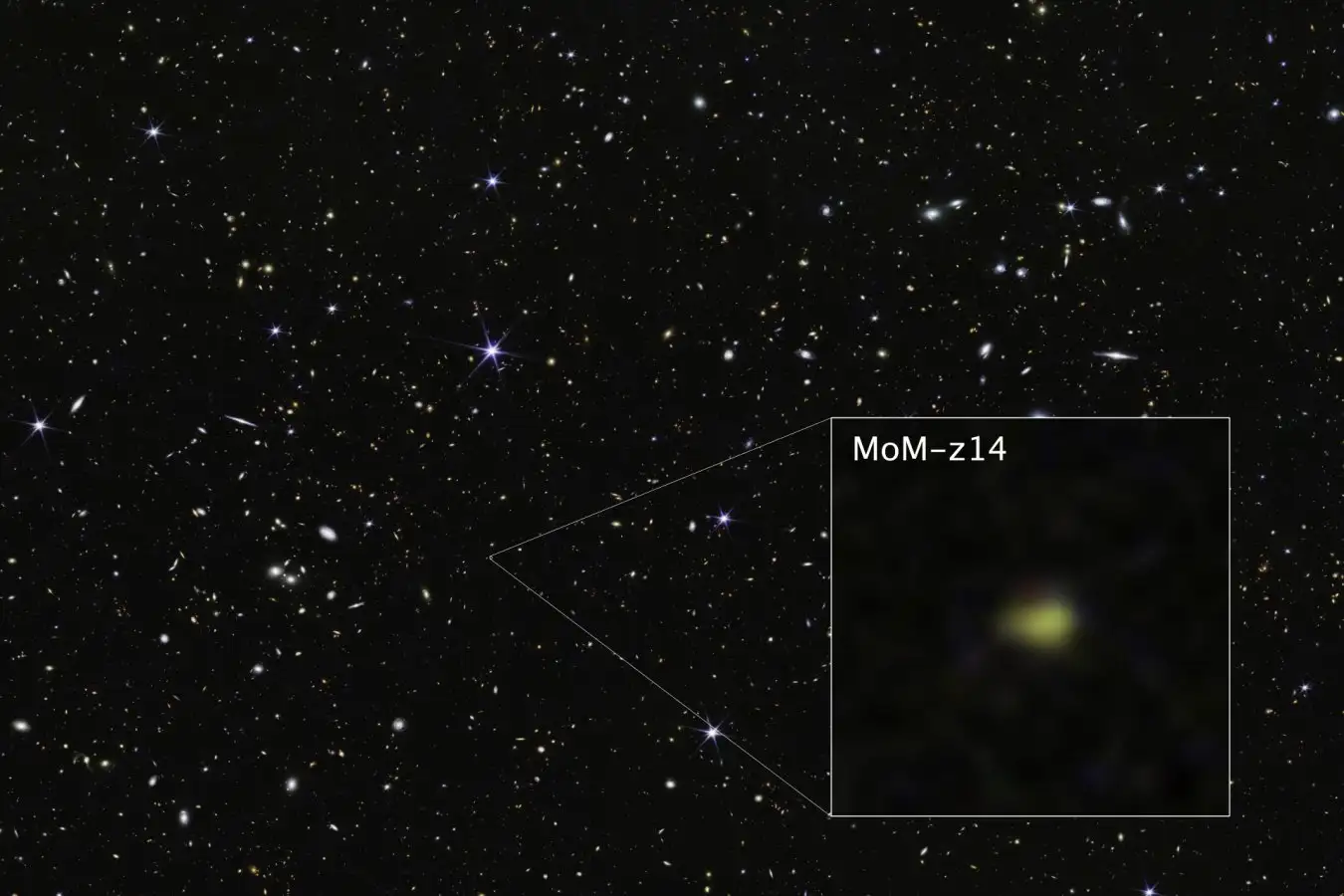
    Galaxy MoM-z14

    Galaxy MoM-z14: A “Cosmic Miracle”

    J. DePasquale (STScI)

    As a scientist observing today’s galaxy research landscape, I feel we are in remarkable times. Despite funding fluctuations in the US and UK, our cosmic knowledge is growing exponentially. The launch of the James Webb Space Telescope (JWST) on Christmas Day 2021 has transformed our understanding of early galaxies. These celestial structures were found to be both brighter and more densely packed with stars and hot gas than previously believed.

    JWST’s groundbreaking observations have revealed galaxies existing just 300 million years post-Big Bang. While it may seem like a lengthy timeline, it’s just a tiny fraction (2.14%) of the universe’s near-14 billion-year history, comparable to my own experiences as a human.

    Led by Rohan P. Naidu, researchers at MIT identified an extraordinary galaxy named MoM-z14 last year. Their study describes MoM-z14 as a “cosmic miracle,” exhibiting brightness surpassing theoretical expectations for its early cosmic epoch. This breakthrough was made possible by JWST’s unparalleled ability to detect such faint celestial entities.

    Although the luminous characteristics of these galaxies excite researchers, they also introduce challenges. We must ask whether these discoveries are indeed galaxies. In April, Marcia Bradaci and a team from UC Davis scrutinized the JWST data, as detailed in a preliminary paper. They claim two bright objects in JWST’s findings are not galaxies but rather brown dwarfs within our Milky Way. These star-like objects are more compact than expansive galaxies filled with stellar populations.

    This unexpected finding surprised me. Brown dwarfs, often viewed as the antipodes of galaxies, exist in a unique niche—too massive to evolve into gas giants like Jupiter, yet lacking the mass for nuclear fusion typical of stars. Future research will determine if Bradaci’s observations redefine our interpretation of other early galaxies.

    Nevertheless, we are more than equipped to respond to these challenges. I anticipate that 2026 will be a landmark year for astronomy. Despite funding constraints, Chile’s Vera C. Rubin Observatory will initiate a decade-long survey mapping the Southern Hemisphere’s skies, capturing images of over 5 billion galaxies. Operating alongside JWST, the upcoming Nancy Grace Roman Space Telescope will enhance our understanding and work in tandem with the ESA’s Euclid mission, which aims to image hundreds of millions of galaxies. This collaboration may revolutionize our comprehension of galactic evolution, including our own Milky Way.

    Topics:

    This revision introduces SEO-friendly language while preserving the original structure and HTML tags.

    Source: www.newscientist.com

    Share. Facebook Twitter Pinterest LinkedIn WhatsApp
    Previous ArticleThe Chicxulub Asteroid Impact Site: How It Stayed Hot for Millions of Years After the Dinosaur Extinction
    Next Article Unlock the Benefits of Sleep Without Actually Sleeping

    Related Posts

    Science

    NASA Unveils Astronauts for Artemis III Mission to Test Innovative Lunar Lander

    Science

    Ancient DNA Uncovered: How Frozen Squirrel Feces Is Preserving Genetic Material from Hundreds of Species

    Science

    How Increasing Individualism is Impacting Modern Love Lives

    Science

    Unlock the Benefits of Sleep Without Actually Sleeping

    Science

    The Chicxulub Asteroid Impact Site: How It Stayed Hot for Millions of Years After the Dinosaur Extinction

    Science

    Understanding Aging: Why Stiff Joints and Muscles Make It Harder to Stand Up

    Science

    Exploring the Impact of Endometriosis Beyond the Pelvis: Insights After Surgical Removal

    Science

    Can Apple and Google Prevent Kids from Sharing Explicit Images? Insights and Solutions

    Add A Comment
    Leave A Reply Cancel Reply

    Stay In Touch
    • Facebook
    • Twitter
    • Instagram
    • Pinterest
    Top Picks
    Science

    Transforming Polystyrene with Sunlight and Sulfur: Innovative Upcycling Techniques – Sciworthy

    Every year, over 20 million tons of polystyrene plastic are manufactured globally, yet only a…

    The Shocking Truth: Why Giant Insects Might Be Here to Stay

    5 Fascinating Facts About Space

    Unveiling the Truth: Why Your Memories May Not Be Accurate

    Astronomers Discover the Missing Black Hole Wind in the Milky Way Galaxy

    Most Popular
    Technology

    Driverless taxi in Japan

    Science

    Exploring Distant Galaxies: Uncovering New Planets – Sciworthy

    Categories
    • AI (13)
    • Gadgets (10)
    • Science (152)
    • Space (9)
    • Technology (37)
    • Wheels (9)
    Our Picks
    Science

    21 Gray Whales Found Dead in 3 Months: Understanding the Surge of Carcasses on Pacific Beaches

    Science

    Discover the Giant Cow Relatives That Roamed Europe 4 Million Years Ago

    © 2026 Hitechub.
    • Home
    • About Us
    • Privacy Policy
    • Terms & Conditions

    Type above and press Enter to search. Press Esc to cancel.

    We are using cookies to give you the best experience on our website.

    You can find out more about which cookies we are using or switch them off in .

    Ad Blocker Enabled!
    Ad Blocker Enabled!
    Our website is made possible by displaying online advertisements to our visitors. Please support us by disabling your Ad Blocker.
    Go to mobile version
    Hitechub
    Powered by  GDPR Cookie Compliance
    Privacy Overview

    This website uses cookies so that we can provide you with the best user experience possible. Cookie information is stored in your browser and performs functions such as recognising you when you return to our website and helping our team to understand which sections of the website you find most interesting and useful.

    Strictly Necessary Cookies

    Strictly Necessary Cookie should be enabled at all times so that we can save your preferences for cookie settings.