


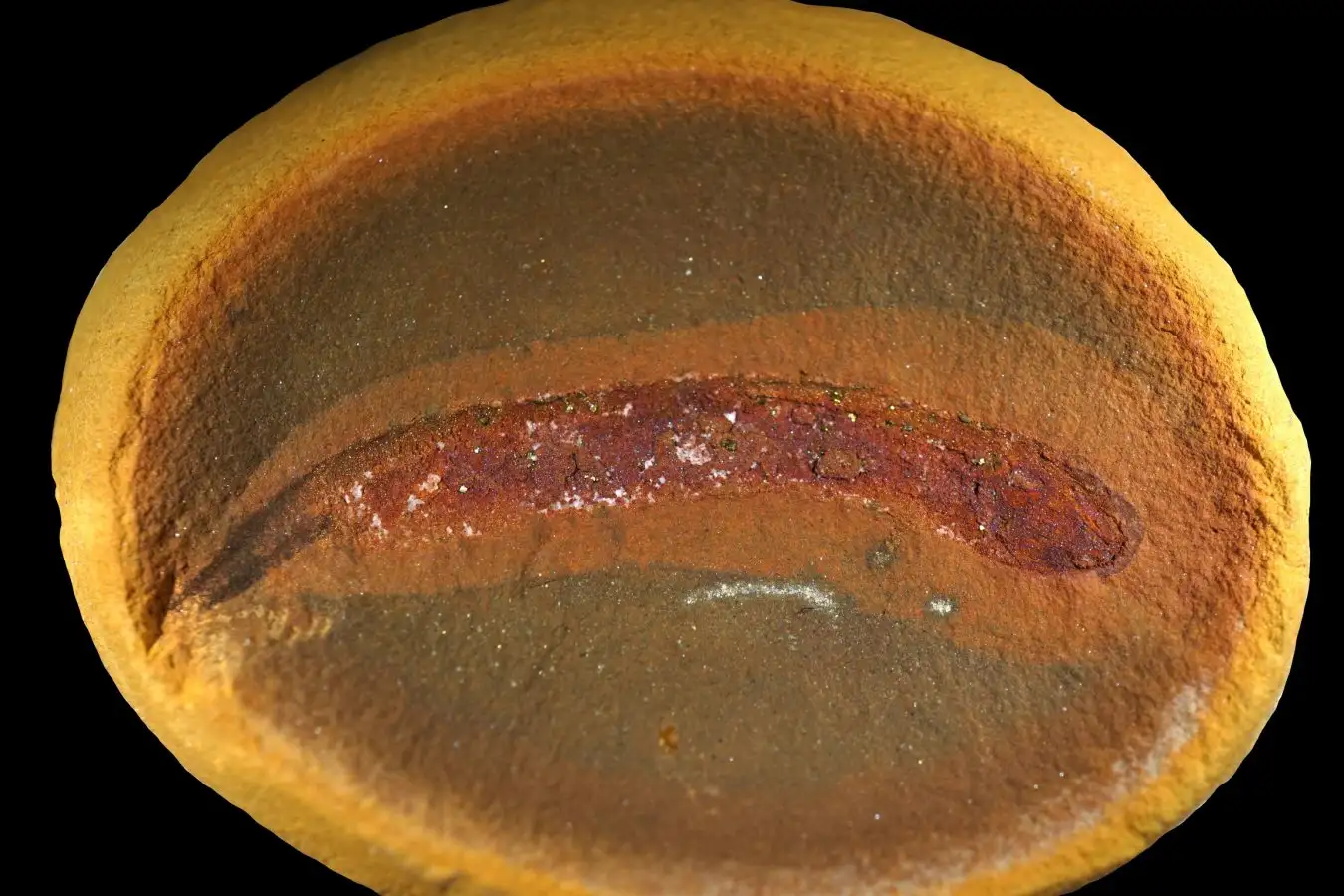
Fossil Baby Embolomere from Mazon Creek, Illinois
Arjan Mann
A remarkable collection of 300-million-year-old fossils reveals that early tetrapod vertebrates may not have undergone a metamorphic transition from juvenile to adult stages, challenging existing theories on terrestrial evolution.
“For a long time, it was believed these creatures demonstrated a metamorphosis similar to amphibians, bridging aquatic and terrestrial life,” stated Jason Pardo from the Field Museum of Natural History in Chicago.
Tetrapods, which include modern reptiles, birds, mammals, and amphibians, evolved from lobe-finned fish approximately 390 million years ago. However, the early developmental stages of these ancestral lobe-finned fishes remained largely unknown, according to John Long from Flinders University, Australia.
Pardo and his team, including Arjan Mann, examined fossils excavated from the 1960s to the 1990s at the Mason Creek Fossil Site near Chicago, which dates back to the Carboniferous period, about 307 to 309 million years ago.
As the largest quadruped of its time, adult Embolomere reached about 2 meters in length and was among the top predators, primarily dwelling underwater, yet could venture onto land with its small limbs.
The fossilized remains of two 2-centimeter-long baby embolomeres were preserved to such a degree that their soft tissues and external yolk sacs were visible.
Unlike tadpoles, which retain yolk sacs for energy post-hatching, young embolomeres had yolk sacs that were external, similar to certain fish, including lungfish.
Notably, while amphibian larvae like tadpoles have external gills, young embolomeres did not. “This suggests a significant difference in their early developmental stages,” Pardo explained.

Illustration of Young Embolomeres
Berit Godring
The fossil evidence indicates that embryos and adults shared similar skeletal features. According to Pardo, “These fossils demonstrate that embolomeres maintained a consistent structure from the moment they hatched until they matured.”
“Like humans, whose bodies develop gradually from birth to adulthood without drastic transformations, our fossil evidence suggests that early land ancestors exhibited a comparable life cycle,” Pardo added.
While embolomeres lived in aquatic environments, the data indicates their ancestral counterparts also skipped a tadpole-like growth stage, Pardo suggests. The research team also analyzed remains of two other early tetrapod species coexisting with Embolomere.
“None displayed characteristics of a tadpole phase,” Pardo emphasized. “Even fishy relatives, including early lungfish and coelacanths, lack this stage. While it is theoretically possible for a tadpole stage to have existed and disappeared, current evidence does not support this notion.”
This study significantly contributes to addressing crucial gaps in our understanding, Long remarked. “It implies that early quadrupedal fishes, dating back about 308 million years, did not require a tadpole stage for land adaptation, contrary to the beliefs of some scientists.”
Join us on this incredible journey through Australia’s fossil-rich landscapes. Once an expansive inland sea millions of years ago, eastern Australia is now home to a plethora of fossils. Over 13 unforgettable days, delve deep into the hinterlands, follow the trails of prehistoric giants, and uncover the mysteries of Earth’s ancient past. Topics:
Fossil Hunting in the Australian Outback
Source: www.newscientist.com