


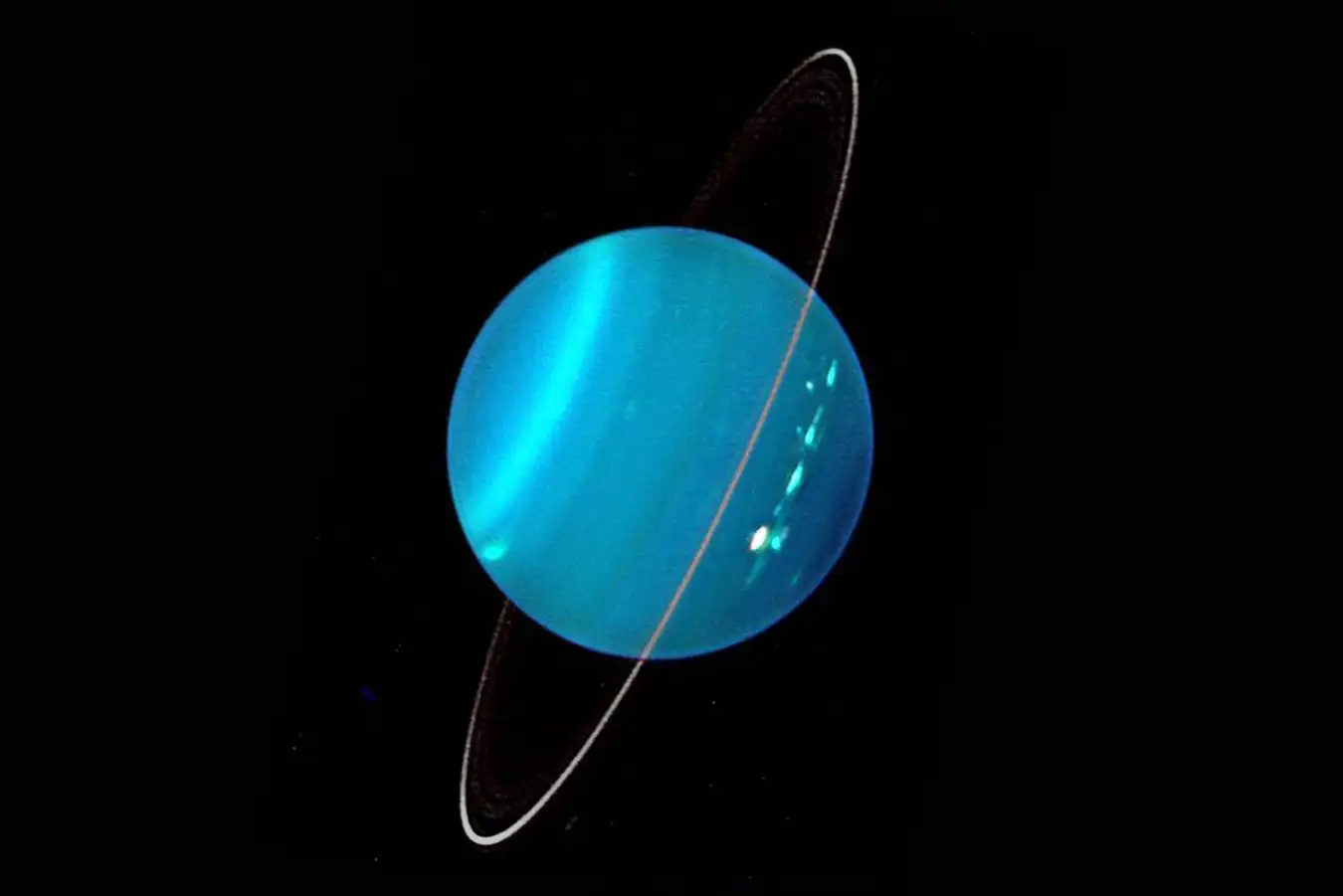
What Lies at the Center of Uranus?
JPL/NASA
Recent studies indicate that Uranus possesses significantly more frozen water than previously assumed, potentially unraveling the mystery about its formation compared to its closest counterpart, Neptune.
The ice giants, including Uranus and Neptune, exhibit dense gaseous atmospheres, complicating our understanding of their internal structures and formation processes. However, researchers are able to analyze atmospheric gases that reveal insights into the deeper elements and processes occurring within these planets.
Carbon monoxide detection in a planet’s atmosphere is frequently linked to a core rich in water and ice. While Neptune shows abundant carbon monoxide indicating an ice-laden core, Uranus previously appeared devoid of this gas, leading some astronomers to suggest it has a rocky interior. If validated, this would imply that Neptune and Uranus have evolved through distinctly different processes, challenging existing assumptions about their similarities.
Recently, Thibault Cavalier from the University of Bordeaux and his team have detected carbon monoxide in Uranus’ lower atmosphere for the first time, suggesting it may be substantially water-rich.
“Our findings indicate that Uranus is more aligned with ice giants than rocky giants,” Cavalier stated. “While we must proceed cautiously because results depend on modeling, this represents a significant milestone in our understanding.”
Utilizing the Atacama Large Millimeter/Submillimeter Array Telescope in Chile, Cavalier and his colleagues conducted three observations of Uranus between 2022 and 2024, successfully identifying considerable levels of carbon monoxide in its lower atmosphere. They modeled different rock-to-ice ratios to replicate the carbon monoxide levels observed, concluding that only an ice-rich model conformed to the data.
The presence of carbon monoxide was also observed in Uranus’ upper atmosphere, suggesting an alternate source, possibly from a comet impact in the distant past, as noted by Cavalier.
The identification of carbon monoxide enhances our understanding of the enigmatic interior of Uranus, yet the origin of this gas remains uncertain. Vanesa Ramirez from Leiden University emphasized, “Deciphering atmospheric abundance relies on assumptions about chemistry, mixing, and internal structure, all of which remain ambiguous for Uranus.”
The ambiguity in assumptions and the diverse models employed to simulate Uranus’ interior lead to various compatible rock-to-ice ratios. Ramirez stated, “This does not resolve whether Uranus should be classified primarily as an ice-rich giant or a rock-rich giant.”
Topic:
Source: www.newscientist.com