


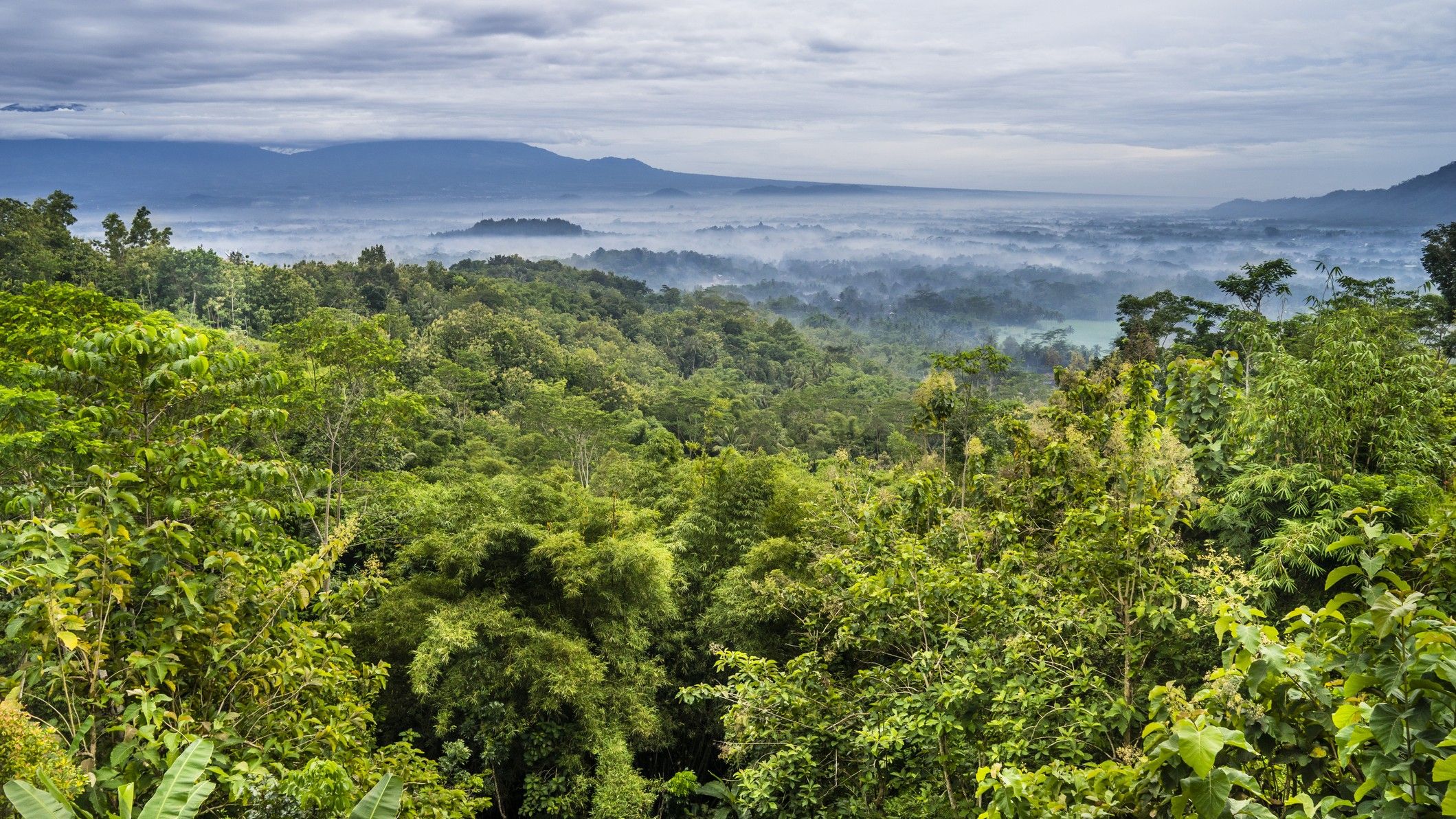
Southeast Asia’s tropical forests may owe much of their plant diversity to a fragment of Earth’s crust that broke away from what is now northwestern Australia about 150 million years ago, according to a new study. The fragment, known as the West Burma Block, or Burma Terrane, carried hundreds of flowering-plant species and other ancient plants north across the prehistoric Tethys Sea before colliding with Southeast Asia.
The findings challenge earlier theories that the fragment originated near present-day Southeast Asia and that the region’s tropical forests developed only after the dinosaurs went extinct about 66 million years ago.
A fragment from Gondwana
When the West Burma Block separated from Gondwana, Australia was connected to Antarctica and India. Gondwana was separated from the ancient supercontinent Laurasia by the Tethys Ocean.
After drifting north for roughly 100 million years, the microplates eventually collided with Southeast Asia. The researchers say they helped seed the tropical forests that later evolved into the lush ecosystems found in the region today.
“Rich tropical rainforest flora” in Southeast Asia is “not endemic, [and] much of its biota is influenced by the great south, Gondwana,” study co-author Byron Lamont, a Distinguished Emeritus Professor in the School of Molecular Life Sciences at Curtin University in Australia, told Live Science by email.
A complicated journey north
The West Burma Block was not the only piece of crust to cross the Tethys Sea. The Indian subcontinent was also moving north at a relatively rapid rate of 4 inches (10 centimeters) per year.
About 80 million years ago, the Indian plate collided with the West Burma Block and reoriented it. India continued pushing against the block until both collided with Asia. The Indian plate then slid beneath the Eurasian plate, forming the Himalayas. The West Burma Block stopped west of present-day Myanmar, where it formed a deep valley between mountain ranges about 35 million years ago, Lamont explained.
“Both [the] Indian Plate and WBB ‘took a long time to shut down,’” Lamont said.
For tens of millions of years, from its separation from Gondwana until its collision with Southeast Asia began about 50 million years ago, the West Burma Block and other microplates drifted near the equator. The climate was hot and humid, much as it is today. Lamont said this combination of a stable climate and isolation gave ancient plant lineages a refuge where they could survive and diversify.
Plants preserved in amber
Lamont and his colleagues examined more than 3,000 plant fossils from Myanmar preserved in amber approximately 100 million years old. The fossils included flowers, leaves, fruits and seeds. They represented at least 392 species of flowering plants, along with large numbers of conifers, ferns, mosses, cycads and liverworts that had traveled on the West Burma Block to Southeast Asia.
Amber has been mined at the northern end of the West Burma Block valley for at least a century, Lamont said. “The beautiful fossil, preserved in 3D, has long been of interest for its novel value alone, and there is a lot of commercial interest, especially from Chinese traders,” he noted.
Some of the study’s co-authors obtained chunks of amber from traders at least a decade ago and have studied them ever since. Experts at institutions around the world are often consulted about the specimens, which led Lamont to participate in the research.
The findings were published Oct. 27 in the journal Nature Ecology & Evolution. They reveal the deep evolutionary roots of the tropical forests that grow in Southeast Asia today.
Lamont said he did not exclude Australia’s ancient flora from the study because descendants of many plants preserved in the 100-million-year-old amber still live in Australia’s hot, humid northeast.
What the fossils cannot show
The fossil assemblage contains only organisms small enough to be preserved in amber, making it difficult to determine what kinds of animals may have reached Southeast Asia on the West Burma Block.
“The animals that exist in amber are small insects such as ants and mosquitoes,” Lamont said. “Typical Australian vertebrates such as marsupials, emus and nectar-sucking birds arrived in Australia from South America more than 100 million years later” than the West Burma Block split off. He added that such animals would not have become trapped in resin even if they had been nearby.
Shi, C., Wang, B., Engel, M.S., Win, T.T.M., Wang, H., Zhu, B., Yang, J., Zhang, Q., Lin, Q., Shi, Z., Huang, H., Cai, H., Shi, Y., Zhao, X., Zhang, D., Guo, X., Jiang, Q., Li, Y., Fan, Y., … Wang, S. (2026). A mid-Cretaceous island that is the birthplace of Southeast Asia’s plant biodiversity. Nature Ecology & Evolution.
Source: www.livescience.com